Aug 21, 2026Comparisons
PET vs PI vs PP – Which Label Material Is Right for Your Application?
PET, PI, or PP? Compare temperature range, chemical resistance, flexibility, and cost. Learn which synthetic label material suits your environment.
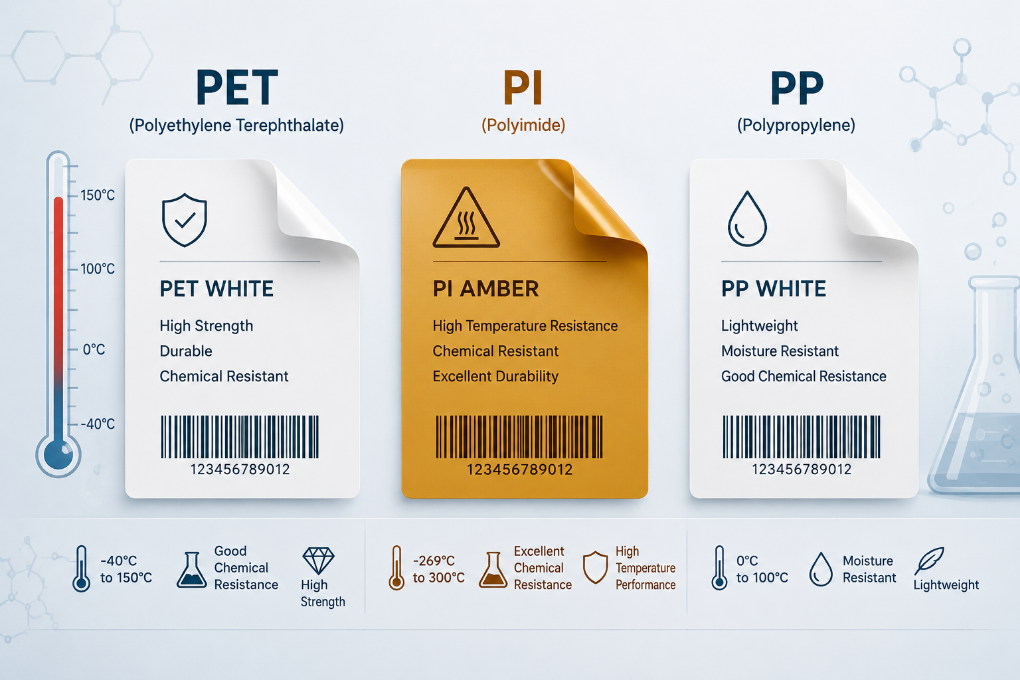
The 30-Second Cheat Sheet (Read This First!)
Material | Best For | Temperature Range | Chemical Resistance | Cost | Skip It If... |
|---|---|---|---|---|---|
PET (Polyester) | Industrial equipment, outdoor assets, long-life barcodes, chemical drums | -40°C to +150°C (up to ~200°C short-term for special grades) | High | $$ | You need extreme flexibility or reflow soldering survival |
PI (Polyimide) | PCB reflow soldering, aerospace, batteries, extreme thermal cycling | -40°C to +200°C+ (up to 300°C short-term) | Very High | $$$$ | Your budget is tight or your application is just general warehousing |
PP (Polypropylene) | Cold storage, wet packaging, squeezable bottles, cost-sensitive runs | -40°C to +80°C (cryogenic grades available) | Moderate to High | $ | You need high heat, heavy abrasion, or extreme outdoor UV longevity |
The Golden Rule: If you are running a 280°C reflow oven, pick PI. If you are labeling chemical drums in a warehouse, pick PET or PP (test them!). For almost everything else—outdoor gear, automotive parts, and general industry—PET is your safest, most balanced bet.
What Are PET, PI, and PP Label Materials?
Before we dive into the nitty-gritty, let us get the basics straight. Think of these three materials like different types of shoes. You would not wear flip-flops to climb a mountain, and you would not wear steel-toe boots to the beach. Labels work the same way.
PET (Polyethylene Terephthalate) – This is the upgraded cousin of the plastic used in water bottles. But do not let that fool you. In the label world, PET is a tough, strong, and stable film. It does not stretch or shrink much when it gets hot or cold. That makes it perfect for printing high-quality barcodes that need to stay readable for years. It stands up to water, oils, and many chemicals. It also handles sunlight well. If you need a label that simply lasts, PET is usually the starting point.
PI (Polyimide) – This is the superhero of the label world. Originally developed for the aerospace industry, PI is famous for surviving extreme heat. It can sit in a soldering oven at 260°C or even 300°C and still stay readable. It also resists chemicals and provides excellent electrical insulation. However, this superpower comes at a price. PI is expensive, and it usually has a yellowish color. You only use PI when you absolutely have to—not because you want to show off.
PP (Polypropylene) – This is the flexible, lightweight champion. PP is soft, bends easily, and hates water. It is the go-to material for shampoo bottles, food packaging, and frozen goods. It is also the cheapest of the three. However, PP does not like heat. It starts to soften around 80°C to 120°C. It also does not handle rough abrasion as well as PET. But if your labels are going into a fridge or a damp warehouse, PP is your best friend.
A very useful distinction to remember is that PET and PP are common label facestocks, while PI is a specialty high-temperature material. You would not substitute PI for everyday packaging, and you would not use PP on a circuit board. Each material has a specific job.
PET vs PI vs PP – How to Choose Based on Your Real Environment
This is the heart of the article. Instead of just throwing numbers at you, we are going to look at your actual workspace. What does your label see every day? Heat? Chemicals? Rain? Let us match the material to your mission.
Which Material Handles Extreme Heat Best? (PI or High-Temp PET)
Heat is the number one killer of labels. When a label gets too hot, three bad things happen. First, the film shrinks or curls. Second, the adhesive melts and loses its grip. Third, the printed text or barcode fades into oblivion.
So, who wins the heat race?
PI (Polyimide) is the undisputed champion. It is specifically engineered for electronics manufacturing. During PCB reflow soldering, temperatures can hit 260°C to 280°C. Ordinary labels turn into crispy black messes. PI labels survive. They stay flat, stay stuck, and stay readable. That is why they are the industry standard for circuit boards, semiconductors, and aerospace components.
However, we need to clear up a big misunderstanding. A PI film can survive 300°C, but the adhesive might not. As an industry expert from a leading adhesive supplier once noted, "The face material often gets all the credit, but in high-heat applications, the adhesive is usually the first component to fail. Always check the complete construction's service temperature, not just the film's rating." This is a critical point. You need a high-temperature silicone or acrylic adhesive to match the PI film.
What about PET? Standard PET handles up to 150°C continuously. That is hot enough for wave soldering and most automotive under-hood environments. But wait—there is a special category called "high-temperature PET." These grades can survive short spikes up to 200°C. If your heat is intermittent (not continuous), a high-temperature PET might save you a lot of money compared to PI.
What about PP? PP is the weakest link here. It softens at just 120°C. Never use PP anywhere near a soldering iron, a hot engine, or a steam pipe.
Temperature Condition | Recommended Starting Material | Reason |
|---|---|---|
Room temperature or refrigerated | PP | Flexible, moisture-resistant, cheap. |
Outdoor or industrial up to 150°C | PET | Strong, stable, handles the sun. |
Short spikes near 200°C | High-Temp PET or PI | Depends on the duration. Test it! |
Reflow soldering (260°C+) | PI | Only PI survives the thermal shock. |
Continuous exposure over 150°C | PI | Thermal stability is a must. |
Bottom line for heat: If you see a reflow oven, you need PI. If you just have a hot warehouse, PET is fine. If you have a freezer, go with PP.
Which Material Fights Off Chemicals Best? (PET vs PI vs PP)
Chemicals are sneaky. They might not melt the label instantly, but they can attack the adhesive from the edges or dissolve the printed ink. Over time, the label falls off or becomes unreadable. This is dangerous, especially on chemical drums or medical devices.
PET is usually the strongest first option for general chemical resistance. It stands up to oils, greases, many solvents, acids, and bases. That is why you see PET labels on automotive parts and industrial chemical containers. It combines good chemical resistance with strong printability. If a drum is leaking a little solvent, a PET label with a resin ribbon will usually survive.
PI is preferable when chemical exposure is combined with high temperatures. For example, on a circuit board that gets washed with cleaning solvents and then baked, PI is the hero. It resists the solvents and the heat. If you just have chemicals at room temperature, PI is overkill.
PP is a bit tricky. PP has excellent resistance to water, acids, and bases. However, it is not universally solvent-resistant. Some aggressive hydrocarbons and aromatic solvents can attack PP. It is fantastic for shampoo bottles (water-based chemicals) and cold storage, but it is not the best choice for a drum of paint thinner.
Here is the golden rule that many people miss: The completed label must be evaluated as a system. You cannot just test the film. You must test:
- The face film (PET/PI/PP).
- The adhesive (does it stick to your plastic drum?).
- The ribbon (resin ribbon is usually best for chemicals).
- The overlaminate (if you use one).
- The actual chemical (concentration, temperature, duration).
According to recent industrial labeling guides, "For solvent-resistant, chemical-drum, and laboratory barcode labels, professionals usually begin testing with PET. It offers the best balance of resistance and cost. Reserve PI for high-heat specialty workflows, and test PP carefully against the specific solvent."
Bottom line for chemicals: For most industrial drums, start with PET. For extreme heat + chemicals, use PI. For water and mild acids on packaging, PP works well. Always test your specific chemical on a printed sample.
Which Material Survives Moisture, Cold, and Outdoor Sun? (PP vs PET)
Water, humidity, and freezing temperatures are a completely different challenge. Heat makes labels shrink. Cold and moisture make them peel.
PP is the king of moisture and cold. Because PP is flexible and hydrophobic (it hates water), it is the top choice for cold-chain logistics. If you are labeling food that goes into a freezer at -20°C, PP stays flexible. PET might become stiff and crack. For wet environments like beverage coolers or refrigerated warehouses, PP excels. There are even PP constructions designed for cryogenic applications down to approximately -196°C, but remember—this is a product-specific construction. The adhesive is the real secret sauce in those extreme low-temperature cases. Do not assume every PP label can handle liquid nitrogen.
PET is the champion for outdoor sun and abrasion. While PP handles water well, it does not handle UV rays for years on end. PP can degrade and become brittle in direct sunlight unless it has UV stabilizers. PET, on the other hand, is naturally more UV-resistant. If your label is going on a piece of construction equipment that sits outside in the Arizona sun for 5 years, PET is your safer bet. It also resists scratches. When workers wipe dirt off the equipment, a PET label keeps its barcode readable.
Where does PI fit here? PI is also very resistant to moisture and cold. But using PI just for water resistance is like using a race car to drive to the grocery store. It works, but it is too expensive. Only pick PI for moisture if that moisture is inside a high-temperature oven or a high-voltage electrical environment.
Environment | Best Choice | Why |
|---|---|---|
Freezer (-20°C) | PP | Stays flexible; adhesive sticks. |
Liquid Nitrogen | Specially-rated PP or PI | Check the adhesive spec! |
Rainy Outdoor (short term) | PP | Handles water well. |
Sun Exposure (years) | PET | UV resistant and scratch-proof. |
Steam / High Humidity | PET or PI | PP softens in heat. |
Bottom line for moisture and cold: Choose PP for refrigerated and squeezable packaging. Choose PET for long-term outdoor exposure and abrasion. Choose PI only if you have a specialized thermal/electrical requirement.
Which Material Gives the Best Barcode and Print Quality? (PET Wins for Durability)
A label is only as good as its barcode. If the scanner cannot read it, the label is useless. When it comes to print quality and scanning reliability, PET is usually the strongest default choice.
Why? Because PET is dimensionally stable. It does not stretch when you print on it. It does not warp when you peel it off the liner. This means the tiny bars and spaces in a Code 128 barcode stay exactly where they should be. High-resolution printers love PET.
Furthermore, PET provides excellent contrast. White PET is bright and opaque. Barcodes printed with a resin ribbon on PET look sharp and crisp. They stay that way because PET resists rubbing and handling. In a factory where labels get bumped and wiped, PET outperforms PP, which is softer and more prone to scratching.
PI is also printable, but the surface is often slicker. You usually need a specific resin ribbon and a compatible topcoat to get good, durable print results. PI is chosen for its heat resistance, not its beauty. The yellowish tint of PI can also reduce contrast slightly, so you need to make sure your barcode verification passes.
PP is very printable, but because it is softer, it is more likely to get scratched. In logistics, if labels rub against each other on a pallet, PP might smudge or fade if you use a wax ribbon. For PP, we strongly recommend a wax-resin or resin ribbon to boost durability.
As one labeling expert puts it: "The barcode is the voice of the product. If you use the wrong film or the wrong ribbon, that voice becomes a whisper. For long-life assets, a PET face with a resin ribbon is the gold standard for 'shoutable' barcodes."
A critical note on ribbons: Do not just buy any ribbon. For PET and PI labels exposed to chemicals or heat, a resin ribbon is the safest starting point. For PP, a wax-resin or resin ribbon works, depending on your budget. Always test the print with your specific printer model to ensure the ink bonds to the topcoat. Check out our ribbon compatibility guide to make sure you are matching your label and ribbon perfectly.
Bottom line for barcodes: For durable, long-life, scratch-resistant barcodes, pick PET with a resin ribbon. For reflow processes where the barcode must survive the oven, pick PI with a resin ribbon. For shipping labels on boxes that get thrown around but not scratched, PP with a wax-resin ribbon is cost-effective.
Quick Comparison Table: PET vs PI vs PP at a Glance
If you are in a hurry, this table gives you the complete picture without the long explanations. Bookmark this page so you can reference it later.
Property | PET (Polyester) | PI (Polyimide) | PP (Polypropylene) |
|---|---|---|---|
Relative Cost | Medium ($$) | Very High ($$$$) | Low to Medium ($) |
Tensile Strength | Very High | Very High | Moderate |
Dimensional Stability | Excellent | Excellent | Moderate |
Flexibility | Moderate | Moderate | High |
Continuous Service Temp | -40°C to +150°C | -40°C to +200°C+ | -40°C to +80°C |
Short-Term Peak Temp | Up to ~200°C | Up to ~300°C | < 120°C |
Chemical Resistance | High | Very High | Moderate to High |
UV / Outdoor Durability | Excellent | Excellent | Moderate (needs additives) |
Moisture Resistance | Excellent | Excellent | Excellent |
Abrasion Resistance | Excellent | Good | Average |
Print Quality (Contrast) | Excellent | Good (yellowish tint) | Very Good |
Best Applications | Industrial, outdoor, chemical drums, automotive, electronics | PCB reflow, aerospace, batteries, extreme heat | Packaging, cold chain, bottles, drums, flexible surfaces |
Recommended When | You need long-life, durable, scannable labels. | Heat and electrical performance are critical. | Moisture resistance, flexibility, or low cost matters most. |
Important Warning: The temperature figures above are planning ranges, not guarantees. A PET label from one supplier might fail at 140°C, while a special grade from another might survive 180°C. Always check the technical data sheet for the specific product you are buying. Also, remember that the adhesive, ink, and application surface change these numbers dramatically. For example, a PET label on a metal surface handles heat better than the same label on a low-energy plastic surface.
The Decision Tree – Ask These 4 Questions First
Still feeling unsure? That is completely normal. Choosing the right label material involves balancing several factors. Here is a simple decision tree to guide you. Just follow the questions in order.
Question 1: Will the label face temperatures above 150°C (especially during reflow soldering)?
- Yes → Go with PI (Polyimide). But wait! Make sure your adhesive is also rated for that temperature. If you are doing PCB work, you need a silicone-based adhesive. Browse our high-temperature PI label collection to see what is available.
- No → Proceed to Question 2.
Question 2: Will the label be exposed to aggressive solvents, acids, or industrial chemicals daily?
- Yes → Choose PET (Polyester). It offers the best chemical resistance at a reasonable price. If the chemical exposure also happens at high temperatures (over 150°C), then go back to PI. For room temperature chemical drums, PET is your winner.
- No → Proceed to Question 3.
Question 3: Is the primary challenge moisture, cold storage, high flexibility (squeezable bottles), or is cost the number one priority?
- Yes → Choose PP (Polypropylene). It is perfect for wet environments, freezers, and packaging that gets squished. It is also the cheapest, so if your application is simple (warehouse boxes, retail shelves), PP saves you money. See our PP synthetic label options for flexible packaging solutions.
- No → Proceed to Question 4.
Question 4: Do you need long-term outdoor UV resistance, heavy abrasion resistance, and a bright white surface for perfect barcode scanning?
- Yes → Choose PET. It is the best all-rounder for durability. If you are labeling outdoor equipment, asset tags, or automotive parts, PET is the reliable choice.
- No (If you just need a basic indoor label for a clean room) → Honestly, you might not even need a synthetic film. Paper labels might work. But if you must have synthetic, PP is the cheapest and easiest to use.
This decision tree works for 90% of applications. For the remaining 10%, you have specialty needs like cryogenic (-196°C) or ultra-high vacuum. In those cases, talk to a technical representative.
Cost vs. Value – Why the Cheapest Label Isn’t Always the Best
Everyone loves saving money. But in the label business, buying the cheapest material often turns out to be the most expensive mistake. Why? Because labels fail. And when labels fail, bad things happen.
Let us do the math. Imagine you buy 10,000 PP labels for a chemical drum because they were cheaper than PET. You save 2,000 in labor and downtime. Suddenly, that 2,000.
The usual cost hierarchy is:
- PP – Lowest cost. Great for high-volume packaging.
- PET – Moderate cost. The best price-to-performance ratio.
- PI – Highest cost. Only justified by extreme environments.
However, material price alone is misleading. A Total Cost of Ownership (TCO) approach is smarter. Consider these hidden costs:
- Re-labeling labor – How much does it cost your staff to peel off failed labels and stick on new ones?
- Downtime – How much production is lost while you fix the label issue?
- Compliance risk – If a safety label fails and someone gets hurt, the lawsuit is millions. If an FDA barcode is unreadable, the shipment is rejected.
- Product loss – If a label on a medical device falls off during sterilization, the whole batch might be scrapped.
An industry expert from a major label converter once stated, "I have seen companies switch from PET to PP to save 15% on material costs, only to spend 300% more on field service calls to re-label outdoor equipment. Never look at the price per roll alone. Look at the cost of the label lasting the required lifetime."
For a typical industrial application, spending an extra $50 per roll on a high-quality PET or a matched ribbon is a tiny insurance policy against a catastrophic failure. Explore our durable PET labels and resin ribbons to see how we match materials for reliability, not just price.
What about Sustainability?
Neither material is automatically "green." The sustainability depends on the application.
- PET benefits from established recycling streams, especially if you use a product with recycled content (like PCR PET).
- PP is highly recyclable if it ends up in a PP waste stream. If you put a PP label on a PP bottle, it is easier to recycle than a PET label on a PP bottle.
- PI is a specialty material used in very small quantities. Its sustainability comes from longevity. A PI label that lasts 10 years in a jet engine prevents the environmental cost of replacing it every year. Currently, the self-adhesive label market is shifting towards synthetic films. In Europe, filmic rolls grew 4.1% in 2025 and now represent about 30% of demand, up from 20% two decades ago. This shows the world is moving away from paper and towards durable plastics like PET and PP, but the choice of which plastic still depends heavily on the application.
How to Test Label Materials Like a Pro (Before You Buy)
This is the most important section in this article. Do not skip it. Do not assume your supplier knows your environment better than you do. You must test the labels yourself. Here is a professional 7-step process to validate your label choice.
Step 1: Define the Exposure
Write down exactly what the label will face.
- What is the max temperature? How long does it stay at that temperature?
- What chemicals will it touch? (Name them specifically: e.g., Isopropyl Alcohol, Hydraulic Fluid, Salt Water).
- Will it be outside in the sun? For how many years?
- Will it be rubbed or cleaned with a rag?
Step 2: Identify the Surface
The material you are sticking the label onto is just as important as the label itself. Is it:
- High-energy metal (like steel or aluminum)?
- Low-energy plastic (like PE or PP)?
- Powder-coated paint?
- A curved bottle or a flat panel?
Step 3: Select Two or Three Candidates
Pick a few different options. For example, test a PP and a PET for a cold storage application. Do not just pick one. Give yourself a backup.
Step 4: Print the Actual Barcode
Do not test with plain labels. Print the actual barcode, text, and serial numbers you will use in production. Use the exact printer and ribbon you plan to use.
Step 5: Apply and Condition
Apply the labels using your standard production method. Then, put them in the actual environment. If you can, run them through a real production cycle. If you cannot, use an oven or freezer to simulate the conditions.
Step 6: Test the Performance
After the exposure, test these things:
- Adhesion: Can you peel it off easily? Is it lifting at the edges?
- Print Rub: Rub a white cloth over the barcode. Does the ink smudge?
- Barcode Readability: Use a barcode verifier. Is it still Grade A or B?
- Chemical Attack: Did the label turn yellow, shrink, or get brittle?
Step 7: Approve the Complete Construction
Only approve the specific combination of face material + adhesive + ribbon + printer settings. Do not write a spec that just says "PET Label." Write a spec that says "PET Label with X adhesive, Y ribbon, printed at Z settings."
Pro Tip: Be very skeptical of a supplier's generic "high-temperature" or "chemical-resistant" claim. These terms are often used loosely. Ask for the Technical Data Sheet (TDS). Ask for test reports. Ask for a sample roll to run through your own process.
At FuYue Labels, we encourage this testing process. We even send out free sample kits so you can test our PI, PET, and PP labels on your own equipment before you make a big decision. Testing is not a waste of time. It is the only way to guarantee success.
Quick Answers to Common Label Questions (FAQ)
Based on search patterns, these are the top questions people ask about these materials.
Is PET better than PP for labels?
It depends on your job. PET is better for outdoor sun, heavy scratching, chemicals, and high heat. PP is better for flexible packaging, cold and wet storage, and saving money. There is no absolute "better" – only "better for your specific application."
Is polyimide better than PET?
Polyimide is better only if you need extreme heat (over 150°C continuously) or specific electrical insulation. For 90% of industrial labels, PET offers better value and similar chemical resistance at a much lower cost.
What is the difference between PET and polypropylene labels?
PET is stiffer, stronger, and handles heat and scratching much better. PP is softer, more flexible, and handles water and cold better but melts at lower temperatures. Think of PET as a durable plastic clipboard and PP as a flexible plastic folder.
Which label material is best for high temperature?
PI (Polyimide) is the safest starting point for sustained or extreme heat (over 200°C). If your heat is under 150°C, PET is perfectly fine and much cheaper. If your heat is above 300°C, you might need a mechanical tag, because even PI adhesives can fail.
Which label material is best for chemicals?
PET is usually the best first choice for general chemical resistance at room temperature. It handles oils and solvents well. PI is better if the chemical exposure also happens at high temperatures. PP is good for water and mild chemicals but test it against strong solvents.
Are PP labels waterproof?
The film itself is highly water-resistant, but the adhesive and ink must also be waterproof. A PP film with a water-soluble adhesive will fall off in the rain. Always check the entire label construction, not just the film.
Are PET labels waterproof?
Yes, PET film is highly water-resistant and works excellently in wet environments. Combined with a permanent acrylic adhesive, PET labels can survive rain, submersion, and high humidity.
Can PET labels be used outdoors?
Yes. PET is a top choice for outdoor labels. Just make sure you use a UV-resistant ribbon (resin ribbon) and an outdoor-rated adhesive. A standard indoor adhesive will break down in sunlight.
Can PP labels be used outdoors?
For short-term or moderate outdoor use, yes. But PP degrades faster in UV sunlight compared to PET. For long-term outdoor use (over 1-2 years), PET is the more reliable choice.
Can polyimide labels be printed?
Yes, but it requires careful matching. PI surfaces are often smooth and require a specific topcoat. Thermal transfer printing with a high-quality resin ribbon is the most common method. Always test your printer settings before committing to a large order.
What ribbon should be used with PET labels?
A resin or resin-enhanced ribbon is generally the best starting point. It provides the scratch, chemical, and heat resistance that PET is known for. Wax ribbons will rub off easily on PET.
What ribbon should be used with PP labels?
For general warehousing, a wax-resin ribbon is a good cost balance. If the PP label faces moisture or rubbing, upgrade to a resin ribbon. Wax-only ribbons are usually too weak for synthetic films.
Can PET and PP labels be recycled?
Potentially, but it depends on the local recycling plant. A PET label on a PET bottle is easier to recycle. A PP label on a PET bottle might contaminate the PET stream. Always check with your local recycling authority and design for recyclability.
Is PP cheaper than PET?
Yes, PP is commonly cheaper per square meter than PET. However, as discussed earlier, if the PP fails, the total cost becomes much higher.
What is the best material for barcode labels?
PET is the strongest general-purpose choice for durable barcode labels because it holds sharp print and resists abrasion. PI is for barcodes that must survive ovens. PP is for shipping barcodes that are not handled roughly.
The Bottom Line – Match the Material to Your Mission
We have covered a lot of ground. Let us bring it all back to the basics.
Choose PP (Polypropylene) when:
- Your labels are going on food packaging, beverage bottles, or shampoo.
- They will sit in a fridge, freezer, or damp warehouse.
- You need the label to bend and flex with a squeezable container.
- Cost is your absolute number one concern, and the environment is mild.
Choose PET (Polyester) when:
- You are labeling industrial equipment, outdoor assets, or automotive parts.
- You need a barcode to survive for 5 to 10 years without fading or scratching.
- Your labels face oils, cleaning solvents, or mild chemicals.
- You need a bright white surface for high-contrast scanning.
- You want the best balance of performance and price.
Choose PI (Polyimide) when:
- You are printing circuit boards and they go through a 260°C reflow oven.
- You have a jet engine, a battery cell, or aerospace component that undergoes extreme thermal cycling.
- You need electrical insulation combined with high heat.
- You have a specific regulatory or engineering requirement that demands it.
Remember the expert advice we shared earlier: "The face material often gets all the credit, but the adhesive is usually the first component to fail." So, no matter which material you choose, make sure the adhesive, the ribbon, and the application method are all rated for the same conditions.
At FuYue Labels, we have been manufacturing industrial labels since 2016. We know that labels are not just sticky paper—they are critical safety and traceability tools. We offer matched label-and-ribbon solutions for PI, PET, and PP. We accept low-volume orders, which is rare in this industry. And we provide free samples so you can test before you invest.
Still not 100% sure? Do not guess. Do not hope. Test. Reach out to us, tell us about your environment, and we will help you select the right construction. Then, we will send you samples to run through your actual production line.
Ready to solve your labeling challenge once and for all?
Contact us today for a free consultation and sample kit. Let us find the perfect match for your application—whether it is PET, PI, or PP.
External Link Ideas & Resources (For further reading):
- Avery Dennison Technical Data Sheets – For verifying specific PET and adhesive construction temperature ranges.
- 3M High-Temperature Tape Guide – For understanding polyimide tape capabilities in extreme environments.
- Mordor Intelligence Polyimide Film Market Report – For data on PI market trends.
- Finat (European Label Association) – For industry statistics and sustainability guidelines on label materials.
- Firsta Group Material Comparisons – For understanding tensile strength and cost differences between packaging films.