Sep 17, 2026Guides
Are PET Labels Really Eco-Friendly? The Truth About Recycling
PET bottles are widely recycled, but PET labels usually are not. Learn why most PET labels end up in landfill and which label materials are truly recyclable.
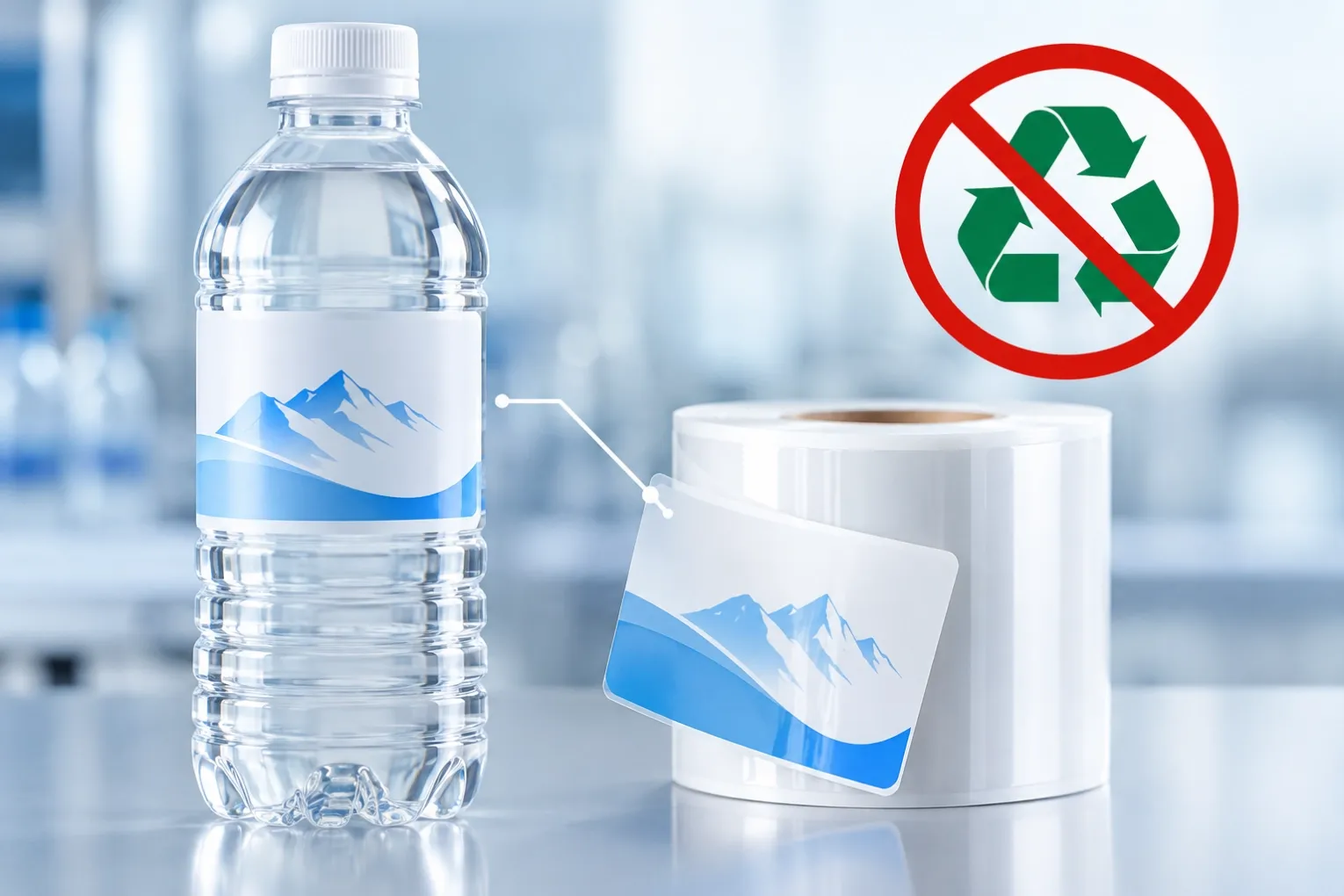
♻️ PET is the most recycled plastic in the world. PET bottles are collected, sorted, and turned into new products every day. So when a label supplier says "our labels are made from PET – they're recyclable," it sounds convincing.
But here is the uncomfortable truth: most PET labels are not recycled. In fact, a PET label on a PET bottle can actually prevent the bottle from being recycled.
This is one of the most misunderstood topics in sustainable packaging. In this guide, I will explain the reality of PET label recycling, why most labels end up in landfill, and which label materials are genuinely better for the environment.
1. The Difference Between PET Bottles and PET Labels 🧴
PET bottles and PET labels share the same polymer name, but they are very different products.
Property | PET Bottle | PET Label |
|---|---|---|
Thickness | 200–500 microns | 25–75 microns |
Adhesive | None | Permanent adhesive |
Ink/print | None or minimal | Printed with ribbon or ink |
Liner | None | Silicone-coated liner |
Recycling stream | Widely accepted | Not accepted |
The PET bottle is a single material – easy to identify, easy to recycle. The PET label is a multi-material composite – PET face stock plus adhesive plus liner plus ink.
This is the core problem: Recycling facilities cannot separate the label from the bottle efficiently. And they cannot separate the adhesive from the PET face stock.
💡 Key insight: A PET label is not "a thinner PET bottle." It is a completely different product with completely different recycling challenges.
2. Why PET Labels Usually End Up in Landfill 🗑️
There are four main reasons why PET labels are rarely recycled:
Reason 1: Adhesive Contamination
The adhesive on a PET label is not the same as the PET face stock. When the bottle is recycled:
- The label is either left on the bottle (contaminating the recycled PET)
- Or it is removed and sent to landfill
Most recycling facilities do not have a process to separate adhesive from PET. The adhesive burns during the melting process, causing:
- Yellowing of recycled PET
- Weak points in recycled products
- Equipment fouling
For this reason, many recyclers reject bales of PET bottles that still have labels attached.
Reason 2: Silicone Liner Waste
Every label roll has a silicone-coated liner (backing paper). After the label is applied, the liner becomes waste.
- Silicone liners are not recyclable with paper or plastic
- They are typically sent to landfill or incinerated
- They represent a significant volume of waste
Most users never see this waste – it is generated at the label application stage, not at the consumer stage.
Reason 3: Ink and Coating Contamination
Printed labels contain ink (from ribbon or direct printing) and sometimes a protective coating. These materials:
- Are not compatible with PET recycling
- Can leach into the recycling stream
- Reduce the quality of recycled PET
Reason 4: No Separate Recycling Stream
Even if a PET label could theoretically be recycled, there is no separate collection stream for labels:
- Consumers cannot remove labels and place them in a separate bin
- Recycling facilities do not have a "label" category
- Labels are too small to be captured by standard sorting equipment
The result: PET labels are almost always landfilled or incinerated – regardless of what the material name suggests.
3. What "Recyclable" Actually Means for Labels 📋
The word "recyclable" is widely misused in the label industry. Here is what it actually means:
Claim | What It Really Means |
|---|---|
"Made from PET" | The material is PET – but it may not be recyclable in practice |
"Recyclable" | The material can theoretically be recycled – but no collection stream exists |
"Mono-material" | The label is made from a single material – but adhesive and ink may still be present |
"Wash-off adhesive" | The adhesive can be removed in a washing process – but only at specialised facilities |
"100% recyclable" | In most cases, this is aspirational – not a guarantee |
The truth: A label is only truly recyclable if:
- It can be separated from the container
- It can be processed in an existing recycling stream
- The adhesive and ink do not contaminate the recycled material
Very few labels meet all three criteria.
4. When PET Labels ARE the Right Choice ✅
Despite the recycling challenges, PET labels have legitimate uses:
Application | Why PET Is Suitable |
|---|---|
Durable asset tags | PET outlasts paper – less frequent replacement = less waste |
Chemical-resistant labels | PET resists solvents where other materials fail |
High-temperature labels | PET withstands heat better than PP |
Long-life outdoor labels | PET survives UV and weather for years |
The key point: In these applications, PET labels are not chosen for recyclability – they are chosen for durability. A label that lasts 10 years creates less waste than a label that fails every 6 months.
However, if recyclability is your primary goal, PET is not the best choice.
5. Which Label Materials Are More Recyclable? 🌍
If recyclability is important, consider these alternatives:
PP (Polypropylene) Synthetic Labels
Feature | Benefit |
|---|---|
Mono-material | Can be recycled with PP containers |
No adhesive contamination | Compatible with PP recycling stream |
Recyclable | Widely accepted in Europe |
Waterproof | Suitable for food and beverage |
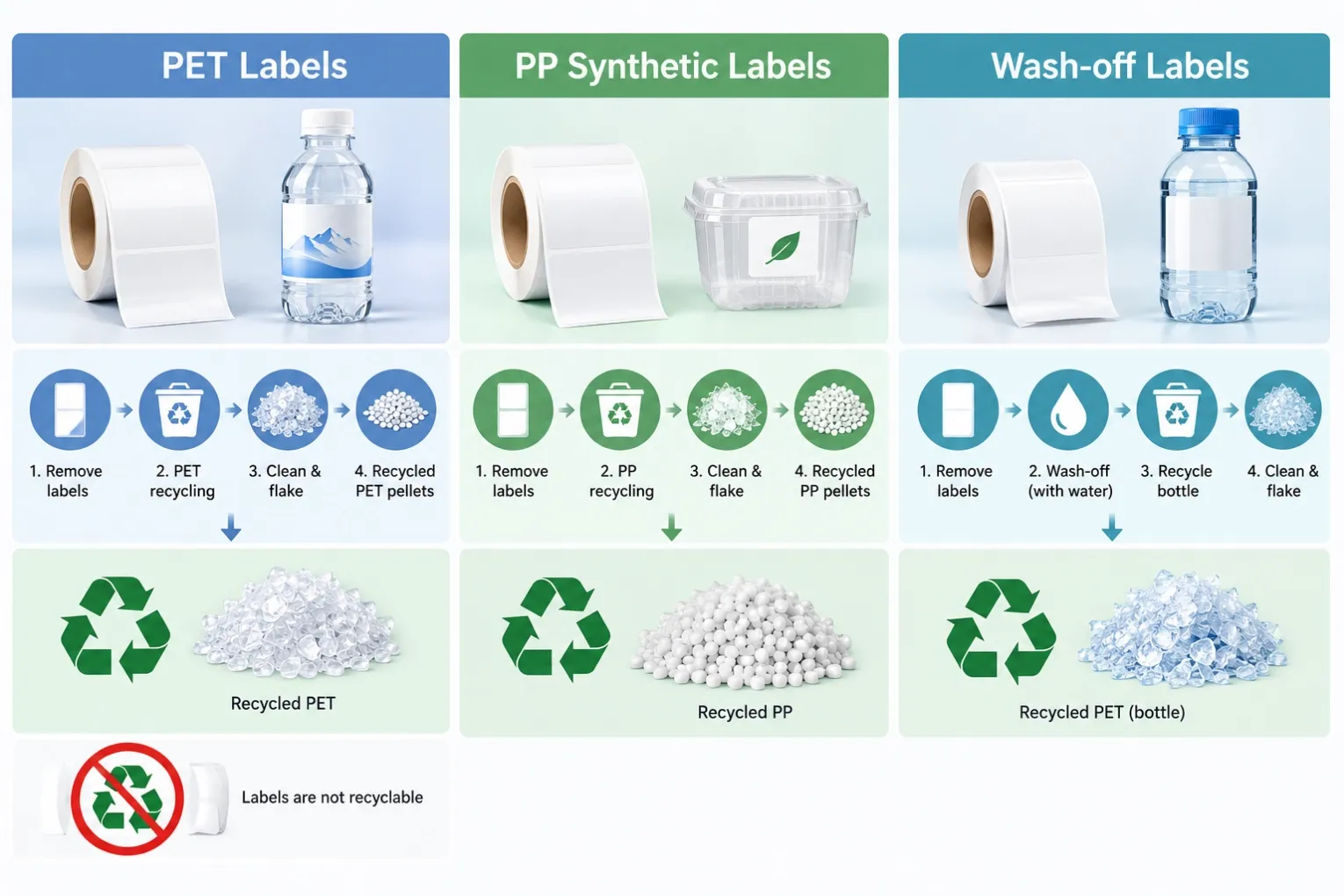
PP synthetic labels are the closest thing to a truly recyclable label. When applied to a PP container, the label and container can be recycled together as a single material.
Wash-Off Adhesive Labels
Feature | Benefit |
|---|---|
Wash-off adhesive | Labels separate from containers in hot water |
Clean removal | Bottle is recycled without label contamination |
Growing availability | More suppliers now offer wash-off options |
Wash-off labels are increasingly used for beverage bottles and food containers where clean recycling is required.
Paper Labels with Bio-Based Adhesive
Feature | Benefit |
|---|---|
Paper from sustainable sources | FSC-certified options available |
Bio-based adhesive | Compostable in industrial facilities |
Lower carbon footprint | Less energy than plastic films |
Paper labels are not waterproof or durable, but for short-life applications they offer a more sustainable option.
6. The Industry's Recycling Problem – A Systemic Issue 🏭
The PET label recycling problem is not just about material choice. It is a systemic issue:
Stakeholder | Challenge |
|---|---|
Label manufacturers | Adhesive and liner are necessary – but not recyclable |
Brands | Want recyclable packaging – but labels complicate it |
Recyclers | Cannot separate labels from containers efficiently |
Consumers | Want to recycle – but labels prevent it |
Regulators | Increasing pressure – but solutions are not yet available |
What Is Being Done?
- Wash-off adhesives – increasingly available for beverage and food applications
- Linerless labels – eliminate the silicone liner entirely
- Mono-material PP labels – compatible with PP recycling streams
- Recycling-friendly adhesives – still in development, but improving
The honest answer: PET labels are not truly recyclable today. But the industry is working on it – and PP synthetic labels are a step in the right direction.
7. How to Choose More Sustainable Labels 🎯
If sustainability is important for your brand, follow this decision guide:
Priority | Recommended Label |
|---|---|
Recyclability with PP containers | PP Synthetic Paper Label |
Clean removal for bottle recycling | Wash-off adhesive label |
Short-life, low-impact | Paper with bio-based adhesive |
Long-life, durable | PET label (recyclability sacrificed for lifespan) |
No liner waste | Linerless label |
Questions to Ask Your Supplier
- "What material is the facestock?"
- "What type of adhesive is used?"
- "Can this label be recycled with the container?"
- "Is there a wash-off version available?"
- "Is the liner recyclable?"
A transparent supplier will give you honest answers. For our recyclable options, see our PP Synthetic Paper Label.
8. The Bottom Line – What You Should Know 🎯
PET labels are not truly recyclable in practice because:
- The adhesive contaminates the PET recycling stream
- The silicone liner is not recyclable
- The ink and coating are not compatible with PET recycling
- No separate collection stream exists for labels
However, PET labels are durable and perform well in harsh environments – which reduces waste over time.
For genuine recyclability, choose:
- PP synthetic labels for PP containers
- Wash-off adhesive labels for beverage bottles
- Linerless labels to eliminate liner waste
The most sustainable label is the one that is matched to its application – not the one with the greenest marketing claim.
9. Summary & Next Steps 🎯
PET labels are made from the same polymer as PET bottles, but they are not recycled in practice. Adhesive, liner, and ink contamination prevent them from entering the PET recycling stream. Most PET labels end up in landfill – even when the container is recycled.
For applications where recyclability matters, PP synthetic labels are a better choice. They are mono-material, compatible with PP recycling streams, and can be recycled with the container.
Need truly recyclable labels? We offer PP synthetic paper labels for recyclable packaging and wash-off adhesive options for clean bottle recycling. Send us your container type and recycling requirements – we will recommend the right label and send free samples for you to test.