Sep 24, 2026Comparisons
RFID Tags vs. Barcode Labels – When to Choose Which?
RFID and barcode labels both track assets – but they work very differently. Compare cost, read range, durability, and use cases to choose the right technology.
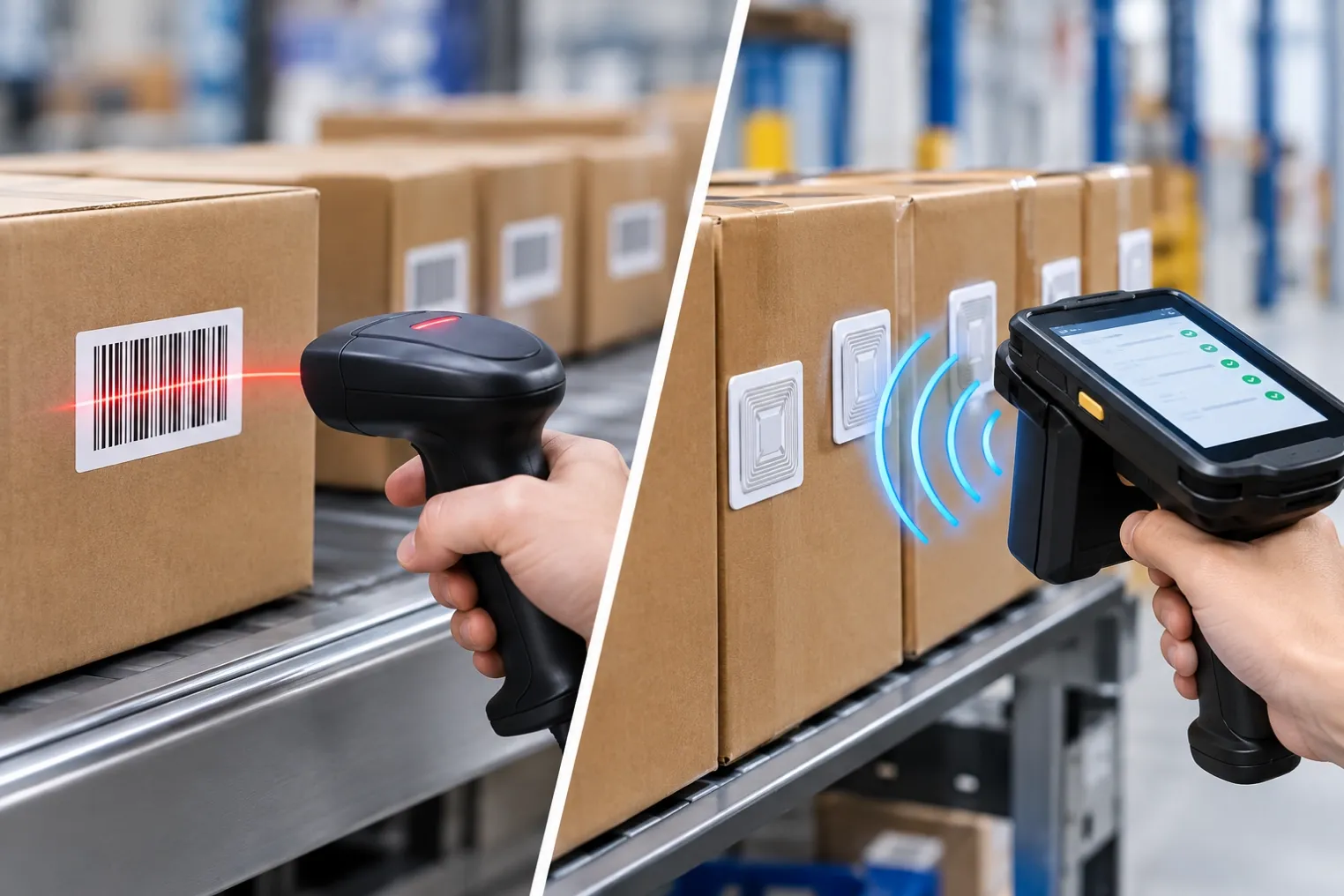
📡 You need to track inventory, assets, or shipments. You have two main options: barcode labels or RFID tags. Both are proven technologies. Both are widely used. But they are fundamentally different in how they work – and choosing the wrong one can cost you time, money, and efficiency.
Barcode labels require line-of-sight scanning, one item at a time. RFID tags can be read in bulk, through packaging, without direct visibility. That single difference drives everything else: cost, speed, accuracy, and the applications each technology is best suited for.
In this guide, I will compare RFID and barcode labels across every key dimension – cost, read range, speed, durability, and data capacity – and provide a clear decision framework for choosing the right one.
1. What Is a Barcode Label? 📊
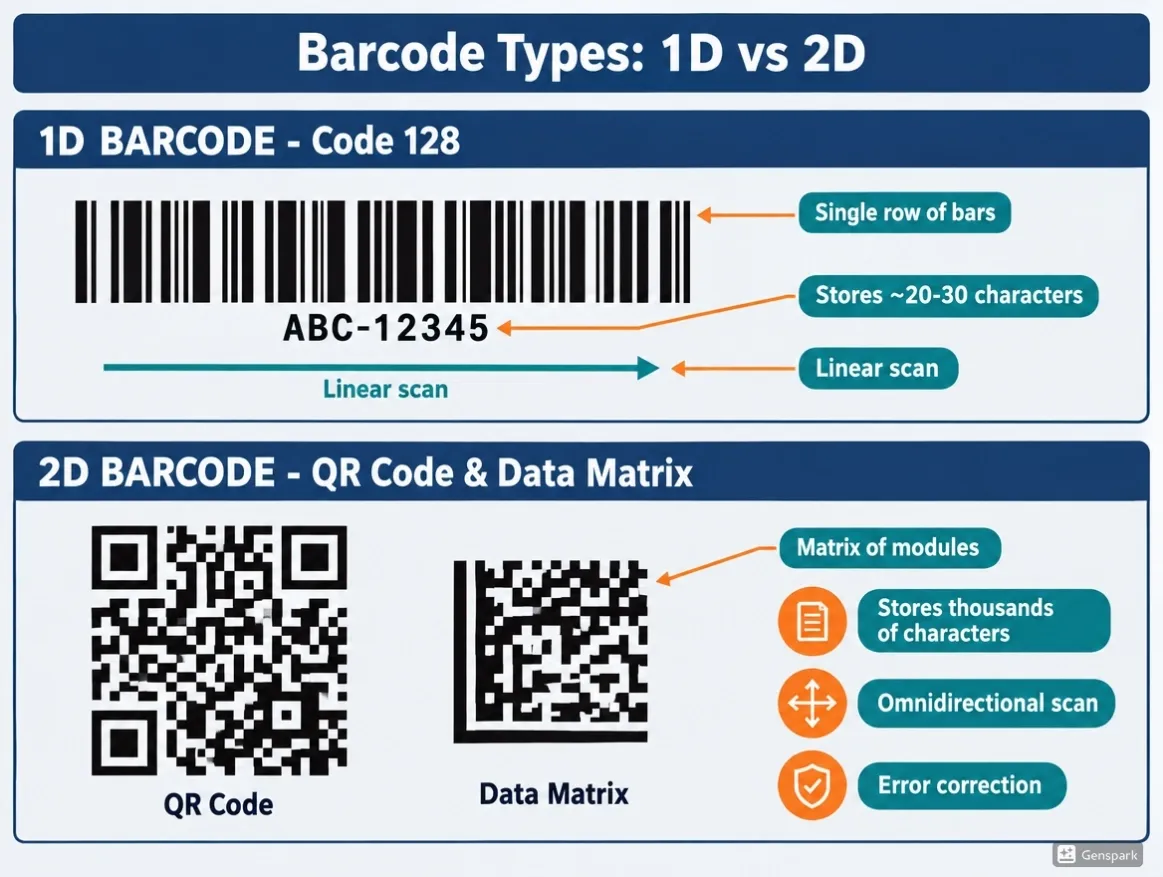
A barcode label encodes data in a visual pattern of bars and spaces. It is read by an optical scanner that requires line-of-sight to the barcode.
Types of Barcodes
Type | Description | Example |
|---|---|---|
1D (Linear) | Traditional barcode – bars of varying widths | UPC, Code 128, GS1-128 |
2D (Matrix) | Square or rectangular pattern of dots | QR Code, Data Matrix, PDF417 |
How Barcode Labels Work
- Data is encoded into a barcode pattern
- The barcode is printed on a label
- The label is applied to the item
- A scanner reads the barcode using light
- The data is transmitted to a database
Key characteristic: Each barcode must be scanned individually. Scanning 100 items means 100 separate scans.
Strengths of Barcode Labels
- ✅ Very low cost per label
- ✅ Universal – every warehouse has barcode scanners
- ✅ Simple to implement
- ✅ High accuracy for individual scans
- ✅ No interference from metal or liquids (unlike RFID)
- ✅ Printable with standard thermal transfer printers
Limitations of Barcode Labels
- ❌ Requires line-of-sight – cannot read through packaging
- ❌ Must scan one item at a time – slow for large volumes
- ❌ Labels must be clean and undamaged to scan
- ❌ Limited data capacity
- ❌ No ability to update data dynamically
2. What Is an RFID Tag? 📡
An RFID (Radio Frequency Identification) tag contains a microchip and antenna that communicate with a reader using radio waves. Unlike barcodes, RFID tags do not require line-of-sight.
Types of RFID
Type | Frequency | Read Range | Best For |
|---|---|---|---|
LF (Low Frequency) | 125–134 kHz | A few cm | Animal tags, access control |
HF (High Frequency) | 13.56 MHz | Up to 1m | Library books, NFC payments |
UHF (Ultra-High Frequency) | 860–960 MHz | Up to 12m | Supply chain, inventory, logistics |
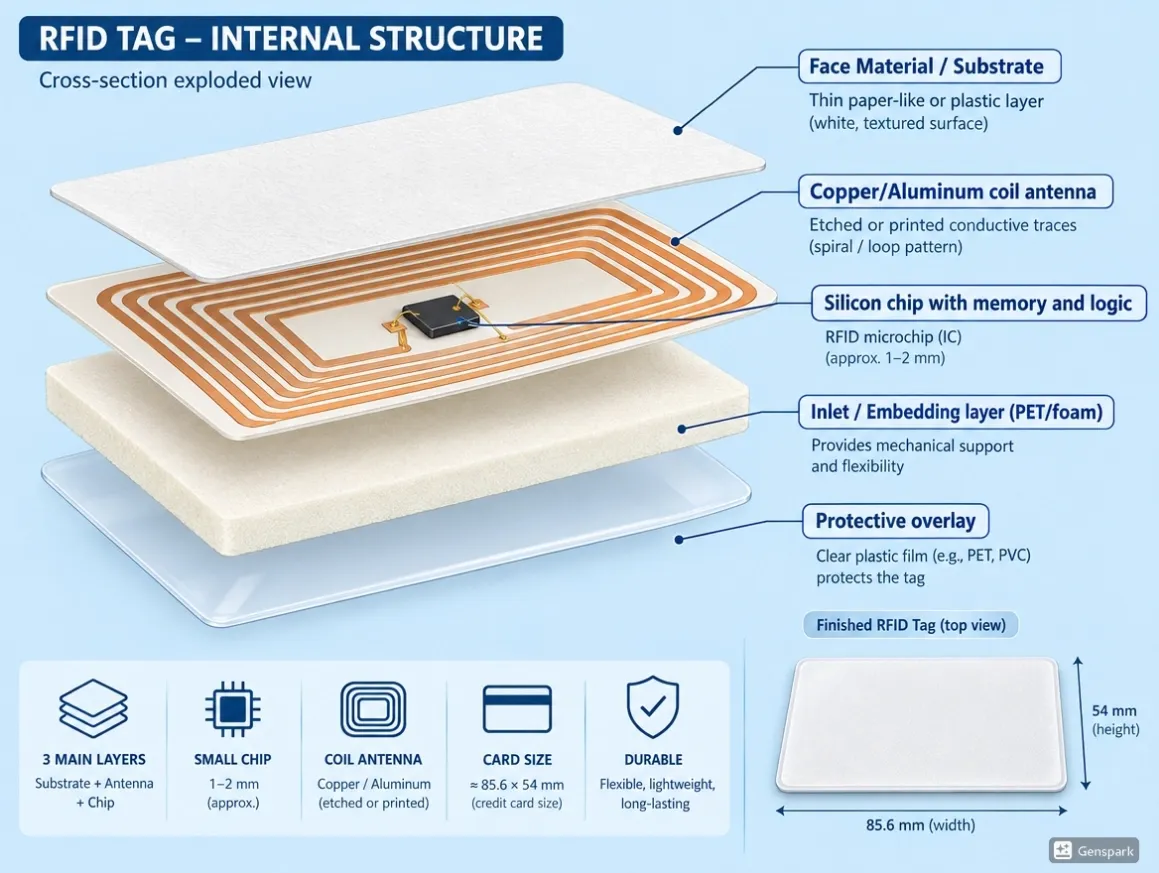
UHF RFID is the standard for industrial and supply chain applications.
How RFID Tags Work
- Data is stored in the tag's microchip
- The tag is attached to the item
- An RFID reader emits radio waves
- The tag's antenna captures the energy and powers the chip
- The chip transmits its data back to the reader
- Multiple tags can be read simultaneously
Key characteristic: RFID readers can read hundreds of tags per second without line-of-sight.
Strengths of RFID Tags
- ✅ Bulk reading – hundreds of tags at once
- ✅ No line-of-sight required – reads through packaging
- ✅ Can read at a distance (up to 12m for UHF)
- ✅ Can store and update data dynamically
- ✅ Resistant to dirt, moisture, and wear
- ✅ Higher accuracy than barcodes in large volumes
Limitations of RFID Tags
- ❌ Higher cost per tag than barcodes
- ❌ Requires RFID readers and infrastructure
- ❌ Interference from metal and liquids
- ❌ More complex to implement
- ❌ Privacy concerns in consumer applications
3. Head-to-Head Comparison ⚖️
Feature | Barcode Label | RFID Tag |
|---|---|---|
Read method | Line-of-sight | Radio frequency (no line-of-sight) |
Read speed | 1–2 seconds per item | Up to 1,000 tags per second |
Read range | A few cm to 1m | Up to 12m (UHF) |
Bulk reading | No – one at a time | Yes – hundreds simultaneously |
Data capacity | Limited (1D: 20–25 chars; 2D: up to 2,000 chars) | Up to 496 bits EPC + user memory |
Data updatable | No – fixed at printing | Yes – can rewrite |
Cost per label | | |
Reader cost | | |
Durability | Must be clean, undamaged | Resistant to dirt, moisture, wear |
Metal/liquid interference | None | Significant – requires special tags |
Implementation complexity | Low | Medium to high |
Accuracy (manual) | ~95–97% | 99.9%+ |
Best for | Low-volume, low-cost, simple tracking | High-volume, fast, automated tracking |
💡 Key insight: Barcodes are cheaper and simpler. RFID is faster and more accurate at scale. The right choice depends on your volume, speed requirements, and budget.
4. When to Choose Barcode Labels ✅
Barcode labels are the right choice when:
Scenario | Why Barcode Works |
|---|---|
Low-volume tracking | Scanning 50 items per day – barcode is faster and cheaper |
Budget-constrained projects | Label cost is 10–100× lower than RFID |
Simple implementation | No reader infrastructure needed – any scanner works |
Retail POS | Universal barcode scanning at checkout |
Shipping labels | Standard carrier requirements – barcodes only |
Small items | RFID tags may not fit on very small items |
Metal or liquid products | Barcodes work where RFID fails |
One-time use | No need to update data – print once |
Typical applications: Retail, shipping, warehousing (manual scanning), document tracking, event ticketing.
5. When to Choose RFID Tags ✅
RFID tags are the right choice when:
Scenario | Why RFID Works |
|---|---|
High-volume inventory | Counting 10,000 items – RFID reads hundreds per second |
Automated tracking | No manual scanning required – readers scan automatically |
Supply chain visibility | Real-time tracking from manufacturing to delivery |
Asset tracking | Tools, equipment, IT assets – bulk reading saves hours |
Reusable containers | Pallets, totes – tags can be reused and updated |
Harsh environments | Tags resist dirt, moisture, and wear better than barcodes |
Anti-counterfeiting | Unique chip IDs cannot be easily replicated |
Regulatory compliance | Serialisation for pharmaceuticals, medical devices |
Typical applications: Warehouse automation, asset tracking, retail inventory, supply chain, healthcare, aerospace.
6. Cost Comparison – The Real Numbers 💰
Cost is often the deciding factor. Here is a realistic comparison for a warehouse tracking 10,000 items:
Cost Factor | Barcode Solution | RFID Solution |
|---|---|---|
Label/tag cost | | |
Reader cost | $1,000 (5 scanners) | $6,000 (2 fixed readers + 2 handhelds) |
Software integration | $2,000 | $8,000 |
Installation | $500 | $3,000 |
Training | $500 | $1,500 |
Total upfront | $4,500 | $23,500 |
But Consider the Labour Savings
Labour Factor | Barcode | RFID |
|---|---|---|
Time to count 10,000 items | 20 hours | 1 hour |
Labour cost per count | $400 | $20 |
Counts per year | 12 | 12 |
Annual labour cost | $4,800 | $240 |
Annual savings with RFID | – | $4,560 |
Payback period for RFID: Approximately 4–5 years for this scenario. For higher volumes or more frequent counts, payback is faster.
💡 The key: RFID has higher upfront costs but lower ongoing labour costs. Barcodes are cheaper to start but more expensive to operate at scale.
7. Can You Use Both? The Hybrid Approach 🔄
Yes – and many operations do.
How Hybrid Systems Work
Stage | Technology | Why |
|---|---|---|
Receiving | RFID | Bulk reading of incoming pallets |
Put-away | RFID | Automated location tracking |
Picking | Barcode | Individual item verification |
Shipping | RFID | Bulk verification of outbound orders |
Retail POS | Barcode | Universal checkout scanning |
Benefits of Hybrid
- ✅ RFID for high-volume, automated processes
- ✅ Barcodes for individual item verification and customer-facing scanning
- ✅ Lower total cost than full RFID deployment
- ✅ Gradual transition – start with RFID in one area
Example: A warehouse might use RFID for pallet-level tracking and barcodes for item-level picking. The RFID tag also carries a printed barcode – so both technologies work from the same label.
8. Decision Framework – Which Should You Choose? 🎯
Ask these questions in order:
Question 1: How many items do you need to track?
Volume | Recommendation |
|---|---|
< 1,000 items | Barcode |
1,000–10,000 items | Barcode or hybrid |
> 10,000 items | RFID |
Question 2: How often do you count inventory?
Frequency | Recommendation |
|---|---|
Annually | Barcode |
Quarterly | Barcode or hybrid |
Monthly | Hybrid or RFID |
Weekly or daily | RFID |
Question 3: Do you need real-time visibility?
Requirement | Recommendation |
|---|---|
Periodic snapshots | Barcode |
Real-time tracking | RFID |
Question 4: What is your budget?
Budget | Recommendation |
|---|---|
< $5,000 | Barcode |
| Hybrid |
> $20,000 | RFID |
Question 5: What are you tracking?
Item Type | Recommendation |
|---|---|
Metal or liquid products | Barcode (RFID has interference issues) |
High-value assets | RFID (better security and tracking) |
Reusable containers | RFID (tags can be reused) |
Single-use packaging | Barcode (lower cost) |
Summary Decision Matrix
Requirement | Best Choice |
|---|---|
Lowest cost | Barcode |
Fastest counting | RFID |
Highest accuracy | RFID |
Simplest implementation | Barcode |
Real-time visibility | RFID |
Metal/liquid products | Barcode |
High-volume warehouse | RFID |
Retail checkout | Barcode |
Asset tracking | RFID |
Supply chain serialisation | RFID |
9. Common Mistakes to Avoid ❌
Mistake | Consequence |
|---|---|
Choosing RFID for low-volume tracking | Over-investment – barcode would suffice |
Choosing barcode for high-volume warehouse | Labour costs spiral – RFID pays back faster |
Assuming RFID works on metal/liquids | Read failures – requires special on-metal tags |
Not accounting for reader infrastructure | Budget overruns – readers cost more than tags |
Skipping pilot testing | Full deployment fails – test first |
Ignoring barcode as a backup | No fallback if RFID fails |
Not considering hybrid | Miss opportunity for cost-effective solution |
Always pilot test before full deployment. Start with one area, measure results, then scale.
10. Summary & Next Steps 🎯
- Barcode labels are cheaper, simpler, and work everywhere – but require line-of-sight and individual scanning.
- RFID tags are faster, more accurate at scale, and enable real-time visibility – but cost more and require infrastructure.
- Choose barcode for low-volume, budget-constrained, or metal/liquid applications.
- Choose RFID for high-volume, automated, or real-time tracking applications.
- Consider hybrid – RFID for bulk processes, barcodes for individual verification.
- Pilot test before full deployment.
Need help choosing between RFID and barcode? We offer both RFID labels and barcode labels for every application. Send us your tracking requirements – volume, speed, environment, and budget – and we will recommend the right solution and send free samples for you to test.