Sep 2, 2026Guides
Why Labels Crack at Low Temperatures – The Glass Transition Temperature Explained
Labels crack and fall off in freezers and liquid nitrogen because of glass transition temperature (Tg). Learn what Tg is, why it causes label failure, and how to choose labels that survive the cold.
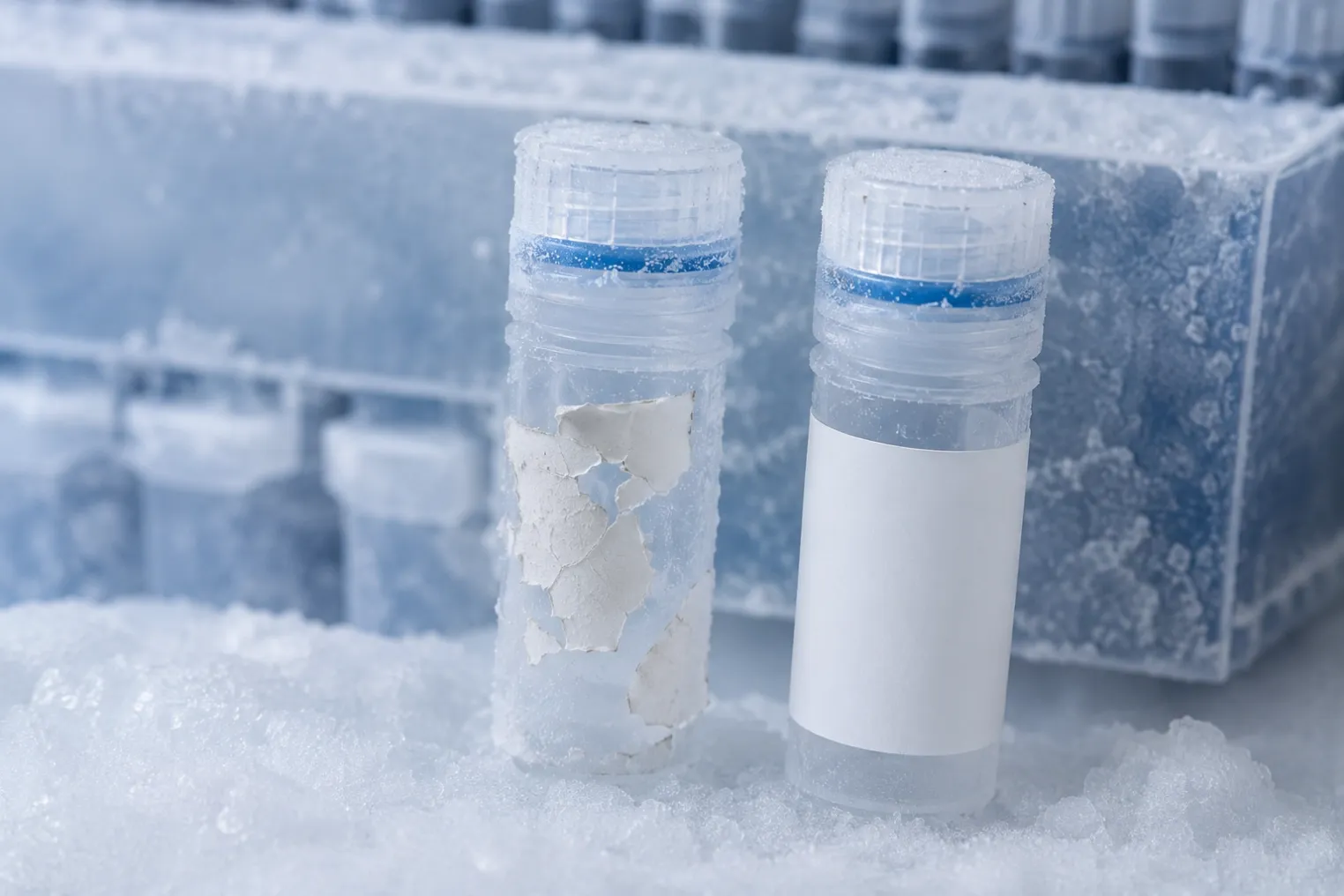
❄️ You pull a sample vial from a -80°C freezer, and the label has cracked, curled, or fallen off entirely. The barcode is unreadable. The sample's identity is lost.
This is not a random failure. It is physics.
The culprit is a material property called the glass transition temperature (Tg) . Understanding it is the key to selecting labels that survive extreme cold – from -20°C freezers to liquid nitrogen at -196°C.
In this guide, I will explain what glass transition temperature is, why it causes labels to fail in the cold, and how to choose labels that stay intact.
1. What Is Glass Transition Temperature (Tg)? 🧊
The glass transition temperature (Tg) is the temperature below which an amorphous material – such as a polymer, adhesive, or plastic – transitions from a flexible, rubbery state to a hard, brittle, glass-like state. Above Tg, polymer chains are mobile and can move past each other, giving the material flexibility and ductility. Below Tg, molecular motion freezes. The material becomes rigid and shatter-prone.
Think of it like this:
State | Temperature Relative to Tg | Material Behaviour |
|---|---|---|
Rubbery | Above Tg | Flexible, absorbs stress, conforms to surfaces |
Glassy | Below Tg | Rigid, brittle, cracks under stress |
For most common materials, Tg varies widely:
Material | Glass Transition Temperature (Tg) |
|---|---|
Window glass | 564°C |
Tire rubber | -72°C |
Polypropylene (PP) | -20°C to 0°C |
Standard acrylic adhesive | ~-20°C |
Polyethylene (PE) | -90°C |
💡 The key insight: If a label or its adhesive has a Tg above your storage temperature, it will become brittle and fail.
2. How Tg Causes Labels to Fail ❌
When a label is exposed to temperatures below the Tg of its materials, three things go wrong:
A. Adhesive Embrittlement
Most standard pressure-sensitive adhesives (PSAs) are acrylic or rubber-based. At room temperature, they are soft and flow into the microscopic pores of the substrate, creating a strong bond.
As temperatures drop, these adhesives reach their Tg and transition from a flexible, rubbery state to a hard, brittle, glass-like state. The polymer chains lock in place. The adhesive loses its "tack" and its ability to dissipate energy. It can no longer flow or wet the surface. Instead of bonding, it becomes a hard, brittle layer that sits on top of the substrate. Any mechanical stress – such as the slight expansion of a freezing vial – will cause the bond to snap.
Most standard acrylic adhesives have a Tg around -20°C. Once the temperature drops below this point, the adhesive turns from a flexible solid into a hard, glassy state.
B. Facestock Brittleness
The label material itself – the facestock – also has a Tg. Below that temperature, it becomes brittle and cracks.
- Standard PET becomes brittle below approximately -20°C to -40°C
- Polypropylene (PP) has a Tg between -20°C and 0°C – it can easily become shatter-prone on a cold day
- Paper absorbs moisture, freezes, and tears
- Nylon has a Tg around 40-50°C, but its brittle point is far lower – specially formulated nylon materials can remain flexible and intact down to -196°C, making them the material of choice for liquid nitrogen labels
When a standard facestock reaches its Tg, it loses flexibility and cracks under the slightest stress. Nylon, by contrast, is engineered to maintain its structural integrity even at cryogenic temperatures.
C. Thermal Contraction Mismatch
This is perhaps the most destructive mechanism.
When a container (like a polypropylene vial or a cardboard box) enters a freezer, it undergoes physical contraction. The label material and the adhesive contract at different rates.
- If the label is rigid (below its Tg) and the container shrinks, the label cannot move with it
- Internal shear stress builds up at the bond interface
- The label "flags" (peels at the edges) or pops off entirely
- If the adhesive is glassy and inelastic, it cannot compensate for this movement
- The bond cracks mechanically and peels off
⚠️ The result: A label that was perfectly applied at room temperature will fail in the cold – not because the adhesive was weak, but because it was frozen solid.
3. Why Standard Labels Fail in Common Cold Environments 🌡️
Environment | Temperature | Why Standard Labels Fail |
|---|---|---|
Standard freezer | -20°C | Adhesive reaches Tg (~-20°C) – becomes brittle |
Ultra-low freezer | -80°C | Adhesive is fully glassy; facestock becomes brittle |
Dry ice shipping | -78.5°C | Same as -80°C – complete failure |
Liquid nitrogen vapour | -150°C to -190°C | All standard materials fail – only specialised cryogenic labels with nylon facestock survive |
Liquid nitrogen liquid phase | -196°C | Extreme failure – only nylon labels with LN₂-rated adhesive can withstand direct immersion |
Standard glues vitrify quickly below -20°C, becoming hard, brittle, and non-adhesive. To survive at -80°C or below, a label must be paired with an ultra-low Tg adhesive and a nylon facestock that remains flexible at cryogenic temperatures.
4. How to Choose Labels That Survive the Cold 🎯
A. Choose the Right Adhesive
The adhesive must have a Tg below your storage temperature.
Application | Required Adhesive Tg | Adhesive Type |
|---|---|---|
Room temperature storage | Above -20°C | Standard acrylic |
Standard freezer (-20°C) | Below -20°C | Modified acrylic |
Ultra-low freezer (-80°C) | Below -80°C | Silicone-based or ultra-low Tg acrylic |
Liquid nitrogen (-196°C) | Below -196°C | Specialised cryogenic acrylic with nylon-compatible formulation |
Key point: Standard acrylic adhesives have a Tg around -20°C. For any temperature below that, you need a specialised adhesive.
B. Choose the Right Facestock
The label material must remain flexible at your storage temperature.
Material | Minimum Temperature | Best For |
|---|---|---|
Standard PET | -20°C to -40°C | General use, not for freezers |
PP (polypropylene) | -10°C to -20°C | Mild cold only |
Cryo-grade PET | -80°C | Ultra-low freezers |
Nylon | -196°C | Liquid nitrogen – remains flexible and intact even at -196°C |
Nylon is the preferred material for liquid nitrogen labels because it combines the flexibility needed to conform to small vials with the durability to withstand extreme cold without cracking. Unlike polyimide, which is brittle at cryogenic temperatures, nylon maintains its structural integrity.
C. Use the Right Ribbon
Even if the label survives, the print must survive too.
- Resin ribbon is required for cryogenic labels – it remains legible at extreme cold
- Wax/resin ribbon may become brittle and flake off
- Wax ribbon will fail completely
D. Apply Correctly
- Apply at room temperature – most cryogenic adhesives require room-temperature application for maximum bond
- Clean the surface – remove frost, moisture, and contaminants
- Press firmly – ensure full adhesive contact
- Allow to set – adhesives need time to cure before cold exposure
5. Real-World Application – What Works Where 🏭
-20°C Freezers (Standard Frozen Storage)
- Adhesive: Modified acrylic (Tg below -20°C)
- Facestock: Cryo-grade PET or PP synthetic
- Ribbon: Resin or high-quality wax/resin
- Typical use: Frozen food, retail cold storage
-80°C Ultra-Low Freezers
- Adhesive: Ultra-low Tg acrylic or silicone-based
- Facestock: Cryo-grade PET
- Ribbon: Resin only
- Typical use: Biobanks, vaccine storage, research samples
-196°C Liquid Nitrogen (Vapour or Liquid Phase)
- Adhesive: Specialised cryogenic acrylic
- Facestock: Nylon – remains flexible and intact even at -196°C
- Ribbon: Resin only
- Typical use: Stem cells, embryos, long-term biostorage
For liquid nitrogen applications, our Liquid Nitrogen Label (-196°C) uses high-quality nylon facestock with a specialised cryogenic adhesive, engineered for direct LN₂ immersion.
6. Common Mistakes to Avoid ❌
Mistake | Consequence |
|---|---|
Assuming "synthetic" means "cold-proof" | Standard PET fails below -40°C |
Using room-temperature adhesive in freezers | Adhesive reaches Tg, becomes brittle |
Applying labels to frosted surfaces | Adhesive bonds to ice, not the container |
Using wax/resin ribbon on cryogenic labels | Print becomes brittle and flakes off |
Not accounting for freeze-thaw cycles | Thermal contraction mismatch causes delamination |
Skipping sample testing | Full batch fails in cold storage |
✅ Always test a sample batch in your actual storage conditions before full deployment.
7. Conclusion & Next Steps 🎯
- Glass transition temperature (Tg) is the temperature below which materials become brittle and glassy.
- Labels fail in the cold when the adhesive, facestock, or both drop below their Tg.
- Standard acrylic adhesives have a Tg around -20°C and fail below that temperature.
- For -80°C storage, you need ultra-low Tg adhesives and cryo-grade facestock.
- For liquid nitrogen (-196°C) , you need nylon labels with LN₂-rated cryogenic adhesive – nylon remains flexible and intact at -196°C, unlike polyimide which becomes brittle.
- Always use resin ribbon for cold-storage labels – wax/resin will become brittle and flake.
Need labels that survive the cold? We offer cryogenic labels for -80°C freezers and liquid nitrogen storage. Send us your storage temperature, vial type, and freeze-thaw requirements – we will recommend the right label and send free samples for you to test.