Aug 21, 2026Guides
The Necessity of Anti-Static Labels in Electronics Manufacturing
Understand why standard labels pose an ESD risk and how anti-static labels protect sensitive components. Covers material science, selection criteria, and common myths in electronics manufacturing.
The 10-Second Reality Check (Read This First!) ⚡
The Problem | The Cost | The Solution |
|---|---|---|
Ordinary labels generate static when peeled or handled | US$5+ billion in annual ESD damage to the electronics industry | Anti-static (ESD) labels control charge dissipation |
Static can destroy components instantly or cause latent failures | Up to 33% of semiconductor failures are ESD-related | ESD PET for general use; ESD PI for reflow soldering |
A | Field returns from latent damage cost 10–50× more than the component | Test the complete label construction before buying |
The Golden Rule: ⚠️ If your label touches a PCB, a chip, or any ESD-sensitive component, it must be anti-static. A regular label is not just harmless—it is a risk.
What Is an Anti-Static Label? (And Why Should You Care?) 🏷️
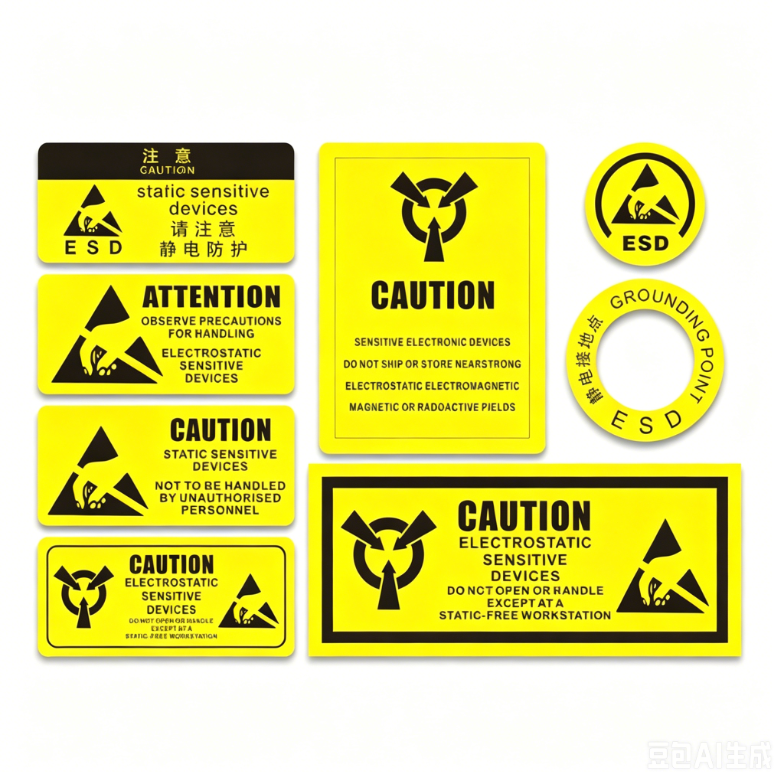
An anti-static label—also called an ESD label or static-dissipative label—is an identification label designed to minimize charge generation and prevent uncontrolled electrostatic discharge near sensitive electronic components.
Think of it like this: When you rub a balloon on your hair, it creates static and sticks to the wall. That same static electricity can happen when you peel a label off its liner. But instead of sticking to a wall, that static can jump into a microchip and destroy it.
A complete anti-static label construction typically includes:
- 🛡️ ESD-treated polyester (PET) or polyimide (PI) facestock
- 🛡️ Static-dissipative or low-charging adhesive
- 🛡️ Printable topcoat that works with thermal transfer printing
- 🛡️ Release liner designed to minimize charge generation
- 🛡️ Compatible thermal-transfer ribbon (usually resin)
The purpose of an anti-static label is not to conduct electricity rapidly. In fact, that can be dangerous. The better objective is controlled dissipation—allowing charge to bleed away gradually rather than producing a sudden discharge into an IC, PCB, sensor, or semiconductor device.
As one industry expert explains, "Today's PCB labels are highly sophisticated. They're produced with specialized materials that actually help to reduce the occurrence of electrostatic discharge in ESD-sensitive devices."
Why Is ESD a Problem in Electronics Manufacturing? 🔥
Electrostatic discharge is the silent killer of electronics. You cannot see it. You cannot hear it. But it can destroy a component in a fraction of a second.
Catastrophic vs. Latent Failure
ESD can damage an electronic component in two ways:
1. Catastrophic Failure – The component fails immediately. You catch it during inspection or testing. You scrap the board. You lose time and money. But at least you know about it.
2. Latent Failure – This is the hidden danger. The component is weakened but still passes initial testing. Then, weeks or months later, it fails in the field. The customer complains. You issue a warranty replacement. You lose reputation. And you may never trace it back to the label that caused the problem.
Industry sources estimate that up to 33% of all semiconductor failures during manufacturing and handling are caused by ESD. The EOS/ESD Association estimates that ESD damage costs the global electronics industry around US$5 billion annually. Many of these failures are latent—they escape detection and cause problems later.
Why Is This Getting Worse?
The electronics industry is growing fast. The Semiconductor Industry Association reported global semiconductor sales of US1 trillion.
More devices mean more components. More components mean more handling. More handling means more ESD risk. Advanced packaging, automotive electronics, AI hardware, and high-density assemblies all mean more high-value components moving through ESD-sensitive manufacturing processes.
Bottom line: The problem is not going away. It is getting bigger.
Can an Ordinary Label Create Static Electricity? 😱
Yes. Absolutely yes.
Ordinary paper labels, polyester labels, plastic labels, adhesive tape, and release liners can all generate triboelectric charge. This happens when two materials rub together and exchange electrons.
How Static Gets Created
Static charge can be generated when labels are:
- 🔹 Peeled from a liner
- 🔹 Unwound from a roll
- 🔹 Applied to a PCB or component
- 🔹 Removed from a surface
- 🔹 Moved across plastic trays or packaging
- 🔹 Handled in dry environments (low humidity makes it worse)
The risk depends on many factors: the materials involved, the humidity level, how fast you peel, what surface you are sticking to, whether you are grounded, and how sensitive your component is.
The Adhesive Matters Too
Here is something most people do not realize: The adhesive is just as important as the film.
A static-dissipative facestock paired with an insulating adhesive may not provide the expected charge-control path. The charge can get trapped at the interface between the label and the component. That trapped charge can then discharge unexpectedly.
A standard label may appear harmless. But when you peel it off and stick it near an exposed circuit or connector, you could be creating a localized charge that fries a chip.
As one industry source notes, "The label's adhesive is also important. A dissipative facestock paired with an insulating adhesive may not provide the expected charge-control path."
How Do Anti-Static Labels Actually Work? 🧪
Anti-static labels work by controlling the electrical behavior of the label surface and, in some designs, the adhesive layer. They do not magically eliminate static. They manage it.
The Science Simplified
Anti-static labels use several techniques:
- Conductive or dissipative coatings – These allow charge to spread out and bleed away slowly.
- Static-control additives – These are mixed into the film during manufacturing.
- Special polyester or polyimide films – These materials are naturally more static-resistant.
- Low-charging adhesives – These generate less static when peeled.
- Controlled surface resistivity – This ensures the label falls within a safe electrical range.
Conductive vs. Dissipative – What Is the Difference?
For most identification labels, the goal is static dissipation, not maximum conductivity.
Type | How It Works | Best For |
|---|---|---|
Conductive | Charge moves very quickly | Grounding applications, shielding |
Dissipative | Charge bleeds away slowly and safely | Identification labels on PCBs and components |
Insulative | Charge stays on the surface | NOT suitable for ESD-sensitive areas |
Conductive materials may discharge too quickly if incorrectly applied. A sudden discharge into an exposed circuit can be just as damaging as a static shock from your finger. That is why dissipative labels are usually preferred for identification purposes.
What Surface Resistance Should a Good ESD Label Have?
There is no single universal number. The required value depends on your ESD control plan, your component sensitivity, your application location, and the relevant standard.
Electrical Classification | Indicative Surface-Resistance Range | General Behavior |
|---|---|---|
Conductive | Below approximately 10⁶ Ω/sq | Charge moves very quickly |
Static-Dissipative | Approximately 10⁶–10¹¹ Ω/sq | Charge dissipates in a controlled manner |
Insulative | Above approximately 10¹² Ω/sq | Charge may remain on the surface |
A common supplier specification for ESD label materials is approximately 10⁶ to 10⁹ ohms per square. But this is just a starting point. Different suppliers and standards may use somewhat different boundaries.
What you should always ask for:
- ✅ Surface resistance or surface resistivity value
- ✅ Test method used (e.g., ANSI/ESD STM11.11)
- ✅ Conditioning temperature and humidity
- ✅ Applied voltage and measurement time
- ✅ Acceptable range for your application
- ✅ Whether the requirement applies to the facestock, adhesive, or complete label
Which Material Is Best for Anti-Static Electronics Labels? 🏆
Not all anti-static labels are created equal. The best material depends on your application—especially the temperature.
Material | Best Use | Main Benefits | Limitations |
|---|---|---|---|
ESD PET (Polyester) | General PCB, component, and equipment identification | Good durability, printability, dimensional stability, and cost | Lower heat capability than PI |
ESD PI (Polyimide) | Reflow soldering, wave soldering, semiconductor, and high-temperature processes | Excellent thermal stability (260°C+), chemical resistance | Higher cost, more specialized printing |
ESD PP (Polypropylene) | Flexible packaging and moisture-sensitive applications | Lightweight, flexible, moisture-resistant | Less heat-resistant, lower dimensional stability |
ESD Paper | Low-temperature packaging and warning labels | Low cost, easy printing | Limited water, chemical, and thermal durability |
Simple Guidance
- ✅ Choose ESD PET for general electronics identification—it is the best all-rounder.
- ✅ Choose ESD PI when the label must pass through high-temperature assembly (reflow soldering at 260°C+).
- ✅ Choose ESD PP for flexible or moisture-resistant packaging applications.
- ✅ Choose ESD paper only when the environment is mild and the label does not need high durability.
FuYue Labels offers both high-temperature PI labels for reflow soldering and white PET labels for general industrial use—both available with ESD-safe constructions.
Why Must the Adhesive Be ESD-Safe? 🧲
The adhesive is often the weakest link in an anti-static label. You can have the best static-dissipative film in the world, but if the adhesive generates charge or fails under heat, the label is useless.
What Can Go Wrong with the Adhesive?
A label may fail if the adhesive:
- 🔸 Generates charge during peeling
- 🔸 Traps charge at the label-substrate interface
- 🔸 Loses adhesion during reflow soldering
- 🔸 Softens under heat and lets the label slide
- 🔸 Leaves residue after removal
- 🔸 Delaminates during cleaning
- 🔸 Does not bond to low-surface-energy plastics
Testing the Adhesive
For high-temperature PCB work, acrylic adhesives are commonly used in reflow-rated constructions. For extremely demanding thermal applications, silicone or specialty high-temperature adhesive systems may be considered.
The adhesive should be tested on the exact substrate you are using:
- FR-4 solder mask
- Bare PCB
- Aluminum
- Stainless steel
- Polycarbonate
- Polypropylene
- Polyethylene
- Conformal-coated assemblies
Pro tip: Never assume an adhesive works on your surface just because it works on someone else's. Test it.
What Printing Method Should Be Used? 🖨️
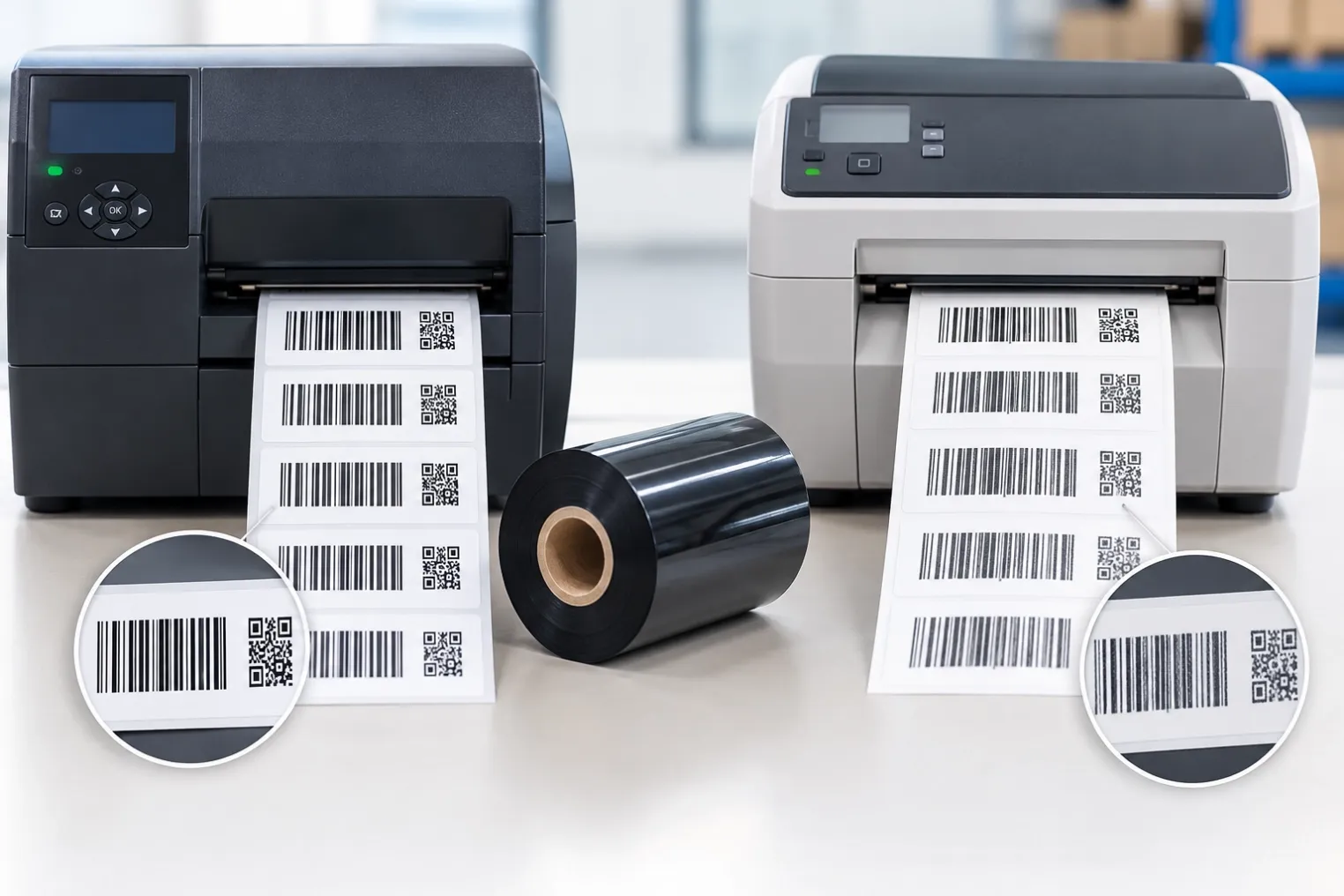
Thermal-transfer printing is the most common method for ESD labels. It supports variable data, barcodes, serial numbers, and manufacturing traceability.
Why Resin Ribbon?
A resin ribbon is generally preferred when the printed label must resist:
- Abrasion (rubbing against other components)
- Solvents (flux removers, cleaning agents)
- Flux (during soldering)
- IPA cleaning (isopropyl alcohol wipes)
- Heat (reflow ovens)
- Moisture (humidity, condensation)
- Repeated handling (during assembly)
FuYue Labels offers premium resin thermal transfer ribbons engineered specifically for synthetic labels (PET, PI, PP, PE) requiring superior resistance to heat, chemicals, and abrasion.
Compatibility Is Critical
The ribbon must be compatible with the label's topcoat. A high-performance film with an unsuitable ribbon can still produce:
- ❌ Poor print adhesion
- ❌ Smearing and smudging
- ❌ Low barcode contrast
- ❌ Premature image loss
Always test the actual barcode and variable data using your intended printer, printhead resolution, print speed, and darkness setting. Do not assume it will work.
Are Anti-Static Labels Required by ANSI/ESD S20.20? 📋
This is a common question—and the answer is important.
ANSI/ESD S20.20 is not a label-material standard. It is a facility-level ESD control-program standard.
What ANSI/ESD S20.20 Actually Covers
The standard covers:
- 🔹 ESD program management
- 🔹 Training requirements
- 🔹 Grounding and equipotential bonding
- 🔹 Personnel grounding
- 🔹 ESD-protected areas (EPAs)
- 🔹 Packaging requirements
- 🔹 Product qualification
- 🔹 Compliance verification
- 🔹 Marking and documentation
The current listed edition is ANSI/ESD S20.20-2021.
What This Means for Your Labels
The standard does not automatically require one particular label material or one universal resistance range. Instead, the organization must document and validate controls capable of protecting its ESD-sensitive products.
IEC 61340-5-1 serves a similar international role. Both standards should be treated as program frameworks, not as permission to label a product "ESD-safe" without test evidence.
Bottom line: You need anti-static labels if your ESD control plan says you do. And if you are handling sensitive components, your plan probably should say you do.
Why Are Anti-Static Labels Important During PCB Assembly? 🔧
PCB assembly is a high-risk environment for ESD. Labels are applied, removed, and handled at multiple stages. Each touch is an opportunity for static discharge.
The Risks at Each Stage
Stage | ESD Risk |
|---|---|
Bare board handling | Static from handlers and packaging |
Solder paste printing | Static from stencil and squeegee |
Component placement | Static from feeders and tape |
Reflow soldering (260°C) | Heat + static = adhesive failure |
Wave soldering | Thermal shock + chemical exposure |
Flux and solvent cleaning | Chemical attack on adhesive and print |
Aqueous or IPA cleaning | Edge lift and delamination |
Mechanical abrasion | Print rub and barcode failure |
Barcode scanning | Unreadable codes = traceability loss |
Multiple handling stages | Cumulative ESD exposure |
Why ESD PI Labels Are Often the Only Option
A standard paper or plastic label may curl, char, shrink, delaminate, or become unreadable during reflow. An ESD polyimide label with a reflow-rated adhesive and resin ribbon is often selected when the label must be applied before soldering and remain traceable afterward.
FuYue Labels' polyimide labels are engineered to survive lead-free reflow soldering at 260°C+ with reliable barcode readability and adhesion through multiple thermal cycles.
What Happens If a Label Is Not ESD-Safe? 💸
The consequences can be severe—and expensive.
Immediate Consequences
- ⚠️ Immediate component failure – The board fails inspection. You scrap it and rework it.
- ⚠️ Latent failures – The component passes test but fails in the field. Customer complaints follow.
- ⚠️ Unreliable PCB traceability – If the label falls off, you lose the history.
- ⚠️ Barcode-scanning errors – Smudged or faded codes cause shipping delays.
Long-Term Consequences
- 🔸 Rework and retesting costs
- 🔸 Production downtime
- 🔸 Warranty claims and field returns
- 🔸 Difficulty identifying the root cause of failures
- 🔸 Nonconformance during customer or quality audits
- 🔸 Damage to your reputation
The Math
The cost of the label itself is usually tiny compared with the cost of a failed board, a delayed production batch, or a field return.
As one industry source notes, "Catastrophic ESD failures cost an average of $500-2,000 per incident in immediate component replacement and production delays". Field returns from latent ESD damage can cost 10 to 50 times more than the component itself.
A 100 PCB. Is it worth the risk?
How Should Manufacturers Test Anti-Static Labels? ✅
Do not trust the label just because it says "anti-static" on the box. Test it. Here is a professional qualification checklist.
10-Step Testing Process
Step 1: Measure Surface Resistance
Use a recognized standard such as ANSI/ESD STM11.11. Measure the facestock, the adhesive side, and the complete construction.
Step 2: Test Charge Generation
Measure the charge generated during peeling and application. A low-charging label should produce minimal static.
Step 3: Test the Complete Construction
Do not test just the film. Test the facestock + adhesive + liner together.
Step 4: Print Actual Barcodes
Print the real barcodes, serial numbers, and variable data you will use in production. Use your actual printer.
Step 5: Run Through Reflow Profile
If your label goes through reflow, run it through the complete soldering profile. Check for shrinkage, curling, and adhesion.
Step 6: Expose to Cleaning Chemicals
Test against flux removers, IPA, and other cleaning agents used in your process.
Step 7: Test Adhesion Before and After
Measure adhesion on your actual substrate—FR-4, aluminum, polycarbonate, etc.
Step 8: Check Print Rub and Barcode Readability
Rub the printed surface. Scan the barcode. Is it still readable?
Step 9: Test at Different Humidity Levels
ESD performance changes with humidity. Test at both dry and humid conditions.
Step 10: Request Certificates
Ask for a certificate of conformance. Verify lot-to-lot consistency.
Pro Tip
Testing only the unprinted film is insufficient. The printed label construction is what enters production. Test that.
Quick Answers to Common Label Questions ❓
What is an anti-static label?
An anti-static label is a label designed to reduce charge generation and control electrostatic discharge near sensitive electronic devices. It commonly uses a dissipative film, adhesive, or coating.
Are anti-static labels the same as ESD labels?
The terms are often used interchangeably, but "ESD label" is more precise when the product has documented electrostatic performance. Buyers should request resistance, charge-generation, and test data rather than relying on terminology alone.
What is the best ESD label for PCBs?
ESD polyester (PET) is suitable for many general PCB identification applications. ESD polyimide (PI) is usually the better choice when the label must pass through lead-free reflow, wave soldering, or aggressive cleaning.
Can ESD labels go through reflow soldering?
Some ESD polyimide labels are specifically designed for reflow soldering, but not every anti-static label is reflow-safe. Confirm the peak temperature, dwell time, number of cycles, adhesive performance, and print durability.
What ribbon should be used with anti-static labels?
A compatible resin thermal-transfer ribbon is generally the starting point for durable ESD labels. The final choice depends on the label topcoat, printer, print speed, chemical exposure, and required service life.
How do you test an anti-static label?
Measure surface resistance using a recognized method such as ANSI/ESD STM11.11, then test charge generation, adhesion, print durability, barcode readability, temperature resistance, and chemical resistance on the actual substrate.
Do anti-static labels need grounding?
The label itself is not a replacement for grounding. Its performance depends on the application and the surrounding ESD-control system. In many cases, the label is designed to minimize charge generation or dissipate charge safely when used within a grounded ESD-protected area.
Are anti-static labels required by ANSI/ESD S20.20?
ANSI/ESD S20.20 requires an effective, documented ESD-control program; it does not automatically mandate one specific label material. The label must be selected and qualified according to the product's sensitivity and the facility's documented controls.
The Bottom Line – Don't Let a Label Zap Your Profits 💪
We have covered a lot of ground. Let us bring it all together.
The Three Key Takeaways
1. Ordinary labels are a hidden risk. When you peel, apply, or handle a standard label near a PCB or sensitive component, you can generate static. That static can destroy a chip—either immediately or later, in the field.
2. Choose the right material for your process.
- ✅ ESD PET – Best for general electronics identification. Durable, printable, and cost-effective.
- ✅ ESD PI – Essential for reflow soldering and high-temperature processes. Survives 260°C+.
- ✅ ESD PP – Good for flexible packaging and moisture-sensitive applications.
3. Test the complete construction. The film is only one part. The adhesive, the ribbon, the printing process, and the application surface all matter. Test everything together.
Why FuYue Labels?
At FuYue Labels, we have been manufacturing industrial labels since 2016. We understand that labels are not just sticky paper—they are critical safety and traceability tools.
What we offer:
- 🔹 High-temperature PI labels for reflow soldering (260°C+)
- 🔹 White PET labels for general industrial use
- 🔹 Resin thermal transfer ribbons for extreme durability
- 🔹 Chemical-resistant labels for harsh environments
- 🔹 Cryogenic labels for liquid nitrogen (-196°C)
What makes us different:
- ✅ Matched label-and-ribbon solutions – because the ribbon matters as much as the label
- ✅ Low-volume orders – no need to buy 10,000 just to test
- ✅ Free samples – test before you commit
- ✅ Custom die-cutting – any shape, any size
- ✅ Printer compatibility support – we check before we ship
Still Not Sure? 🧐
Do not guess. Do not hope. Test.
Reach out to us. Tell us about your environment. We will help you select the right construction. Then, we will send you samples to run through your actual production line.
Ready to protect your components and your reputation?
Contact us today for a free consultation and sample kit. Let us find the perfect ESD label for your application—whether it is PET, PI, or something else.
External Link Ideas & Resources (For further reading):
- ESD Association (ESDA) – The only ANSI-accredited body for electrostatic standards. Source for ANSI/ESD S20.20, STM11.11, and other ESD standards.
- Semiconductor Industry Association (SIA) – For semiconductor sales data, market trends, and industry reports.
- ANSI/ESD S20.20-2021 Standard Information – Official standard details for the ESD control program.
- IEC 61340-5-1:2024 Standard – International ESD control program framework.
- ANSI/ESD STM11.11-2022 Test Method – Surface resistance measurement standard for planar materials.