Jun 26, 2026Guides
Cryogenic Label Selection Guide – From -80°C Freezers to Liquid Nitrogen (-196°C)
Labels that crack at -80°C or fall off in liquid nitrogen? Learn which materials and adhesives work for ultra-low temperatures and how to test them.
Cryogenic Label Selection Guide – From -80°C Freezers to Liquid Nitrogen (-196°C)
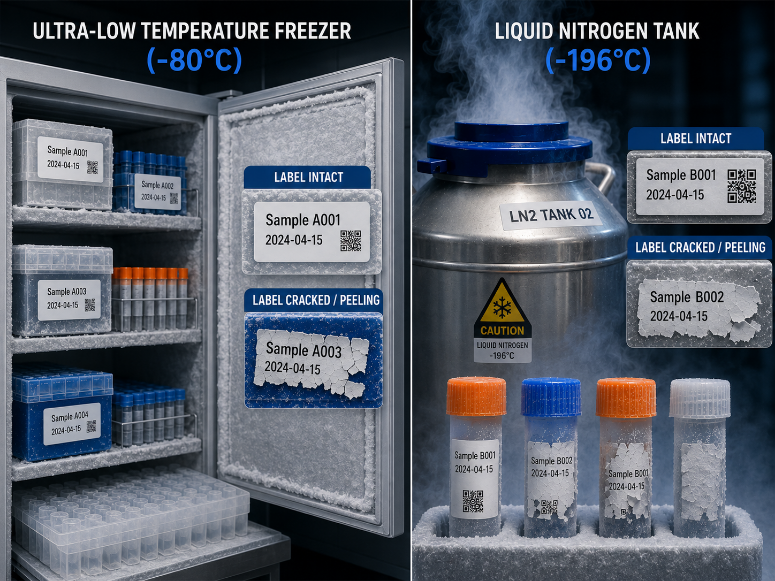
You’ve spent weeks preparing biological samples, only to find that the labels have cracked, fallen off, or become illegible after a week in an ultra‑low freezer or liquid nitrogen dewar.
Ordinary paper or standard synthetic labels are not designed for cryogenic temperatures. When the temperature drops below -40°C, most materials become brittle, adhesives lose their tack, and thermal contraction causes delamination.
In this guide, I’ll explain what happens to labels in extreme cold, which materials and adhesives actually work at -80°C and -196°C, how to test them, and when you need a specialised cryogenic label.
1. What Happens to Ordinary Labels at Low Temperatures?
Two physical changes occur as temperature drops:
- Glass transition (Tg): Most polymers (PET, PP, vinyl) become hard and brittle below their Tg. Standard White PET Label becomes brittle below approximately -20°C to -40°C. Paper absorbs moisture and freezes, tearing easily. Polypropylene (PP) becomes brittle below -10°C.
- Adhesive failure: Most acrylic adhesives lose compliance and tack below -20°C. Silicone‑based adhesives can remain flexible down to -100°C, but not all are rated for -196°C.
- Thermal contraction mismatch: The label, adhesive, and substrate (e.g., polypropylene vial) contract at different rates, causing edge lifting and delamination.
Result: Labels that work at room temperature will often crack, curl, or detach in cryogenic storage.
2. Label Materials That Work in Cryogenic Conditions
Not all “synthetic” labels are equal. Here are the materials that have proven performance at low temperatures:
Material | Minimum temperature | Best for |
|---|---|---|
Cryo‑grade PET | -80°C | Ultra‑low freezers (e.g., -80°C biobanks) |
-196°C | Liquid nitrogen immersion (-196°C) | |
Specialized vinyl | -80°C (limited) | Short‑term cold storage, not for LN₂ |
Cryo‑grade polyolefin | -80°C | Flexible vials, some freezers |
Why these work:
- Cryo‑PET is formulated with plasticisers that keep the film flexible down to -80°C. It is not for liquid nitrogen.
- Polyimide (PI) remains flexible and strong at -196°C. It is the only common label stock proven for direct LN₂ immersion.
- Avoid standard PET, PP, paper, and standard vinyl below -40°C.
For vapour phase liquid nitrogen (-150°C to -190°C), PI is the safe choice. Some cryo‑PET may survive, but testing is required.
3. Adhesives for Ultra‑Low Temperatures
The adhesive is often the first to fail. Two types work:
- Silicone‑based adhesives: Remain flexible and maintain bond strength down to -100°C or lower. Good for -80°C freezers.
- Specialised cryogenic acrylics: Formulated with low‑Tg monomers, they can function down to -80°C but may fail at -196°C.
For liquid nitrogen (-196°C): Only high‑performance silicone adhesives or specially formulated PI‑compatible adhesives have been validated. Many suppliers offer “LN₂ labels” with a proprietary adhesive.
Key property: The adhesive must not become so hard that it cannot wet the surface upon application, and it must not crack during thermal cycling.
4. Printing and Ribbon Compatibility
Even the best label is useless if the barcode wipes off at -80°C or flakes in LN₂.
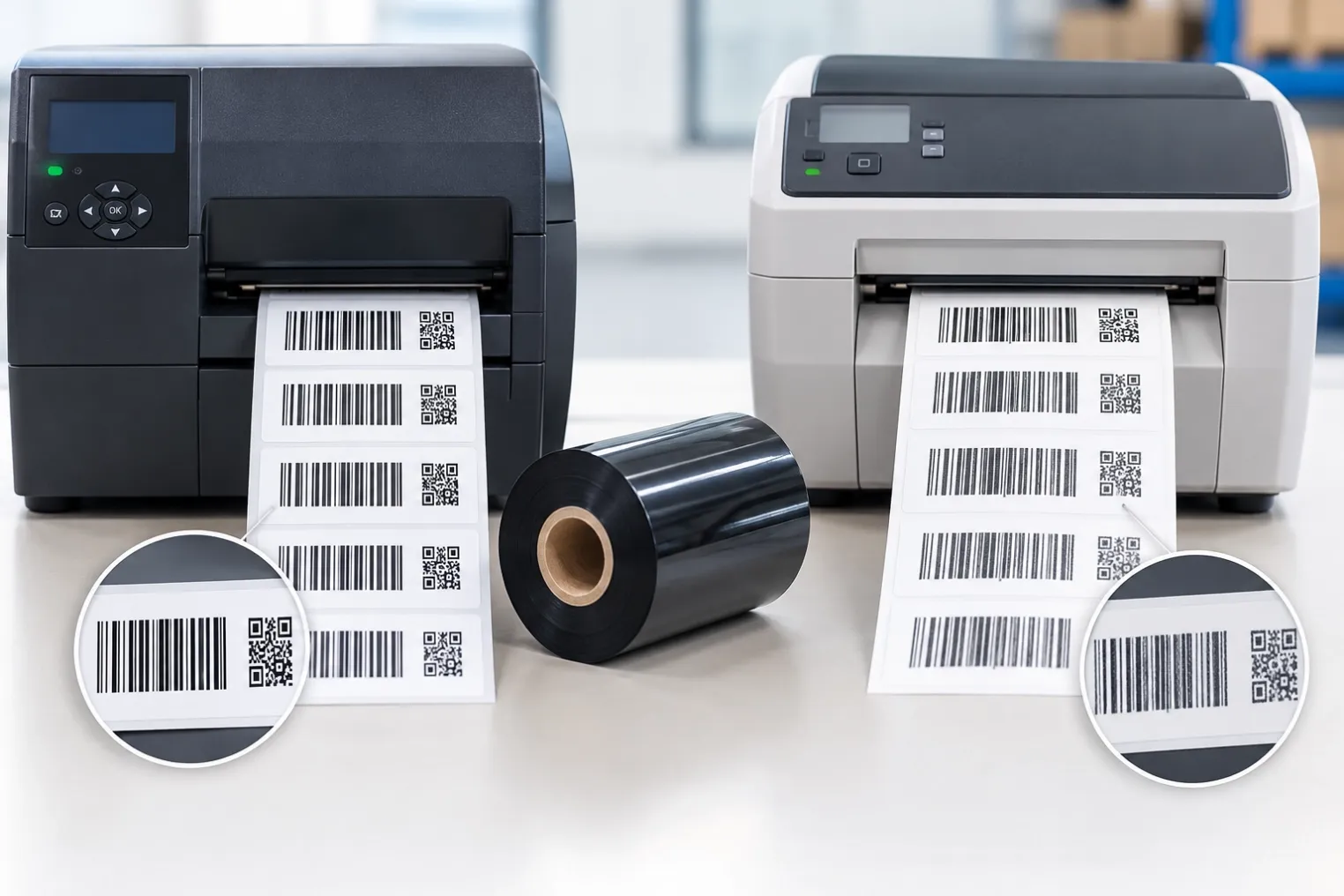
- Ribbon: Resin Ribbon is mandatory. Wax/resin ribbons become brittle and will flake off.
- Printer settings: Increase darkness (28–35%) and reduce speed (2–3 ips) to ensure complete transfer.
- Surface treatment: Some cryogenic labels have a special coating to accept resin ribbon. Test before bulk printing.
Important: Print the label before applying to the vial. Most cryogenic adhesives will not accept printing after application.
5. When Do You Need a Cryogenic Label?
You need a label rated for the specific low temperature if:
- Ultra‑low freezer storage (-80°C) – Biological samples, vaccines, enzymes, plasma.
- Liquid nitrogen vapour phase (-150°C to -190°C) – Stem cells, tissues, reproductive cells.
- Direct liquid nitrogen immersion (-196°C) – Long‑term biobanking, IVF, cryopreservation.
- Frequent freeze‑thaw cycles – Labels must survive repeated warming and cooling without delamination.
- Regulated environments (GMP, FDA) – Requires validated cryogenic labels with traceability.
Examples:
- COVID‑19 mRNA vaccines stored at -80°C need -80°C‑rated labels.
- Sperm or embryo vials stored in LN₂ need -196°C‑rated labels.
6. Testing Methods for Cryogenic Labels
Before trusting a label, perform these simple tests:
- Cold soak: Apply labels to vials, place in -80°C freezer for 24 hours. Remove and inspect for cracking, lifting, or adhesive failure.
- Liquid nitrogen immersion: Submerge labelled vials in LN₂ for 1 hour. Remove (carefully), thaw to room temperature, and check adhesion and print readability.
- Thermal cycling: Freeze at -80°C for 12 hours, thaw at 37°C for 2 hours, repeat 3–5 cycles. Look for edge lifting.
- Rub test at low temperature: While still cold, gently rub the label with a gloved finger – print should not transfer.
Ask your supplier for their internal test data or third‑party validation. For a general method to test label durability, read our guide: How to Test Chemical Resistance of Labels.
7. Comparison Table – Standard vs Cryogenic Label
Property | Standard PET Label | Cryo‑PET Label (-80°C) | PI Cryogenic Label (-196°C) |
|---|---|---|---|
Min temperature | -20°C to -40°C | -80°C | -196°C |
Material | Standard PET | Plasticised PET | Polyimide (PI) |
Adhesive | General acrylic | Silicone or low‑Tg acrylic | High‑performance silicone |
Recommended ribbon | Wax/resin or resin | Resin | Resin |
LN₂ immersion | No | No | Yes |
Flexibility at -80°C | Brittle | Flexible | Flexible |
Relative cost | $ | $$ – $$$ | $$$$ |
Common applications | Room temp storage | -80°C freezers, biobanks | Liquid nitrogen, cryo‑vials |
8. Quick Selection Guide
Ask these questions:
- What is the lowest temperature the label will experience?
- Above -40°C → Standard PET or PP may work (test).
- -40°C to -80°C → Cryo‑PET.
- -80°C to -196°C → PI (polyimide).
- Will the label be directly immersed in liquid nitrogen?
- Yes → Only PI with LN₂‑rated adhesive.
- No (vapour phase or freezer) → Cryo‑PET may suffice.
- Will there be freeze‑thaw cycles?
- Yes → Choose a label with flexible adhesive and facestock (cryo‑PET or PI).
- Do you need pre‑printed barcodes or variable data?
- Yes → Ensure the label accepts resin ribbon printing before cryo exposure.
For a broader comparison of synthetic label materials, see PET vs PI vs PP – Which Label Material Is Right for You?.
9. Common Mistakes
❌ “Any synthetic label will work at -80°C.”
Standard PET becomes brittle. You need cryo‑grade PET or PI.
❌ “Room‑temperature adhesive is fine for freezers.”
No. Most acrylics lose tack below -20°C. Use adhesives rated for the target temperature.
❌ “I can apply labels after freezing.”
Most cryogenic adhesives require application at room temperature. Applying to a frosted vial will result in failure.
❌ “Liquid nitrogen labels are all the same.”
Some “cryo” labels are only rated for -80°C. Always check the minimum temperature spec.
10. Conclusion & Next Steps
- -80°C freezers → Use cryo‑grade PET with silicone or low‑Tg acrylic adhesive and resin ribbon.
- Liquid nitrogen (-196°C) → Use polyimide (PI) labels with LN₂‑rated adhesive and resin ribbon.
- Always test with your actual vials, freezing conditions, and handling procedures.
Get it right the first time. We offer free cryogenic label samples validated for -80°C and -196°C. Send us your vial type, storage temperature, and any freeze‑thaw requirements – we’ll recommend the correct label and send samples for you to test.