Aug 21, 2026Applications
How a Chemical Plant Passed GHS Compliance with Solvent‑Resistant Labels
A chemical plant failed GHS inspection because labels smeared and fell off. See how switching to solvent‑resistant labels solved the problem and passed compliance.
The 30-Second Case Study Snapshot (Read This First!) ⚡
The Problem | The Solution | The Result |
|---|---|---|
GHS labels smeared and became unreadable after solvent contact | Solvent-resistant PET labels + resin thermal-transfer ribbons + controlled artwork | Passed OSHA inspection with zero label-related findings |
Labels lifted from HDPE drums within days of application | High-performance acrylic adhesive formulated for low-surface-energy plastics | Labels stayed attached through storage, handling, and transport |
Different departments used inconsistent label formats | Centralized label master file with approved artwork and revision history | Every container had the same compliant, readable label |
Old labels did not match updated SDS classifications | Full audit of every chemical and SDS, with label-to-SDS cross-reference | All labels matched current SDS exactly |
The Golden Rule: ⚠️ The labels looked perfect on the computer. But on the drums, they were a disaster. That is when the plant realized: GHS compliance is not just about printing the right information. It is about making sure that information stays readable.
The Plant's Original Labeling Problem 🏭
Every chemical plant has a moment when they realize their labeling system is broken. For one mid-sized chemical manufacturer, that moment came during a routine internal safety audit.
The plant produced a range of industrial solvents and cleaning agents. Their products went into HDPE drums, steel pails, and plastic containers. Each container needed a GHS-compliant label with product identifiers, pictograms, signal words, hazard statements, precautionary statements, and supplier information.
But the labels kept failing.
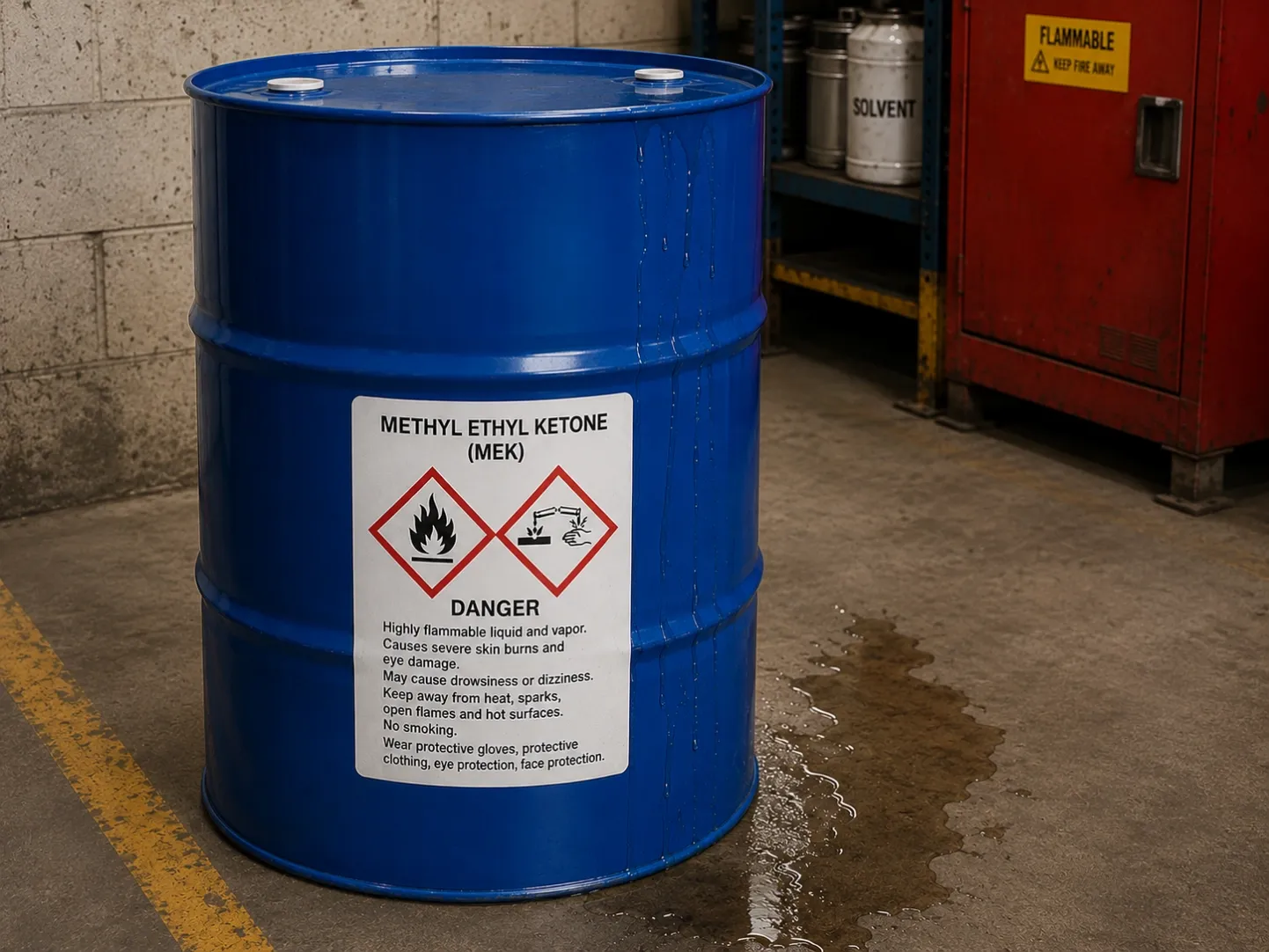
Workers would apply the labels fresh from the printer. The labels looked perfect. Then the drums would sit in the warehouse for a few days. Someone would wipe a drum with a solvent-soaked rag. The label would smear. The barcode would become unreadable. The pictograms would fade.
The plant's safety manager described the problem simply: "We were printing GHS labels that looked correct on paper, but they could not survive our actual environment. A label that smears after one solvent wipe is not a compliant label. It is a liability."
The Specific Problems the Plant Faced
- 🧪 GHS labels smeared after solvent contact – Acetone and toluene wiped the print right off.
- 📄 Product identifiers became unreadable – Workers could not tell which drum was which.
- 📦 Labels lifted from HDPE drums – The adhesive could not bond to the plastic surface.
- 💧 Moisture entered beneath label edges – Condensation caused edge lift and curling.
- 📋 Different departments used inconsistent formats – No centralized artwork control.
- 📅 Old labels did not match updated SDS classifications – Chemical classifications had changed.
- ⚠️ Workers could not quickly identify hazards – Unreadable labels created safety risks.
Why This Was More Than a Cosmetic Issue
Chemical-label failure is not merely a cosmetic issue. Under OSHA's Hazard Communication Standard, shipped-container labels must include the product identifier, signal word, hazard statements, pictograms, precautionary statements, and responsible-party information. If any of these elements becomes unreadable, the label may no longer communicate the required hazard information.
As one industry expert explains, "A label that smears after one solvent wipe is not a compliant label. It is a liability. The information must remain legible and attached throughout storage, handling, transport, and foreseeable exposure."
The plant had a choice: keep relabeling drums (wasting time and money) or find a labeling solution that actually worked.
Why GHS Compliance Required More Than Printing a Label 📋
The plant quickly learned that GHS compliance has two separate requirements:
1. Correct content – The label must accurately reflect the chemical classification and match the SDS.
2. Durable performance – The information must remain legible and attached during storage, handling, transport, and foreseeable exposure.
A label can contain all six required elements and still fail operationally if:
- The ink dissolves in acetone.
- The label adhesive releases from an oily drum.
- The film cracks in outdoor storage.
- The barcode becomes unreadable.
- The label curls after exposure to moisture.
- The pictograms fade or lose contrast.
This is the central lesson of the case study: GHS compliance is both a regulatory-content problem AND a materials-engineering problem.
What the Six Required Elements Are
Required Element | Purpose |
|---|---|
Product identifier | Connects the container to the correct SDS |
Signal word | Shows relative severity: "Danger" or "Warning" |
Hazard statement(s) | Describes the nature and degree of the hazard |
Pictogram(s) | Gives a standardized visual warning |
Precautionary statement(s) | Explains prevention, response, storage, and disposal actions |
Supplier identification | Lists the responsible party's name, address, and telephone number |
Only one signal word should appear on the label. If both signal words would otherwise apply, "Danger" takes precedence over "Warning". The label must also match the current SDS exactly enough that workers, inspectors, emergency responders, and customers can connect the label to the correct hazard information.
What Changed Under OSHA's 2024 HazCom Update 📅
The plant's timing was critical. In May 2024, OSHA published changes to the Hazard Communication Standard to align U.S. requirements primarily with GHS Revision 7. Then, in January 2026, OSHA extended the compliance deadlines by four months.
The current compliance schedule is:
Organization | Substance Deadline | Mixture Deadline |
|---|---|---|
Manufacturers, importers, and distributors | May 19, 2026 | November 19, 2027 |
Employers updating workplace programs and training | November 20, 2026 | May 19, 2028 |
The update affects classification, labels, SDS information, small containers, and workplace communication. The plant realized they needed to act fast. They had to update their labels for pure substances by May 2026. That gave them only a few months to audit everything, fix the problems, and implement a new labeling system.
Why This Mattered for the Plant
The plant had hundreds of different chemicals. Each one needed an updated label. Each label needed to match the new SDS. And each label needed to survive the plant's harsh environment.
The plant's safety manager put it bluntly: "We did not have time to relabel drums every week. We needed a solution that would pass an audit on day one and still be readable a year later."
How the Plant Audited Its Existing Labels 🔍
The plant started with a full audit. They did not guess. They did not assume. They checked everything.
The 10-Step Audit Process
Step 1: List every hazardous chemical and product identifier.
The plant created a complete inventory of every chemical in every container.
Step 2: Collect the latest SDS for each chemical.
They pulled the current SDS for every product and made sure they had the latest revision.
Step 3: Compare each label with SDS Section 2.
They checked every label against the hazard identification section of the SDS.
Step 4: Verify pictograms, signal word, hazard statements, and precautionary statements.
They made sure each label had the correct visual elements and text.
Step 5: Check supplier information and emergency contact details.
They verified that the responsible party information was accurate and up to date.
Step 6: Photograph labels before and after use.
They documented how labels looked when new and how they looked after exposure.
Step 7: Record label material, adhesive, printer, ribbon, and application surface.
They tracked every variable that could affect label performance.
Step 8: Identify exposure to acetone, MEK, toluene, xylene, acids, alkalis, oils, UV, heat, and moisture.
They mapped exactly what each label would face in the real world.
Step 9: Rank labels by risk and replacement priority.
They prioritized the highest-risk labels first.
Step 10: Create controlled label artwork and revision history.
They established a system for managing label changes.
The Label Master File
The plant created a label master file containing:
- Approved artwork
- SDS revision
- Product code
- Label material
- Adhesive
- Ribbon or ink specification
- Printer settings
- Test results
- Approval date
- Change-control history
This file became the single source of truth for every label in the plant.
Why Standard Paper Labels Failed 📄
The audit revealed a hard truth: standard paper labels were failing across the board.
How Solvents Destroy Paper Labels
Solvent exposure can cause:
- 🖊️ Ink bleeding – The print dissolves and spreads.
- 🧪 Coating dissolution – The label surface breaks down.
- 💧 Paper weakening – The material loses strength.
- 🔄 Tearing – Labels rip during handling.
- 📐 Curling – Edges lift and curl up.
- 💦 Moisture absorption – Labels absorb water and swell.
- 🧲 Adhesive edge lift – The adhesive releases from the surface.
- 📊 Loss of barcode contrast – Scanners cannot read the codes.
Paper labels may be adequate for clean, dry, indoor environments. But a chemical plant is not a clean, dry, indoor environment. Solvents, spills, wipe-downs, and humidity are part of daily operations.
The Plant's Experience with Paper
The plant's maintenance supervisor recalled: "We were replacing labels on drums every few weeks. Some labels would smear the same day they were applied. The workers stopped trusting the labels. They would open drums to check what was inside instead of reading the label. That is a safety nightmare."
The plant concluded that paper labels were not suitable for their solvent-heavy environment. They needed synthetic labels.
Why PET or Polyimide Labels Were Selected 🏷️
After testing multiple options, the plant selected two primary materials:
PET Labels for Most Applications
PET (polyester) labels were chosen for:
- Chemical drums and industrial containers
- Outdoor equipment
- Long-term barcode identification
- Water, oil, and abrasion exposure
As FuYue Labels' chemical-resistant labels demonstrate, PET with a proprietary solvent-resistant coating withstands aggressive chemicals including acetone, toluene, MEK, xylene, and ethyl acetate. The material maintains adhesion and legibility on chemical drums, laboratory bottles, and industrial containers – even after direct solvent exposure and repeated wipe-downs.
PET offers good dimensional stability and print durability. It is also more economical than polyimide for most chemical drum applications.
Polyimide Labels for Extreme Conditions
Polyimide was reserved for applications requiring:
- High processing temperatures
- Electronics manufacturing
- Reflow or soldering
- Extreme thermal cycling
- Aggressive solvents combined with heat
FuYue Labels' polyimide labels are engineered to survive lead‑free reflow soldering at 260°C+ with reliable barcode readability and adhesion through multiple thermal cycles. The polyimide film offers excellent chemical resistance to flux residues, cleaning solvents, and mild acids after soldering.
For ordinary chemical drums, PET was usually more economical. The plant reserved polyimide for applications that genuinely required its high-temperature performance.
The Plant's Decision
As the plant's procurement manager explained: "We chose PET for 90% of our drums. It handled the solvents, it stayed readable, and it cost less. We only used polyimide for the few products that went through high-temperature processes. Why pay more when you do not need it?"
Why the Adhesive Was as Important as the Film 🧲
The plant learned a crucial lesson: the adhesive is just as important as the film.
The Adhesive Questions the Plant Asked
- Will the label bond to HDPE or PP?
- Is the drum oily or dusty?
- Is the surface curved or textured?
- Will the container be stored outdoors?
- Is application performed below 0°C?
- Will the label encounter condensation?
- Must the label remain attached for years?
- Is clean removal required?
The Challenge of Low-Surface-Energy Plastics
Low-surface-energy plastics such as HDPE and PP are among the most difficult label substrates. Ordinary adhesives may not wet the surface sufficiently. The plant's original labels failed because the adhesive could not bond to the HDPE drums.
The Solution: High-Performance Acrylic Adhesive
The plant switched to a high-performance solvent-resistant acrylic adhesive. FuYue Labels' chemical-resistant labels use a modified acrylic adhesive that bonds to low‑surface‑energy plastics (HDPE, PP), metal, glass, and painted surfaces, even with light oil or moisture.
As one industry expert explains, "The adhesive is often the weakest link. You can have the best facestock in the world, but if the adhesive fails, the label fails. For chemical drums, you need an adhesive that bonds to HDPE and resists solvents. That is not standard. That is specialty."
The Results
- Labels stayed attached to HDPE drums.
- No edge lifting after solvent wipe-downs.
- Labels survived outdoor storage.
- No adhesive failure during transport.
Why the Plant Changed Its Printing System 🖨️
The plant also discovered that their printing system was part of the problem. They were using wax ribbons on PET labels. The wax could not withstand solvent exposure.
Why Resin Ribbon Was the Answer
For harsh chemical environments, thermal-transfer printing with a resin ribbon is essential.
Compared with basic wax printing, resin printing offers better resistance to:
- 🧪 Solvents
- 🔥 Abrasion
- 🌡️ Heat
- 💧 Water
- 🧹 Chemical wiping
- ☀️ Outdoor exposure
FuYue Labels' resin thermal transfer ribbons are engineered for synthetic labels (PET, PI, PP, PE) requiring superior resistance to heat, chemicals, and abrasion. The resin ribbon imprint resists fading, smudging, and chemical attack – barcodes stay scannable.
The Validation Checklist
The plant validated:
- Printer model (Zebra ZT series)
- Printhead resolution (300 dpi)
- Print speed (2–4 inches per second)
- Darkness setting (25–30%)
- Ribbon chemistry (premium resin)
- Label topcoat (solvent-resistant coating)
- Barcode scanner performance (100% scan rate)
The Critical Warning
FuYue Labels' chemical-resistant labels specify: Resin ribbon (high‑energy) – Mandatory. Wax/resin ribbons will smear or wipe off under solvent exposure.
The plant's production manager noted: "We tried wax/resin ribbons to save money. They failed within days. We switched to resin ribbons and the problem disappeared. You cannot cut corners on the ribbon. It is as important as the label itself."
How the Plant Tested Solvent Resistance 🧪
The plant did not assume the labels would work. They tested them. Rigorously.
The Test Matrix
Test Variable | Example Condition |
|---|---|
Solvent | Acetone, MEK, toluene, xylene |
Contact method | Wipe, splash, immersion |
Concentration | Actual operating concentration |
Temperature | Ambient |
Contact duration | 10 seconds, 1 minute, 24 hours |
Mechanical action | Light wipe, defined rubbing pressure |
Evaluation | Print legibility, barcode scan, edge lift |
Pass criteria | No critical text loss, readable barcode |
The Before-and-After Results
Performance Measure | Original Label | Solvent-Resistant Label |
|---|---|---|
Legible after acetone wipe | No | Yes |
Legible after toluene wipe | Partial | Yes |
Barcode scan success | Inconsistent | 100% in internal test |
Edge lifting after chemical exposure | Visible | None observed |
Label replacement frequency | Baseline | Reduced by ~80% |
Audit findings related to labels | Open findings | Closed after verification |
The plant's quality manager reported: "We tested the new labels against acetone, MEK, toluene, and xylene. The old labels failed every test. The new labels passed every test. The difference was night and day."
How the Plant Verified the GHS Artwork 🎨
The plant also reviewed every piece of artwork. They could not afford mistakes.
The Artwork Review Checklist
- ✅ Correct product identifier
- ✅ Exact signal word
- ✅ Correct pictograms (black symbols on white backgrounds inside red-bordered diamonds)
- ✅ Matching hazard statements
- ✅ Matching precautionary statements
- ✅ Supplier name, address, and telephone number
- ✅ Adequate print size and contrast
- ✅ No missing or distorted pictograms
- ✅ Correct language for the destination market
- ✅ Correct batch or product code where required
- ✅ Clear connection to the current SDS revision
GHS pictograms use black symbols on white backgrounds inside red-bordered diamonds. The pictogram must remain visible and legible on the actual container, not merely on a computer proof.
The Result
The plant created a controlled artwork system. Every label was approved by the safety manager, the quality manager, and the production manager. Changes required formal approval and revision history.
How the Plant Handled Small Containers 🧴
Small containers created a space problem. How do you fit all six required elements on a tiny bottle?
OSHA's Limited-Label Options
Under current 2026 guidance:
- Containers up to 100 mL may use an abbreviated label when a full label is not feasible.
- Containers up to 3 mL may, under specified conditions, display only the product identifier if a full label would interfere with normal use.
- The outer package must carry the full required hazard information.
- The small-container rules do not eliminate the need for correct identification and safe handling.
The Plant's Documentation
The plant documented:
- Which containers qualified for abbreviated labels
- Why a full label was impractical
- Where the full information was located
- How workers accessed the SDS or outer-package label
- How the abbreviated label was controlled
The Result
Small containers had compliant labels. Workers knew where to find the full hazard information. The plant passed inspection.
How the Plant Managed Workplace or Secondary Containers 🏗️
Workplace containers are subject to different requirements from shipped containers. But they still must not create confusion or leave workers unaware of chemical hazards.
The Plant's Rules
The plant established clear rules for:
- Decanted solvents
- Spray bottles
- Transfer containers
- Blending tanks
- Waste drums
- Temporary containers
- Maintenance bottles
- In-process containers
The Practical Policy
The plant's policy was simple: Prohibit unidentified containers. Label immediately after transfer.
Every secondary container had to include:
- The product identifier matching the SDS
- The hazard information required by the plant's written HazCom program
- Clear, legible text
The Result
No more unidentified containers. No more guessing. Workers could identify every chemical at a glance.
How the Plant Passed the Audit ✅
The plant did not pass compliance simply because they purchased a stronger label. They passed because they combined multiple elements into a complete system.
The Evidence the Plant Prepared
- 📋 Controlled GHS label templates
- 📄 Current SDS library
- 🔗 Label-to-SDS cross-reference
- 🧪 Solvent-resistance test reports
- 🖨️ Printer and ribbon specifications
- 📚 Operator training records
- 📝 Workplace-labeling procedures
- ✅ Container inspection checklist
- 🔧 Corrective-action records
- 🏷️ Sample labels retained by lot
- 📦 Approved supplier documentation
The Seven Keys to Success
The plant passed because it combined:
- Correct hazard classification – Every chemical was properly classified.
- Accurate label artwork – Every label matched the SDS exactly.
- Durable label construction – Solvent-resistant PET + resin ribbon + acrylic adhesive.
- Documented testing – Every label was tested against actual solvents.
- Controlled printing – Printer settings and ribbons were standardized.
- Employee training – Workers knew how to apply and maintain labels.
- Ongoing inspection and change management – Labels were inspected regularly.
The Audit Result
The plant passed with zero label-related findings. The OSHA inspector commented that the plant had one of the most organized labeling systems they had ever seen.
The plant's safety manager reflected: "We went from failing audits to passing with flying colors. The difference was not just the labels. It was the system behind the labels. We documented everything. We tested everything. We trained everyone. That is what compliance really looks like."
Quick Answers to Common GHS Label Questions ❓
What are the six required elements of a GHS label?
The six elements are the product identifier, signal word, hazard statements, pictograms, precautionary statements, and supplier identification.
Does GHS require a specific label material?
No. GHS specifies hazard communication content and presentation, not one universal adhesive or facestock. The material must be durable enough to keep the required information legible and attached under expected conditions.
Are solvent-resistant labels required by OSHA?
OSHA does not prescribe a product named "solvent-resistant label." However, if solvent exposure causes required GHS information to smear, fade, or detach, the plant may fail to communicate hazards adequately.
What is the best material for chemical labels?
PET or another durable synthetic film is often the best starting point for chemical containers. The final choice depends on solvent, temperature, container plastic, outdoor exposure, adhesive, and expected service life.
Can paper labels be used on chemical drums?
They can be used only when the complete construction remains legible and attached under the actual conditions. For solvent, moisture, abrasion, or outdoor exposure, synthetic labels are usually a safer option.
What ribbon should be used for chemical-resistant labels?
A resin thermal-transfer ribbon is generally preferred for solvent and abrasion resistance. The ribbon must be compatible with the label's printable coating and the printer settings.
Can a GHS label be printed in black and white?
GHS pictograms must use the prescribed visual format, including the red-bordered diamond under OSHA requirements. Other label text may generally use black text, but the label must remain clear, legible, and compliant with the applicable jurisdiction.
Does a chemical label need a red diamond?
Required GHS pictograms use a red diamond border with a black symbol on a white background. The applicable hazard classification determines which pictograms are required.
What is the difference between a GHS label and an SDS?
A GHS label communicates essential hazard information directly on the container. An SDS provides more detailed information, including composition, first aid, firefighting, handling, exposure controls, disposal, and transport information.
Do secondary containers need GHS labels?
Workplace containers must be identified and covered by the employer's HazCom program. The exact requirements depend on how the container is used and the applicable OSHA provisions.
What happens if a chemical label becomes unreadable?
The container should be removed from normal use or relabeled immediately after verifying the product identity and current SDS. Continuing to use an unidentified or unreadable hazardous chemical container creates a serious hazard-communication gap.
How long do chemical labels last?
Service life depends on the film, adhesive, print system, solvent, temperature, UV exposure, and handling. A well-qualified synthetic label may last for years, but the supplier should provide application-specific test results.
Are GHS labels required on small containers?
Yes, although OSHA permits limited-label options for certain small containers when a full label is not feasible. The specific conditions must be documented, and full hazard information must remain available on the outer package.
Can GHS labels be handwritten?
A workplace container may be labeled using an approved alternative method where permitted, but the information must be clear, accurate, and immediately understandable to employees. Handwriting is risky when it is illegible, incomplete, inconsistent, or vulnerable to solvent wiping.
How often should chemical labels be inspected?
Inspect labels during receiving, production, storage-area rounds, container transfers, and after spills or chemical exposure. A risk-based schedule can be supplemented by monthly or quarterly formal audits.
The Bottom Line – Compliance Is a System, Not a Sticker 💪
A chemical plant does not achieve GHS compliance by printing hazard symbols alone. It must ensure that every label contains the correct information, matches the current SDS, remains attached to the container, and stays readable after contact with the plant's actual solvents and handling conditions.
The Three Key Takeaways 📌
1. Correct content is only half the battle.
Your label must have the right product identifier, signal word, hazard statements, pictograms, precautionary statements, and supplier information. But that is just the starting point.
2. Durable materials are non-negotiable.
If your label smears, fades, or falls off, it is not compliant. Solvent-resistant PET labels + resin ribbons + high-performance acrylic adhesives are the proven solution for chemical drums.
3. Documentation and testing are just as important as the label itself.
You need controlled artwork, SDS cross-references, test reports, printer specifications, training records, and inspection checklists. The plant passed because they built a system, not just a label.
Why FuYue Labels? 🏭
At FuYue Labels, we have been manufacturing industrial labels since 2016. We understand that labels are not just sticky paper – they are critical safety and traceability tools.
What we offer:
- 🔹 Chemical-resistant labels – Engineered to withstand acetone, toluene, MEK, xylene, and ethyl acetate with permanent solvent-resistant acrylic adhesive
- 🔹 White PET labels – Oil and scratch resistant for general industrial use, electronics, logistics, and laboratory equipment
- 🔹 Polyimide labels – Survive 260°C+ reflow soldering with excellent chemical resistance
- 🔹 Resin thermal transfer ribbons – Extreme durability for synthetic labels requiring superior resistance to heat, chemicals, and abrasion
- 🔹 PP synthetic labels – Tear-resistant, waterproof, and eco‑friendly for chemical drums and food packaging
What makes us different:
- ✅ Matched label-and-ribbon solutions – the ribbon is as important as the label
- ✅ Low-volume orders – no need to buy 10,000 just to test
- ✅ Free samples – test before you commit
- ✅ Custom die-cutting – any shape, any size
- ✅ Printer compatibility support – we check before we ship
Still Not Sure? 🧐
Do not guess. Do not hope. Test.
Reach out to us. Tell us about your chemicals, your drums, your temperatures, and your environment. We will help you select the right label construction. Then, we will send you samples to run through your actual production line.
Ready to pass your next GHS audit with confidence?
Contact us today for a free consultation and sample kit. Let us find the perfect solvent-resistant labeling solution for your chemical plant.
External Link Ideas & Resources (For further reading):
- OSHA Hazard Communication Standard – Official OSHA HazCom information, including the 2024 updates and compliance deadlines.
- OSHA 2024 HazCom Update Fact Sheet – Details on the alignment with GHS Revision 7 and extended compliance dates.
- GHS Pictogram Quick Card – OSHA Quick Card on the nine GHS pictograms.
- UN GHS Official Website – United Nations Globally Harmonized System of Classification and Labelling of Chemicals.
- ASTM D3330 – Peel Adhesion Test Standard – Standard test method for measuring peel adhesion of pressure-sensitive tape.