Sep 10, 2026Guides
Outdoor Label Weather Resistance Testing – UV, Salt Spray, and Humidity Explained
Outdoor labels must survive sun, rain, salt, and temperature swings. Learn how UV, salt spray, and humidity tests work and how to choose labels that last for years.
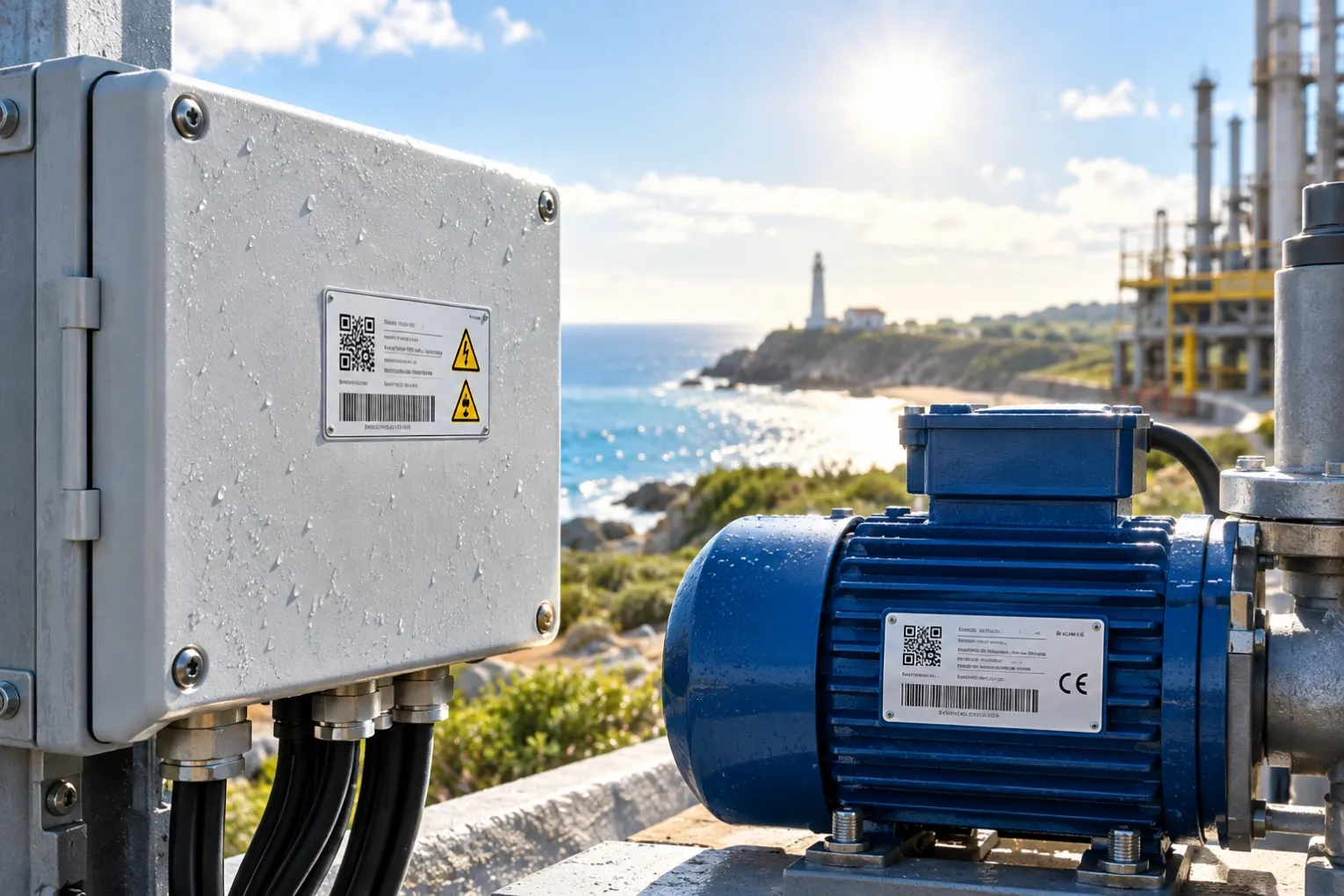
☀️ You apply a label to outdoor equipment, a shipping container, a solar panel, or a marine vessel. Six months later, the label has faded, curled, or fallen off entirely. The barcode is unreadable. The asset is untraceable.
This is not bad luck. It is a failure to match the label to its environment.
Outdoor labels face a combination of threats that indoor labels never encounter: ultraviolet radiation, salt spray, humidity, temperature cycling, and abrasion. To select a label that lasts, you need to understand how these threats are tested – and what the results actually mean.
In this guide, I will explain the three most important weather resistance tests for outdoor labels: UV exposure, salt spray, and humidity. By the end, you will know how to read test data and choose labels that survive years outdoors.
1. Why Outdoor Labels Fail – The Four Threats 🌦️
Before diving into the tests, it helps to understand what actually destroys outdoor labels:
Threat | What It Does | Typical Failure |
|---|---|---|
UV radiation | Breaks down polymer chains in facestock and adhesive | Fading, yellowing, embrittlement, cracking |
Salt spray | Accelerates corrosion and adhesive degradation | Edge lifting, adhesive failure, metal corrosion beneath |
Humidity | Penetrates facestock and adhesive layer | Wrinkling, delamination, mold growth |
Temperature cycling | Causes expansion and contraction mismatch | Curling, edge lifting, adhesive failure |
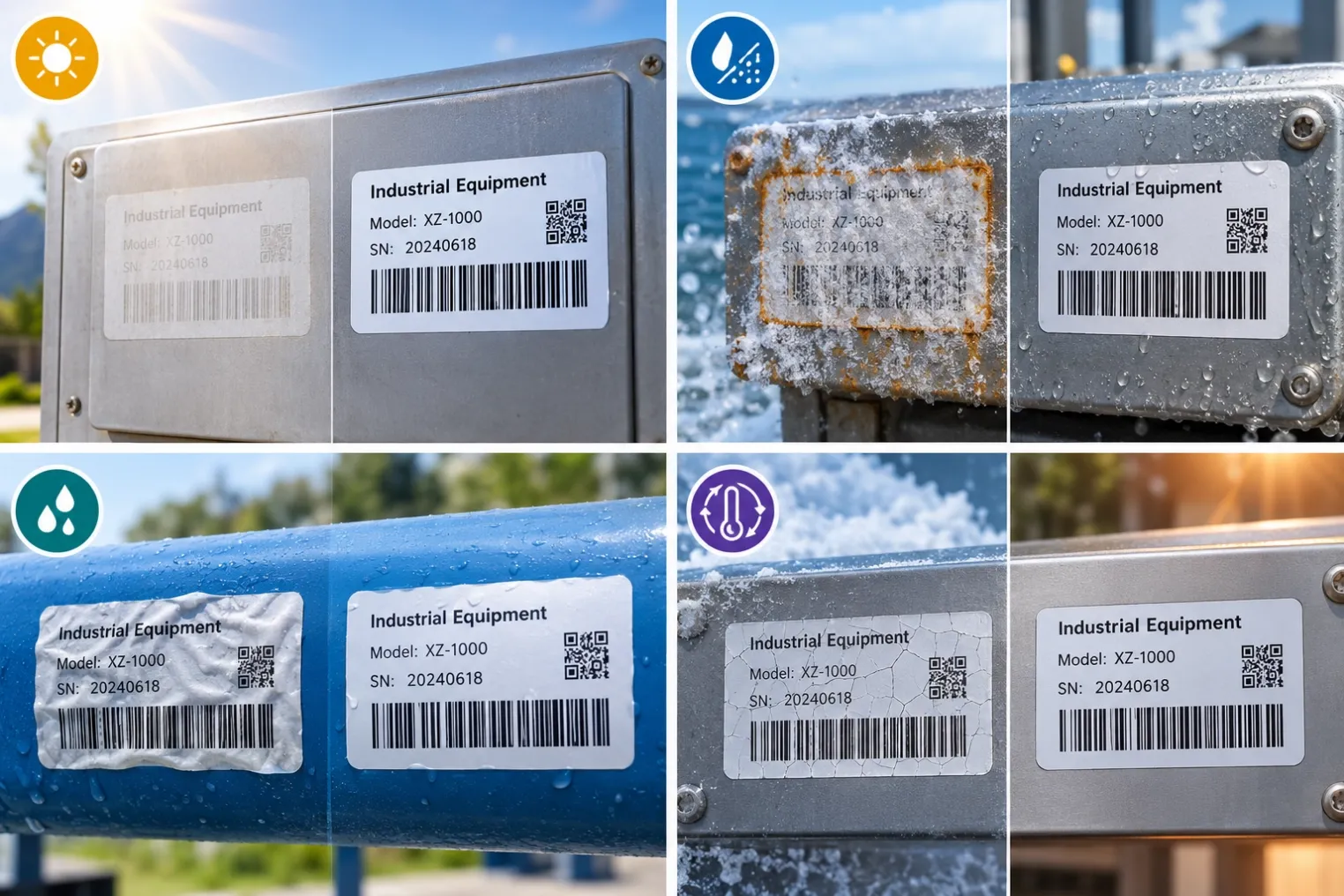
Most outdoor label failures are caused by a combination of these threats – not just one. A label that resists UV may still fail in salt spray. A label that resists humidity may crack when temperatures cycle.
💡 Key insight: There is no "outdoor label" that works everywhere. You must match the label to the specific combination of threats in your environment.
2. UV Resistance Testing – How Sunlight Destroys Labels ☀️
What UV Radiation Does
Ultraviolet radiation from sunlight carries enough energy to break chemical bonds in polymers. Over time, this causes:
- Facestock degradation – the label material becomes brittle, yellows, or cracks
- Adhesive breakdown – the adhesive loses tack or becomes hard
- Ink fading – printed text and barcodes fade or become unreadable
- Colour shift – white labels turn yellow; coloured labels fade
How UV Testing Works
The most common UV test methods are:
Test Method | Description | Typical Duration |
|---|---|---|
QUV Accelerated Weathering | Alternating cycles of UV light and condensation | 500–2000 hours |
Xenon Arc | Full-spectrum simulated sunlight | 500–2000 hours |
ASTM G154 | Standard practice for fluorescent UV exposure | Variable |
ASTM G155 | Standard practice for xenon arc exposure | Variable |
Interpreting UV Test Results
UV test results are usually expressed as hours of exposure or as a percentage of property retention.
Exposure Hours | Equivalent Outdoor Time | Typical Result |
|---|---|---|
500 hours | ~1–2 years outdoor | Passes for short-term outdoor use |
1000 hours | ~2–3 years outdoor | Good for general outdoor applications |
2000 hours | ~5+ years outdoor | Excellent for long-term outdoor use |
What to look for:
- ΔE colour change – a value under 3 is considered negligible fading
- Adhesive peel strength retention – should remain above 80% of original
- No cracking or embrittlement – the facestock must remain flexible
Materials That Resist UV Best
Material | UV Resistance | Notes |
|---|---|---|
Standard PET | Moderate | UV-stabilised grades available |
PP synthetic | Good | Excellent for outdoor cartons |
Acrylic adhesive | Good | Better UV resistance than rubber |
Paper | Poor | Not suitable for outdoor use |
For outdoor labels that need UV resistance, our White PET Label is available in UV-stabilised formulations.
3. Salt Spray Testing – Surviving Coastal and Marine Environments 🌊
What Salt Spray Does
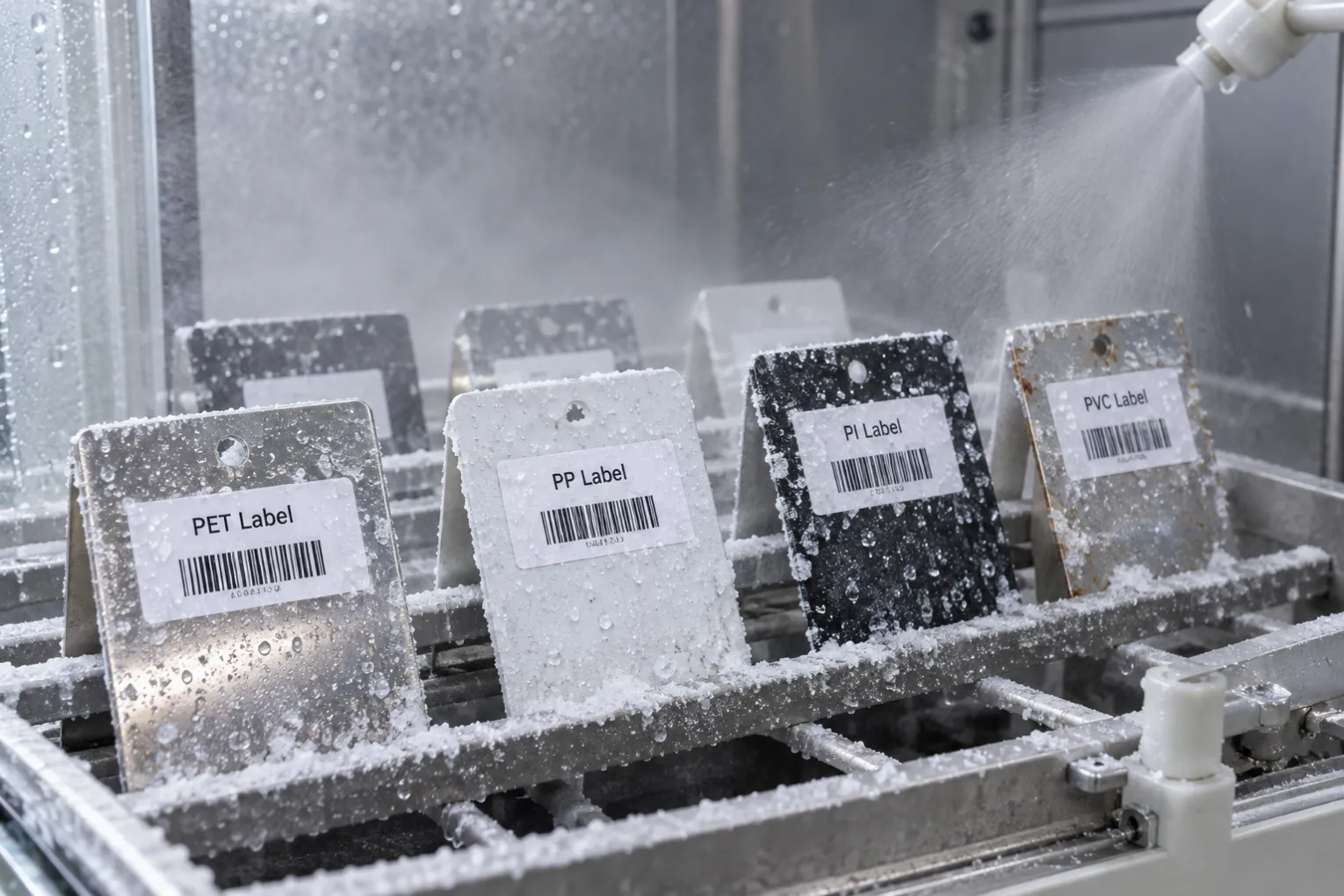
Salt spray – whether from ocean air, road de-icing, or industrial processes – attacks labels in two ways:
- Chemically – salt accelerates corrosion of metal surfaces beneath the label
- Physically – salt crystals penetrate the adhesive layer and edge, causing lifting
How Salt Spray Testing Works
Test Method | Description | Typical Duration |
|---|---|---|
ASTM B117 | Continuous salt spray (5% NaCl solution) | 24–1000 hours |
ISO 9227 | Neutral salt spray test | 24–1000 hours |
ASTM G85 | Modified salt spray (acidified, cyclic) | Variable |
Interpreting Salt Spray Results
Salt spray results are expressed as hours of exposure before failure.
Exposure Hours | Typical Environment | Result |
|---|---|---|
24–96 hours | Inland, occasional exposure | Adequate for sheltered outdoor use |
168–500 hours | Coastal, moderate exposure | Good for coastal outdoor use |
500–1000+ hours | Marine, offshore, severe exposure | Required for marine and offshore |
What to look for:
- No edge lifting – the label must remain fully adhered
- No blistering – salt must not penetrate the adhesive
- No corrosion beneath the label – the substrate must be protected
- Barcode remains readable – print must not fade or smear
Materials That Resist Salt Spray Best
Material | Salt Spray Resistance | Notes |
|---|---|---|
PET | Excellent | Best choice for marine applications |
PP synthetic | Good | Suitable for coastal environments |
Paper | Poor | Fails quickly in salt spray |
PVC | Moderate | Can be used but not ideal for marine |
For marine and offshore applications, PET labels with a permanent acrylic adhesive are the standard choice.
4. Humidity Testing – Surviving Moisture and Condensation 💧
What Humidity Does
Moisture is the most common cause of outdoor label failure. High humidity causes:
- Facestock swelling – paper absorbs water and wrinkles
- Adhesive dilution – moisture weakens the adhesive bond
- Delamination – the label separates from the substrate
- Mold and mildew – organic materials degrade
How Humidity Testing Works
Test Method | Description | Typical Conditions |
|---|---|---|
Constant humidity | Exposure to fixed temperature and humidity | 40°C, 90% RH for 7–30 days |
Cyclic humidity | Alternating high and low humidity | Variable |
Water immersion | Direct immersion in water | 24–168 hours |
ASTM D2247 | Testing coatings at 100% relative humidity | Variable |
Interpreting Humidity Results
Test Condition | Typical Environment | Result |
|---|---|---|
40°C / 90% RH, 7 days | Humid indoor | Adequate for most indoor use |
40°C / 90% RH, 30 days | Tropical outdoor | Good for humid outdoor environments |
Water immersion, 24 hours | Rain, splash, wash-down | Required for wash-down applications |
Water immersion, 168 hours | Marine, continuous exposure | Required for marine and offshore |
What to look for:
- No wrinkling – the facestock must not absorb water
- No edge lifting – the adhesive must maintain bond strength
- No delamination – the label must remain fully intact
- No mold growth – the material must be non-organic
Materials That Resist Humidity Best
Material | Humidity Resistance | Notes |
|---|---|---|
PET | Excellent | Non-absorbent, waterproof |
PP synthetic | Excellent | 100% waterproof |
PVC | Good | Waterproof but less durable |
Paper | Poor | Absorbs water and fails |
For humid and wet environments, both PET and PP synthetic labels are excellent choices. See our PP Synthetic Paper Label for a recyclable, waterproof option.
5. Combined Weathering – The Real-World Test 🌍
In reality, outdoor labels face all three threats simultaneously – plus temperature cycling and abrasion. For this reason, some tests combine multiple stressors.
Cyclic Corrosion Testing
Cyclic corrosion tests alternate between:
- Salt spray
- Dry periods
- Humidity periods
- Temperature changes
This better simulates real-world conditions than a single continuous test.
Accelerated Aging
Accelerated aging tests (such as ASTM F1980) use elevated temperatures to simulate years of outdoor exposure in a shorter time. Results are used to estimate shelf life and service life.
What to Ask Your Supplier
When evaluating outdoor labels, ask:
- "What UV exposure test data do you have?"
- "Has this label passed salt spray testing (ASTM B117)? For how many hours?"
- "What is the humidity resistance? Any water immersion test data?"
- "Is the adhesive rated for outdoor use?"
- "Do you have real-world field data from similar applications?"
A reputable supplier should be able to provide this data. For technical documentation on our labels, see our guide to reading TDS and MSDS.
6. Choosing Outdoor Labels – A Practical Decision Guide 🎯
Step 1: Define Your Environment
Environment | Key Threats | Recommended Label |
|---|---|---|
Inland, sheltered | UV, moderate humidity | White PET with UV-stabilised adhesive |
Coastal | UV, salt spray, humidity | PET with permanent acrylic adhesive |
Marine / offshore | UV, salt spray, immersion | PET with high-performance adhesive |
Industrial outdoor | UV, chemicals, abrasion | Chemical-resistant PET or PP |
Cold climate | UV, temperature cycling, moisture | Cryo-grade PET or PP |
Hot climate | UV, heat, humidity | UV-stabilised PET or PP |
Step 2: Choose the Right Material
Material | Best For | Avoid In |
|---|---|---|
PET | General outdoor, marine, industrial | Extreme cold (below -40°C) |
PP synthetic | Eco-friendly outdoor, food packaging | High heat (>80°C) |
PVC | Flexible outdoor, cable marking | EU/California (restricted) |
Paper | Indoor only | Any outdoor use |
Step 3: Choose the Right Adhesive
Adhesive | Outdoor Suitability |
|---|---|
Standard acrylic | Good for moderate outdoor use |
High-performance acrylic | Excellent for marine and industrial |
Rubber-based | Poor UV resistance – not for outdoor |
Silicone | Excellent for extreme temperatures |
Step 4: Choose the Right Ribbon
For outdoor labels, the print must survive as long as the label. Use:
- Resin ribbon – for maximum UV and abrasion resistance
- Wax/resin ribbon – for moderate outdoor use
7. Common Mistakes When Selecting Outdoor Labels ❌
Mistake | Consequence |
|---|---|
Using paper labels outdoors | Fail within weeks from humidity and UV |
Using rubber-based adhesive outdoors | Adhesive degrades rapidly in UV |
Assuming all PET labels are UV-stable | Standard PET yellows and embrittles – specify UV-stabilised grade |
Ignoring salt spray in coastal areas | Edge lifting and adhesive failure within months |
Using wax ribbon for outdoor barcodes | Print fades and smears – barcodes unreadable |
Not testing in actual conditions | Lab results may not reflect real-world performance |
Always test a sample label in your actual environment before full deployment.
8. Summary & Next Steps 🎯
Outdoor labels face three primary threats: UV radiation, salt spray, and humidity. Each requires specific testing to validate performance.
UV testing measures resistance to sunlight – look for 1000+ hours for long-term outdoor use. Salt spray testing measures resistance to coastal and marine environments – look for 500+ hours for marine applications. Humidity testing measures resistance to moisture – look for 30 days at 40°C/90% RH for humid environments.
The best outdoor labels use PET or PP facestock with high-performance acrylic adhesive and resin ribbon printing. Paper and rubber-based adhesives should never be used outdoors.
Need labels that survive the outdoors? We offer UV-stabilised, salt-spray-tested, and humidity-resistant labels for every outdoor environment. Send us your application details – location, exposure conditions, and expected service life – and we will recommend the right label and send free samples for you to test.