Aug 27, 2026Guides
How to Read Technical Data Sheets (TDS) and Safety Data Sheets (MSDS) for Industrial Labels and Ribbons
Technical Data Sheets and Safety Data Sheets contain critical information about label and ribbon performance. Learn how to read them and make better purchasing decisions.
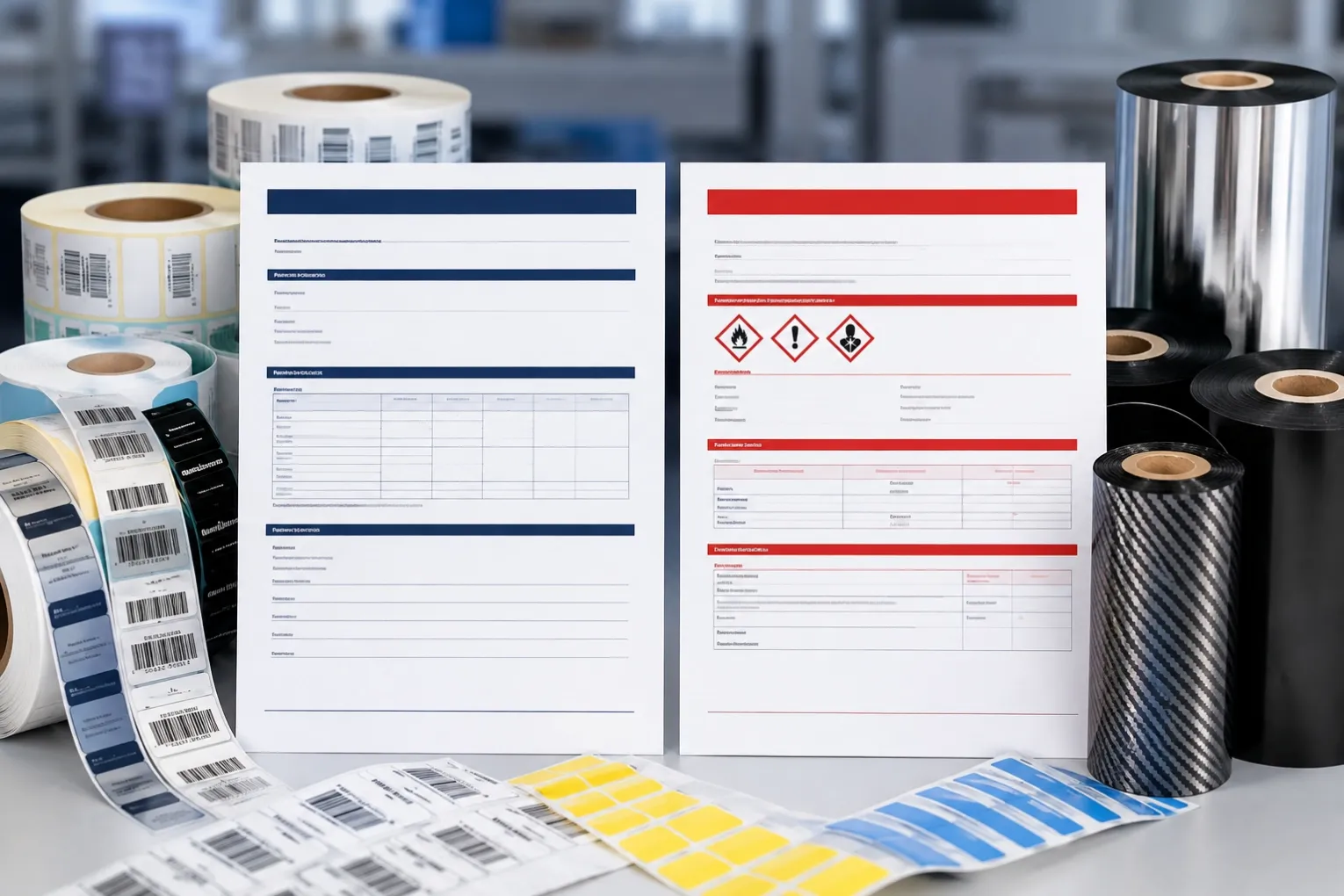
📄 You have received a sample of industrial labels or thermal transfer ribbons. The supplier sends you two documents: a Technical Data Sheet (TDS) and a Safety Data Sheet (SDS or MSDS) . You open them and see tables of numbers, chemical names, and testing standards. What do they all mean?
These documents are not just paperwork – they are essential tools for making informed purchasing decisions. The TDS tells you how the product performs. The SDS tells you how to handle it safely.
In this guide, I will explain what information is in each document, how to read the key sections, and how to use them to compare products and ensure compliance. For a complete overview of our product range, see our full product collection.
1. What Is a Technical Data Sheet (TDS)? 📋
A Technical Data Sheet (TDS) – also called a Product Data Sheet – is a document that provides technical specifications and performance characteristics of a product. It is written for engineers, quality managers, and procurement professionals who need to evaluate whether a product will work for their application.
What You Will Find in a TDS
Section | What It Tells You |
|---|---|
Product description | What the product is and what it is designed for |
Physical properties | Thickness, colour, tensile strength, etc. |
Performance data | Temperature range, chemical resistance, adhesion values |
Testing standards | ASTM, ISO, or other test methods used |
Shelf life and storage | How long the product lasts and how to store it |
Application guidelines | Recommended printer settings, application temperature, etc. |
For detailed specifications on our synthetic labels, see the White PET Label TDS and the PP Synthetic Paper Label TDS.
2. How to Read a Label TDS – Key Parameters 🏷️
When you receive a TDS for an industrial label, focus on these critical parameters:
Temperature Range
This tells you the minimum and maximum temperatures the label can withstand.
Term | Meaning |
|---|---|
Service temperature | The temperature range where the label will perform reliably |
Application temperature | The minimum temperature at which the label should be applied |
Peak temperature | Short-term temperature the label can survive (e.g., reflow soldering) |
Example: A label rated for -40°C to +120°C can be used in a freezer and in a warm warehouse, but should be applied at room temperature for best adhesion.
Adhesion Values
Adhesion is measured in Newtons per 25mm (N/25mm) . Higher values mean stronger bonds.
Adhesion Type | What It Tests |
|---|---|
Initial tack | How sticky the label is immediately after application (measured at 20 minutes) |
Final adhesion | How sticky the label becomes after full cure (measured at 24 hours) |
Peel adhesion (90° or 180°) | How much force is needed to peel the label off a specific surface |
What to look for:
- Higher final adhesion values are better for permanent applications
- Lower values may be preferred for removable labels
Facestock and Adhesive Material
The TDS will specify the material composition:
- Facestock – PET, PI, PP, PVC, or paper
- Adhesive – Acrylic, rubber-based, or silicone-based
- Liner – Glassine, PET, or paper (affects how labels peel from the roll)
Chemical Resistance
Some TDS include chemical resistance data – often based on ASTM D5402 (solvent rub test).
The TDS may list:
- Which chemicals the label resists (e.g., water, oil, alcohol, acetone)
- How long it can be exposed (e.g., 24 hours immersion)
- Whether the label remains legible after contact
Testing Standards
Common standards you may see:
Standard | What It Tests |
|---|---|
ASTM D903 | Peel strength |
ASTM D3654 | Shear strength |
ASTM D5402 | Solvent resistance |
ASTM F1980 | Accelerated aging (shelf life) |
ANSI/ESD S20.20 | ESD compliance |
For a comparison of different label materials and their TDS parameters, see our PET vs PI vs PP comparison guide.
3. How to Read a Ribbon TDS – Key Parameters 🎗️
When you receive a TDS for a thermal transfer ribbon – such as our Resin Ribbon or Wax/Resin Ribbon – focus on these parameters:
Ribbon Type
The TDS will specify which printhead technology the ribbon is designed for:
- Flat-head (edge) printers – Standard ribbons (Wax, Wax/Resin, Resin)
- Near-edge printers (TTO) – Near-edge ribbons only
Important: Using the wrong ribbon type will result in poor print quality or no transfer at all. For TTO printers, see our Near-Edge Ribbon for TTO.
Print Density (OD – Optical Density)
Optical density measures how dark the print is. Higher OD values mean darker, more legible barcodes.
Value | Meaning |
|---|---|
>1.6 OD | Good for general purpose |
>1.8 OD | High density – suitable for fine barcodes and 2D codes |
>2.0 OD | Excellent contrast – ideal for small codes and high-speed scanning |
Recommended Printer Settings
The TDS typically recommends:
- Darkness (heat setting) – Usually 20–30% depending on ribbon type
- Print speed – IPS (inches per second) for optimal transfer
- Printhead pressure – If applicable
Always start with the recommended settings and adjust based on your specific printer and substrate.
Ribbon Width, Length, and Core
The TDS will specify available dimensions:
- Width – Standard widths (40mm, 50mm, 60mm, etc.)
- Length – 300m, 450m, 600m, etc.
- Core diameter – 1 inch or 0.5 inch
- Coating side – Outside or inside wound
Width guideline: The ribbon must be slightly wider than your label to protect the printhead.
Durability Performance
The TDS may include data on:
- Scratch resistance – How well the print withstands abrasion
- Smear resistance – Resistance to smudging (particularly with solvents)
- Heat resistance after printing – The maximum temperature the printed code can survive
For high-durability applications like chemical drum labels or outdoor use, choose our Chemical & Solvent Resistant Label.
4. What Is a Safety Data Sheet (SDS / MSDS)? 🧪
A Safety Data Sheet (SDS) – historically called a Material Safety Data Sheet (MSDS) – provides information about hazards, handling, and emergency measures for a chemical product. For labels and ribbons, the SDS covers:
- Adhesive chemicals – What is in the adhesive and whether it is hazardous
- Ink/coating chemicals – Materials used in the ribbon coating
- Storage requirements – How to store the product safely
- Disposal instructions – How to dispose of unused or waste material
An SDS is required by law in many countries (OSHA in the US, REACH in Europe, etc.) and must be provided by the supplier before or at the time of delivery.
How to Read an SDS – Key Sections
SDS documents follow a standard 16‑section format (according to GHS – Globally Harmonized System):
Section | Title | What It Tells You |
|---|---|---|
1 | Identification | Product name, supplier contact, recommended use |
2 | Hazard(s) identification | Classification, hazard pictograms, signal word (e.g., Warning or Danger) |
3 | Composition/information on ingredients | Chemical components and their concentrations |
4 | First-aid measures | What to do in case of exposure |
5 | Fire-fighting measures | Suitable extinguishing media, special hazards |
6 | Accidental release measures | How to clean up spills |
7 | Handling and storage | Safe handling practices and storage conditions |
8 | Exposure controls/personal protection | PPE recommendations (gloves, goggles, ventilation) |
9 | Physical and chemical properties | Appearance, pH, flash point, etc. |
10 | Stability and reactivity | How the material behaves under different conditions |
11 | Toxicological information | Health effects from exposure |
12 | Ecological information | Environmental impact |
13 | Disposal considerations | Safe disposal methods |
14 | Transport information | Shipping class and regulations |
15 | Regulatory information | Compliance with regulations (REACH, RoHS, etc.) |
16 | Other information | Revision date, additional notes |
What to Check on an SDS
- Section 2 – Is the product classified as hazardous? If so, what precautions are needed?
- Section 7 – Does the storage temperature align with your warehouse conditions?
- Section 8 – Do you need special PPE (gloves, ventilation) when using the product?
- Section 15 – Does the product comply with REACH, RoHS, and other regulations?
5. Using TDS and SDS Together – A Practical Example 🔗
Here is a step-by-step approach to using both documents when evaluating a product:
Step 1: Check the TDS for Performance
- Does the product meet your temperature requirements?
- Does it adhere to your substrate (metal, plastic, paper)?
- Does it have the chemical resistance you need?
Step 2: Check the TDS for Compatibility
- Will it work with your printer (ribbon) or applicator (labels)?
- What printer settings are recommended?
- What is the expected shelf life?
Step 3: Check the SDS for Safety and Compliance
- Is the product safe to handle in your work environment?
- Does it meet regulatory requirements (RoHS, REACH, etc.)?
- How should it be stored and disposed of?
Step 4: Compare Suppliers
Use the TDS and SDS to compare:
- Performance specifications – Which product has better temperature resistance or adhesion?
- Compliance – Which product has better regulatory documentation?
- Safety – Which product has fewer handling restrictions?
6. Common Mistakes When Reading TDS and SDS ❌
Mistake | Consequence |
|---|---|
Assuming all PET labels have the same temperature range | PET can be rated from -20°C to +120°C or higher depending on formulation |
Using a ribbon TDS for the wrong printer type | Poor print quality or no transfer at all |
Ignoring shelf life recommendations | Product may degrade and fail prematurely |
Not checking chemical compatibility | Label may dissolve or lose adhesion when exposed to workplace chemicals |
Assuming the SDS is “just paperwork” | Missing critical safety or compliance information |
Not verifying that the TDS matches the specific batch | Batch-to-batch variation can occur – always request batch-specific TDS for critical applications |
7. Summary & Next Steps 🎯
- TDS tells you how the product performs – temperature range, adhesion, chemical resistance, and printer compatibility.
- SDS tells you how to handle the product safely – hazards, PPE, storage, and disposal.
- Use both documents together to evaluate products, compare suppliers, and ensure regulatory compliance.
- Check Section 15 of the SDS for RoHS and REACH compliance – critical for electronics, medical, and automotive industries.
Need help reading a TDS or SDS? We provide full technical documentation for every product on our website. Contact us with your application requirements, and we can help you interpret the data and select the right product.