Aug 20, 2026Applications
How to Use RFID Labels for Automated Warehouse Cycle Counting
Manual warehouse counting takes days and is prone to errors. Learn how RFID labels enable automated cycle counting – cutting inventory time by 80% or more.
📦 You run a warehouse. Every quarter, you shut down operations for two days to conduct a manual inventory count. Staff walk the aisles with barcode scanners, scanning each item one by one. It's slow, expensive, and error‑prone. And the data is already outdated by the time you finish.
What if you could count your entire warehouse in hours – without stopping operations?
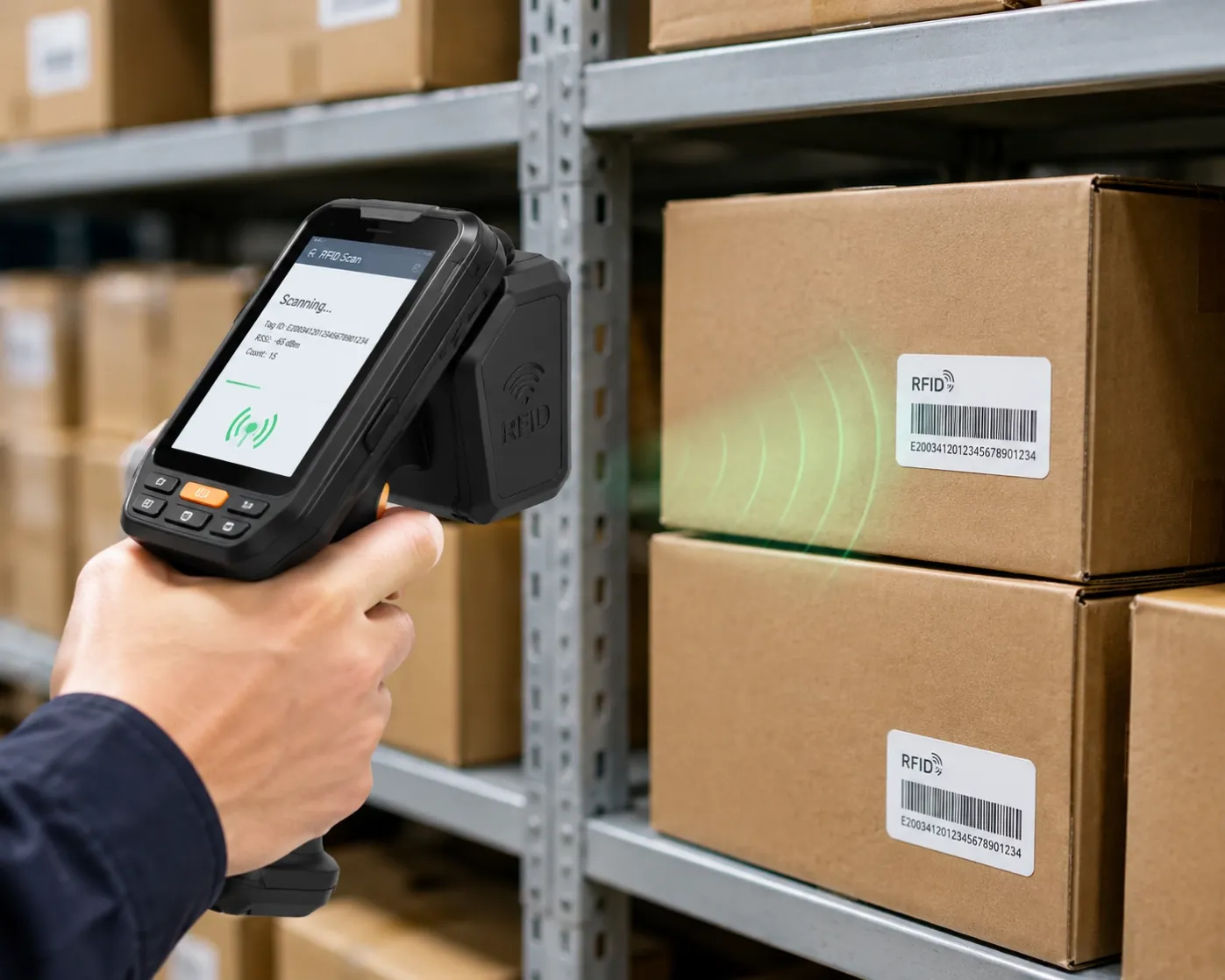
That’s exactly what RFID (Radio Frequency Identification) labels enable. Unlike barcodes, which require line‑of‑sight scanning of each individual item, RFID labels can be read in bulk, from a distance, without direct visibility.
In this guide, I’ll explain how RFID labels work for warehouse automation, walk through a step‑by‑step implementation plan, and share real‑world results from companies that have made the switch.
1. The Problem with Traditional Barcode Counting ❌
Most warehouses still rely on barcode‑based inventory management. Here’s why that’s a problem:
- ❌ Line‑of‑sight required – Every single barcode must be visible and scanned individually.
- ❌ Labour‑intensive – Counting thousands of items takes days or weeks.
- ❌ Error‑prone – Manual scanning leads to misreads, missed items, and data entry errors.
- ❌ Operations must stop – Many warehouses shut down during counts.
- ❌ Data is outdated – By the time the count is finished, inventory has already changed.
The cost: Up to 55% of warehouse operating costs can be attributed to picking and inventory labour. Traditional counting methods are simply not sustainable in today’s fast‑paced supply chain environment.
2. How RFID Labels Enable Automated Counting ✅
RFID labels contain a tiny microchip and antenna that can be read by an RFID reader without needing to be in the reader’s direct line of sight. Here’s how they transform warehouse counting:
Key Advantages Over Barcodes
Feature | Barcode | RFID Label |
|---|---|---|
Read method | Line‑of‑sight, one at a time | Non‑line‑of‑sight, hundreds at once |
Read speed | ~1–2 seconds per item | ~1,000 tags per second |
Labour required | High | Minimal |
Accuracy | ~97% (manual errors) | 99.9%+ |
Real‑time visibility | No | Yes |
How It Works in Practice
- Tag items – Attach UHF RFID labels to products, cartons, pallets, or reusable containers.
- Deploy readers – Install fixed readers at entry/exit points, conveyor belts, and dock doors.
- Automated scanning – As tagged items move through the warehouse, readers capture their data automatically.
- Real‑time updates – Inventory data syncs instantly with your Warehouse Management System (WMS).
The result: Inventory is counted continuously, not just once a quarter. You always know exactly what’s in your warehouse.
3. Implementation Guide – How to Get Started 🔧
Here’s a step‑by‑step approach to deploying RFID labels for automated cycle counting:
Step 1: Define Your Use Case and Scope
Not every item needs an RFID label. Start by identifying:
- High‑value items – Where accuracy matters most.
- Fast‑moving SKUs – Where inventory changes frequently.
- Reusable assets – Pallets, totes, containers that need tracking.
💡 Tip: Many warehouses start with a pilot on one product line or one aisle before scaling up.
Step 2: Choose the Right RFID Labels
Select labels based on:
- Frequency – UHF (860–960 MHz) is the standard for warehouse applications.
- Chip type – Impinj Monza or NXP UCODE series are common choices.
- Facestock – PET for durability, thermal paper for short‑term use.
- Adhesive – Permanent for long‑term assets, removable for reusable containers.
For metal surfaces, you will need on‑metal RFID labels (special inlay design).
Step 3: Deploy Readers and Antennas
Location | Reader Type | Purpose |
|---|---|---|
Receiving dock | Fixed portal reader | Auto‑register incoming goods |
Conveyor belts | Tunnel reader | Count items as they move |
Aisles / shelves | Handheld or mobile reader | Cycle counting and spot checks |
Shipping dock | Fixed portal reader | Verify outbound accuracy |
Step 4: Integrate with Your WMS / ERP
RFID data is only useful if it connects to your inventory system. Ensure:
- Tag reads automatically update stock levels.
- Missing items trigger alerts.
- Inventory data is visible in real‑time.
Step 5: Train Staff and Run a Pilot
Start with a small pilot (e.g., one aisle, 1,000 items). Measure:
- Read accuracy
- Time saved
- Integration issues
Then scale based on results.
4. Real‑World Results – What Companies Are Achieving 📊
A logistics company in China operated two identical warehouses: one with barcodes, one with RFID. After one month, the RFID‑enabled warehouse outperformed the barcode‑based system across all metrics – with benefits including non‑contact operation, large‑scale automated data capture, and efficient information retrieval.
A retail company implemented RFID for inventory counting and reported over 99% inventory accuracy with virtually zero stock data errors. Their inventory time was reduced by 80% – processes that previously took hours are now completed in minutes.
In another deployment, a warehouse automated its cycle counting system. A single cycle count dropped from 47.5 hours to 3.76 hours. Every sub‑process improved by over 77%, with some reaching 99.9% efficiency, generating annual labour savings of approximately $24,000.
A military logistics centre implemented RFID automation and saw cycle count time drop from two months to just 20 minutes, while staff requirements were reduced from 10 people to 4, enabling real‑time flow tracking.
Even major logistics operators have explored RFID automation. In a pilot, autonomous drones equipped with RFID readers scanned tagged items at speeds of up to 1,000 tags per second, achieving a 99.9% read success rate and dramatically improving inventory accuracy and resource allocation.
5. ROI – Is It Worth the Investment? 💰
The upfront cost of RFID labels and readers can seem significant. But the ROI is compelling:
Benefit | Typical Impact |
|---|---|
Labour reduction | 60–80% less time spent on inventory counting |
Error reduction | RFID error rate <0.01% vs ~3.2% for barcode scanning |
Inventory accuracy | 99.5–100% accuracy |
Payback period | 9–14 months for most warehouse implementations |
The math: If you currently spend 40 hours per week on inventory counting, an 80% reduction frees up 32 hours per week – the equivalent of a full‑time employee.
6. Common Challenges and How to Overcome Them ❌
Challenge | Solution |
|---|---|
Tag readability issues | Test label placement and reader power; metal and liquid affect read range |
Integration with existing WMS | Work with a vendor that offers pre‑built WMS/ERP connectors |
Tag cost for high‑volume items | Start with high‑value items first, expand as tag costs decline |
Reader interference | Professional site survey for antenna placement |
Staff resistance | Involve staff early, show them the time savings |
✅ The key: Start small, measure results, and scale gradually.
7. The Future – Autonomous Inventory Robots 🤖
The next evolution of RFID warehouse automation is autonomous robots that roam warehouses scanning RFID tags continuously.
Spanish fashion retailer Tendam deployed an autonomous robot that uses RAIN RFID to automate stock reading. The robot scans stock daily using RAIN tags, detects items that are physically present but not registered in the system, reduces preparation times and errors, and provides inventory data that warehouse teams can trust for everyday decisions.
Other innovations include RFID‑equipped robot dogs for flexible inventory monitoring in complex environments, and AI‑powered RFID platforms that deliver error‑free pallet and item‑level data directly to ERP and WMS systems.
8. Conclusion & Next Steps 🎯
RFID labels transform warehouse cycle counting from a manual, time‑consuming chore into an automated, continuous process.
Key takeaways:
- ✅ RFID reads hundreds of tags at once – no line‑of‑sight required.
- ✅ Counting time can be reduced by 80% or more.
- ✅ Accuracy reaches 99.9%+.
- ✅ ROI is typically achieved in 9–14 months.
- ✅ Start with a pilot, measure results, and scale.
Ready to automate your warehouse counting? We offer UHF RFID labels compatible with all major reader brands. Send us your item types, warehouse layout, and current counting process – we’ll recommend the right labels and deployment strategy.