Aug 26, 2026Applications
Electronics Component Labels – Full Traceability from Components to Finished Products
From passive components to finished devices, traceability is critical. Learn how to implement a complete labeling solution across the electronics supply chain.
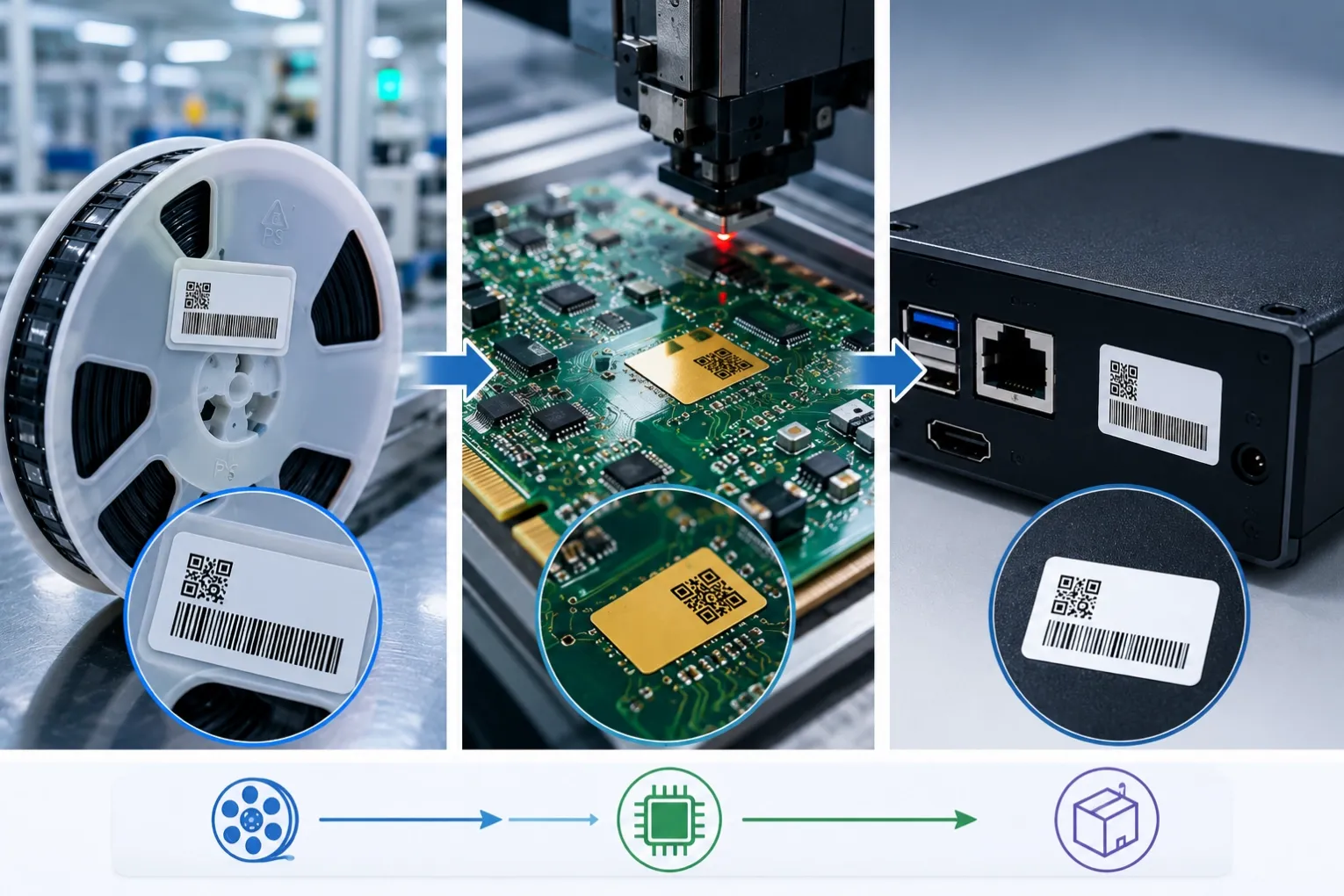
📱 A smartphone contains over 1,000 individual components. Each one comes from a different supplier, passes through multiple assembly stages, and must be traceable in case of a recall. A single failure – a faulty capacitor, a misidentified PCB, or an unreadable barcode – can cascade into millions of dollars in losses.
In electronics manufacturing, traceability is not optional. It is a regulatory, safety, and quality requirement that begins at the component level and continues through to the finished product.
This guide explains how to implement a complete labeling solution across the electronics supply chain – from passive components and ICs to PCBs, subassemblies, and final devices.
For a comprehensive overview of our electronics labeling solutions, see our applications page for electronics manufacturing.
1. The Traceability Challenge in Electronics Manufacturing 🧩
Why Traceability Matters
Component traceability is critical in electronics manufacturing for several reasons:
- Regulatory compliance – Medical, aerospace, and automotive electronics require full traceability records (ISO 13485, AS9100, IATF 16949).
- Recalls and quality issues – Identifying which components went into which finished products is essential for targeted recalls.
- Counterfeit prevention – Tracking components from verified sources prevents counterfeit parts from entering the supply chain.
- Root cause analysis – When failures occur, traceability enables rapid identification of the source.
- Customer expectations – Major OEMs (Apple, Tesla, Siemens, etc.) require full traceability from their suppliers.
The Labeling Needs at Each Stage
Stage | What Needs Labeling | Key Challenge |
|---|---|---|
Component manufacturing | Reels, trays, tubes of passive components, ICs, connectors | Small size, high volume, cleanroom environment |
PCB assembly (SMT) | Bare PCBs, stencils, pallets, carriers | Reflow soldering (260°C+), ESD sensitivity |
Final assembly | Enclosures, subassemblies, finished devices | Brand identity, UDI, regulatory compliance |
Supply chain | Shipping cartons, pallets, warehouse bins | Logistics tracking, barcode readability |
2. Component-Level Labeling – Reels, Trays, and Tubes 📦
The Challenge
Individual components – resistors, capacitors, ICs, connectors, and sensors – are typically supplied in:
- Reels – Surface‑mount components (SMDs) on tape‑and‑reel
- Trays – Larger ICs, BGAs, and connectors
- Tubes – ICs in plastic tubes
Each packaging type requires a label that is:
- ✅ Legible – Even at very small sizes
- ✅ Durable – Surviving handling, storage, and automated pick‑and‑place
- ✅ Barcode‑readable – Supporting 1D and 2D codes (Data Matrix, QR)
Recommended Label Solutions
For small reels and trays:
- Small‑format labels using ultra‑thin materials that do not interfere with packaging
- High‑contrast printing for reliable scanning
- Permanent adhesive that stays attached through automated handling
For tube labels:
- Durable synthetic labels that withstand handling and friction
- Resin or wax/resin printing for abrasion resistance
Data to include:
- Part number (manufacturer and OEM)
- Batch/lot number
- Quantity
- Date code
- 2D Data Matrix barcode (for automated scanning)
In industries where traceability is especially critical (medical devices, aerospace, automotive), these labels are the foundation of compliance.
3. PCB and SMT Labels – Surviving the Reflow Soldering Process 🔥
The Challenge
Printed circuit boards go through lead‑free reflow soldering at peak temperatures of 260°C+. Most labels cannot survive this environment. Those that fail:
- ❌ Burn, char, or turn to ash
- ❌ Soften, shrink, or delaminate
- ❌ Lose adhesive bond – labels fall off
- ❌ Become unreadable – barcodes lost
The Solution – Polyimide (PI) Labels
Polyimide (PI) labels are the only reliable solution for PCB tracking through reflow soldering. They:
- ✅ Withstand 260°C+ continuous – up to 340°C peaks
- ✅ Retain adhesive integrity – silicone adhesive remains intact
- ✅ Stay legible – resin ribbon print remains scannable
- ✅ Are ultra‑thin (25–50µm) – do not interfere with component placement
What to Print on PI Labels
- Unique PCB identifier (serial number)
- Product revision and version
- Date of manufacture
- 2D Data Matrix or QR code linking to the assembly data
- Batch number for traceability
Where to Apply PI Labels
Apply PI labels to bare PCBs before solder paste printing. They remain on the board through the entire SMT process and into final assembly, providing continuous traceability.
Real‑World Impact – PCB Factories Using PI Labels
PCB manufacturers that have switched to PI labels report that rework caused by misidentification drops to near zero. Operators spend less time sorting boards and more time fixing actual defects, while the same label follows the board through wave soldering, test, and final assembly without relabeling.
Key performance metrics observed:
Metric | Before PI Labels | With PI Labels |
|---|---|---|
Label survival through reflow | <60% | >99.5% |
Barcode scan success rate | 82% | 99.7% |
Label‑related rework | 8% | <0.5% |
For a deeper dive into this topic, read our guide to high‑temperature PI labels for reflow soldering.
4. ESD Labels – Protecting Sensitive Electronics in Assembly ⚡
The Challenge
Electrostatic discharge (ESD) can damage sensitive components – even at voltages as low as 30 volts. Standard labels can generate static when peeled from the liner or rubbed against other materials.
The Solution – Anti‑Static ESD Labels
ESD labels are static‑dissipative (10⁶–10⁹ Ω/sq) and designed for:
- PCB assembly lines – Work‑in‑progress (WIP) labels on bare boards
- Clean rooms – Labels on bins, tools, and enclosures (ISO Class 5–8)
- Repair and service centres – Labels on devices undergoing repair
- Shipping of ESD‑sensitive products – Labels that do not charge
ESD labels are critical for:
- ✅ Maintaining ESD‑safe work environments
- ✅ Preventing costly latent failures
- ✅ Meeting ANSI/ESD S20.20 compliance
5. Finished Device Labeling – UDI, Branding, and Compliance 🏷️
The Challenge
At the final assembly stage, finished devices require labels for:
- Regulatory compliance – UDI (Unique Device Identification) for medical devices
- Brand identity – Product name, logo, model number
- Consumer information – Serial number, manufacturing date, country of origin
- Safety and certification marks – CE, FCC, UL, RoHS, WEEE
Recommended Label Solutions
For clean, durable product labels:
- Silver PET – Premium metallic finish for brand appearance
- White PET – Durable, scratch‑resistant, good for barcodes
- Chemical‑resistant labels – For devices that will be wiped with cleaners
Key features:
- ✅ High‑quality printing with resin or wax/resin ribbon
- ✅ Durable facestock that resists scratching and handling
- ✅ Permanent adhesive that stays attached through product lifetime
UDI Labeling Requirements
For medical devices, UDI labels must include:
- UDI‑DI (Device Identifier) – Identifies the device model
- UDI‑PI (Production Identifier) – Batch/lot number, serial number, expiry date
- Machine‑readable barcode – GS1‑128 or Data Matrix
- Human‑readable text – Clear, legible, and durable
6. RFID Labels – Smart Tracking for Electronics Supply Chain 📡
The Challenge
Manual barcode scanning is labour‑intensive and error‑prone in high‑volume electronics assembly. Component reels, PCBs, and finished products need to be tracked automatically.
The Solution – RFID Labels
RFID labels enable:
- Automated tracking – Reads multiple tags simultaneously, no line‑of‑sight required
- Inventory visibility – Real‑time stock counts of components and finished goods
- Anti‑counterfeiting – Unique chip IDs that cannot be easily replicated
- Streamlined logistics – Faster receiving, put‑away, and shipping
For more on RFID applications, see our RFID asset tracking label product page and our guide to using RFID for automated warehouse cycle counting.
Ideal for:
- Component reel tracking in warehouses
- PCB tracking through assembly lines
- Finished product serialisation and shipping
7. How to Select the Right Label for Each Stage 🎯
Stage | Recommended Label | Ribbon | Key Requirement |
|---|---|---|---|
Component reel | PET or PP synthetic | Resin | Small size, high durability |
PCB / SMT | Polyimide (PI) | Resin | 260°C reflow survival |
ESD‑sensitive area | Anti‑static ESD label | Resin or wax/resin | Static‑dissipative surface |
Final device (premium) | Silver PET | Resin or wax/resin | Brand appearance |
Final device (standard) | White PET | Resin or wax/resin | Durability, barcode quality |
Chemical‑resistant | Chemical‑resistant PET | Resin | Solvent exposure |
RFID tracking | RFID label | Resin or wax/resin | Automatic bulk reading |
Selection Decision Flow
Question | Yes → | No → |
|---|---|---|
Will it go through reflow soldering (>200°C)? | PI label | Continue |
Will it be exposed to ESD‑sensitive components? | ESD label | Continue |
Will it contact solvents or chemicals? | Chemical‑resistant label | Continue |
Need brand premium finish? | Silver PET | White PET |
Need automated bulk reading? | RFID label | Standard barcode |
8. Common Mistakes to Avoid ❌
Mistake | Consequence |
|---|---|
Using standard PET labels on PCBs that go through reflow | Labels melt, burn, or fall off |
Applying ESD labels in non‑ESD areas | Over‑specification, unnecessary cost |
Using wax/resin ribbon on PI labels | Print wipes off, barcodes unreadable |
Not including 2D barcodes for component traceability | Manual data entry needed – slow, error‑prone |
Using non‑permanent adhesive on final devices | Labels fall off in use – product returns |
Not aligning label data with WMS/ERP | Traceability is broken – recalls impossible |
✅ Always validate your label system with your specific processes and equipment.
9. Conclusion & Next Steps 🎯
Electronics manufacturing requires a layered approach to labeling – different stages need different labels:
- Component reels/trays → PET or PP synthetic labels with resin ribbon – durable, small‑format
- PCBs through reflow → Polyimide (PI) labels with high‑temperature silicone adhesive and resin ribbon
- ESD‑sensitive areas → Anti‑static ESD labels with static‑dissipative surface and adhesive
- Finished devices → Silver PET or White PET labels with resin or wax/resin ribbon for brand and compliance
- Supply chain automation → RFID labels for bulk reading and real‑time visibility
The bottom line: Traceability starts at the component level and follows the product through every stage. Choose the right label for each stage, and you will have a complete, auditable record of where every component went.
Need a complete electronics labeling solution? We offer a full range of labels and ribbons for every stage of electronics manufacturing – from component reels to finished devices. Send us your application requirements, printer models, and process conditions – we will recommend the right labels and send free samples for you to test.