Aug 20, 2026Applications
TTO Near-Edge Ribbon Applications – Date Coding in Food Packaging
Date codes on snack bags, frozen food pouches, and coffee packs must be clear and durable. Learn how TTO near-edge ribbons enable high-speed, reliable date coding on food packaging lines.
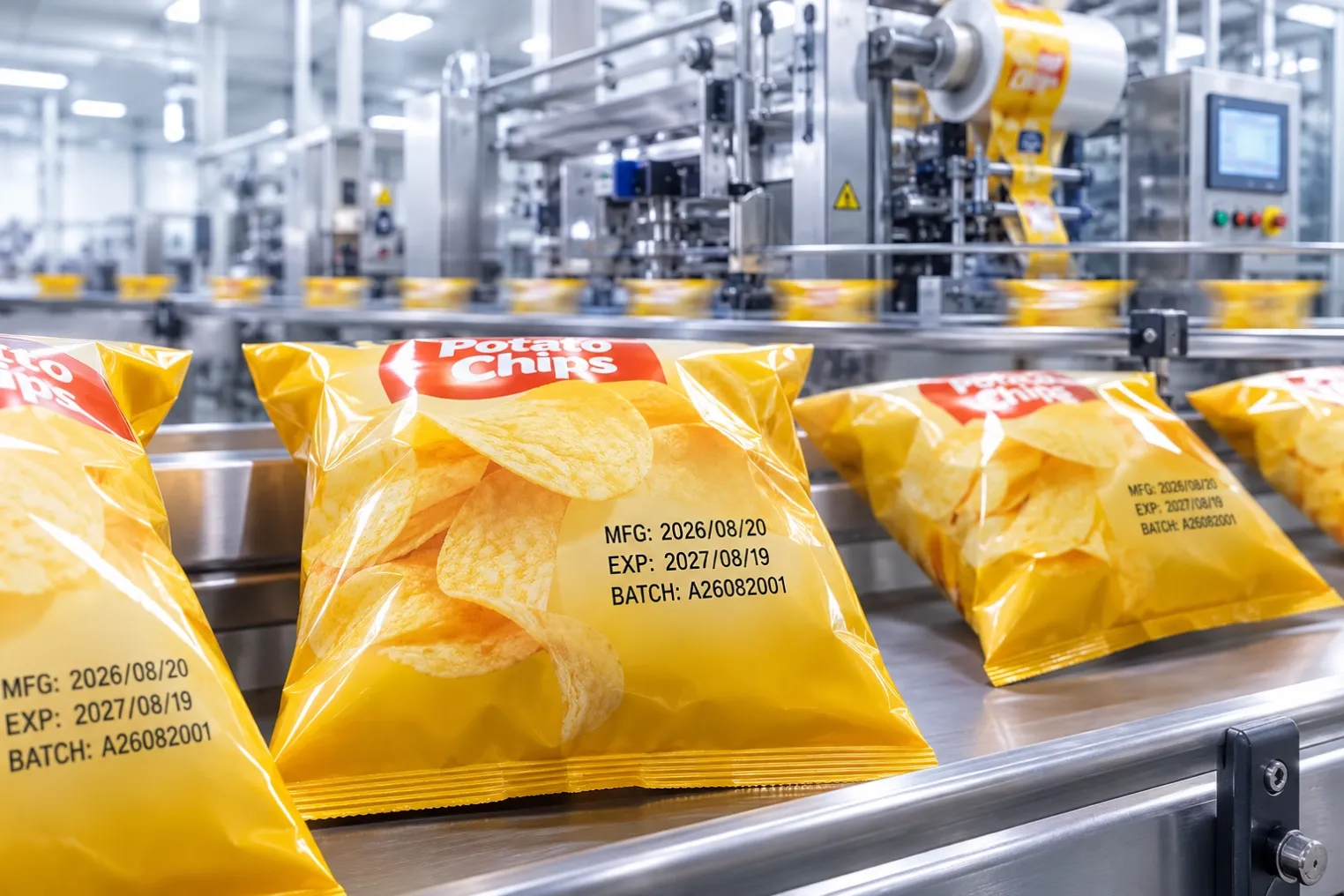
🥨 You run a snack food production line. Bags of potato chips, nuts, or puffed snacks fly down the line at high speed. The packaging film is thin, the line never stops, and the date code must be crisp, clear, and durable – or the entire batch risks being rejected.
Date codes, batch numbers, and traceability information are not mere embellishments; they bear the manufacturer’s compliance responsibilities and brand reputation. Blurred characters, smudges, or missing digits can render entire batches non-compliant. Consumers seldom praise the typography, but they will invariably distrust blurred or missing dates.
This is where TTO (Thermal Transfer Overprint) near-edge ribbons come in. They are specifically engineered for high-speed printing directly onto flexible food packaging films – delivering sharp, scannable codes that survive handling, cold chain, and shelf life.
1. What Is TTO Date Coding? 🖨️
Thermal Transfer Overprinting (TTO) is a printing process where heat is used to transfer ink from a ribbon onto a flexible substrate like food, beverage, and medication packaging. Unlike traditional label printing, TTO prints directly onto the packaging film – no label required.
What Gets Printed?
TTO printers are used to print variable data that changes from batch to batch:
- Production date – when the product was made
- Expiry date / best‑by date – when the product should be consumed
- Batch number / lot number – for traceability and recalls
- Barcodes and QR codes – for supply chain trackin
Where Is It Used?
TTO is widely used in the food, pharmaceutical, beverage, and daily chemical packaging industries. Common applications include:
- Snack bags (potato chips, nuts, puffed snacks)
- Frozen food pouches (vegetables, ready meals)
- Confectionery and bakery packaging
- Dairy products and fresh produce
- Coffee and fractional coffee packs
2. Why TTO Printers Need Near-Edge Ribbons ⚡
This is the most critical concept to understand.
The Mechanical Difference
Flat-head printers (like most Zebra or Datamax label printers) have a printhead that lies flat. The ribbon stays in contact with the substrate for a brief moment after heating, allowing the ink to cool and bond before the ribbon is peeled away.
Near-edge (TTO) printers have a printhead angled at approximately 45 degrees, with heating elements located at the very edge of the ceramic. The ribbon and the packaging film separate instantly after heating – there is zero cooling time.
Why Standard Ribbons Fail on TTO
Flat-head ribbons are designed to melt and stay semi‑molten for a moment to transfer onto the substrate. Near-edge ribbons must melt and release instantly.
If you load a standard flat-head ribbon into a near-edge TTO printer, the ink will not transfer. Because the ribbon is peeled away immediately, the standard ink polymer does not have time to release from its PET carrier. You will get:
- ❌ Blank prints or faint grey smudges
- ❌ Ribbon snapping and frequent downtime
- ❌ Potential printhead damage
💡 The golden rule: TTO printers require TTO-specific near-edge ribbons. Standard ribbons will not work.
3. Key Applications in Food Packaging 🥫
Snack Foods (Potato Chips, Nuts, Puffed Snacks)
Snack food packaging typically uses BOPP/PET composite films. TTO printers integrate directly into vertical or horizontal packaging machines, printing production dates, shelf life, batch numbers, and barcodes before the bag is sealed. Wax-based or wax-resin mixed TTO ribbons are commonly used – wax ribbons offer low cost and high blackness for ordinary date printing, while wax-resin ribbons provide better scratch resistance for traceability QR codes.
Frozen Food Pouches
Frozen vegetables, ready meals, and frozen food pouches require ribbons that perform in cold environments – from the production line to the freezer aisle. Resin or high‑durability wax/resin ribbons are recommended for deep‑freeze applications.
Confectionery & Bakery
Bakery items and confectionery often use metallised films or coated papers. The ribbon must produce sharp, high-contrast codes on glossy or reflective surfaces.
Fresh Produce & Fractional Coffee Packs
Fresh cut produce, vegetables, and fractional coffee packs require codes that survive moisture and handling. Near‑edge wax/resin ribbons with good scratch and moisture resistance are ideal.
4. How to Choose the Right TTO Ribbon for Food Packaging 🎯
Step 1: Identify Your Substrate (Packaging Material)
Substrate | Recommended Ribbon |
|---|---|
Paper / cardboard | Wax or wax/resin TTO ribbon |
BOPP, PET, PE films | Wax/resin or resin TTO ribbon |
Metallised films | Resin or high‑durability wax/resin |
Frozen food pouches | Resin (cold‑chain compatible) |
Nylon / Tyvek (medical) | Resin (high‑durability) |
Step 2: Consider Your Production Speed
Speed | Ribbon Type |
|---|---|
Standard speed (up to 600mm/s) | Wax/resin TTO ribbon |
High speed (600–1000mm/s) | Resin or high‑speed wax/resin |
Ultra‑high speed (>1000mm/s) | Premium resin TTO ribbon |
Step 3: Check Durability Requirements
Environment | Ribbon Feature Needed |
|---|---|
Ambient storage | Standard wax/resin |
Cold chain / frozen | Cold‑resistant resin |
High friction (handling, transport) | Scratch‑resistant wax/resin or resin |
Heat sealing (nitrogen‑filled bags) | Heat‑resistant resin |
Step 4: Match Ribbon Width and Core
- Width: Choose a ribbon slightly wider than your print area to protect the printhead
- Core: Most TTO printers use 1‑inch cores
- Coating side: Check your printer manual – most TTO printers use outside‑coated ribbon
5. TTO in Action – Food Industry Performance 📊
On a typical snack food production line, a TTO printer integrated into the vertical packaging system efficiently codes batch details on flexible film packaging – including product name, batch number, production date, shelf life, and ingredients list. This integration significantly enhances the efficiency and accuracy of product marking, with intermittent printing up to 53×75mm at 300 DPI resolution and speeds up to 600mm/s, perfectly suited for high‑speed vertical packaging operations.
Many major food and beverage brands have adopted TTO technology for their date coding needs. In the snack food industry specifically, products such as potato chips, nuts, and puffed foods generally use composite film flexible packaging, with fast production line speeds and thin packaging materials – imposing extremely high requirements on the stability and clarity of coding equipment.
TTO printers can be directly integrated into vertical or horizontal packaging machines, with resolution up to 300 DPI – clear and sharp characters ensure QR code scannability even on high‑speed production lines. For nitrogen‑filled potato chip bags, TTO ribbons need temperature resistance to avoid blurring during the heat sealing process. High‑quality TTO ribbons maintain stable character quality from -20°C to 80°C, ensuring product information remains complete and readable from factory to consumer.
Key performance metrics observed across the industry:
Metric | Typical Performance |
|---|---|
Print resolution | Up to 300 DPI |
Print speed | Up to 600mm/s (standard), 1000mm/s+ (high‑speed) |
Temperature range | -20°C to +80°C |
Ribbon life | Matches production shift duration |
Code durability | Survives handling, cold chain, and shelf life |
6. Common Mistakes to Avoid ❌
Mistake | Consequence |
|---|---|
Using standard flat-head ribbon on TTO printer | Ink won't transfer – blank prints, downtime |
Choosing ribbon narrower than print area | Printhead contacts substrate directly – accelerates wear |
Ignoring substrate compatibility | Poor adhesion, smudging, fading |
Using low‑quality ribbon on high‑speed line | Inconsistent print quality, frequent change‑overs |
Not testing cold‑chain performance | Codes fade or smear in frozen storage |
✅ Always test a sample ribbon with your actual packaging material, printer settings, and environmental conditions before full deployment.
7. Summary & Next Steps 🎯
- TTO (Thermal Transfer Overprint) prints variable data directly onto flexible food packaging films – no label required.
- Near‑edge ribbons are required for TTO printers – standard flat‑head ribbons will not work.
- Choose the right ribbon based on your substrate (BOPP, PET, metallised film), speed, and durability requirements.
- Food applications include snack bags, frozen food pouches, confectionery, fresh produce, and coffee packs.
- Test before scaling – run a sample batch with your actual packaging and printer settings.
Need TTO near‑edge ribbon for your food packaging line? We offer high‑quality near‑edge ribbons compatible with all major TTO printers (Markem‑Imaje, Videojet, Domino, Toshiba, and more). Send us your printer model, packaging material, and speed requirements – we'll recommend the right ribbon and send a free sample for you to test.