Aug 21, 2026Product-knowledge
Label Adhesive Types – Permanent vs Removable vs Low‑Temperature
Not all adhesives are the same. Learn the difference between permanent, removable, and low‑temperature adhesives – and which one to choose for your application.
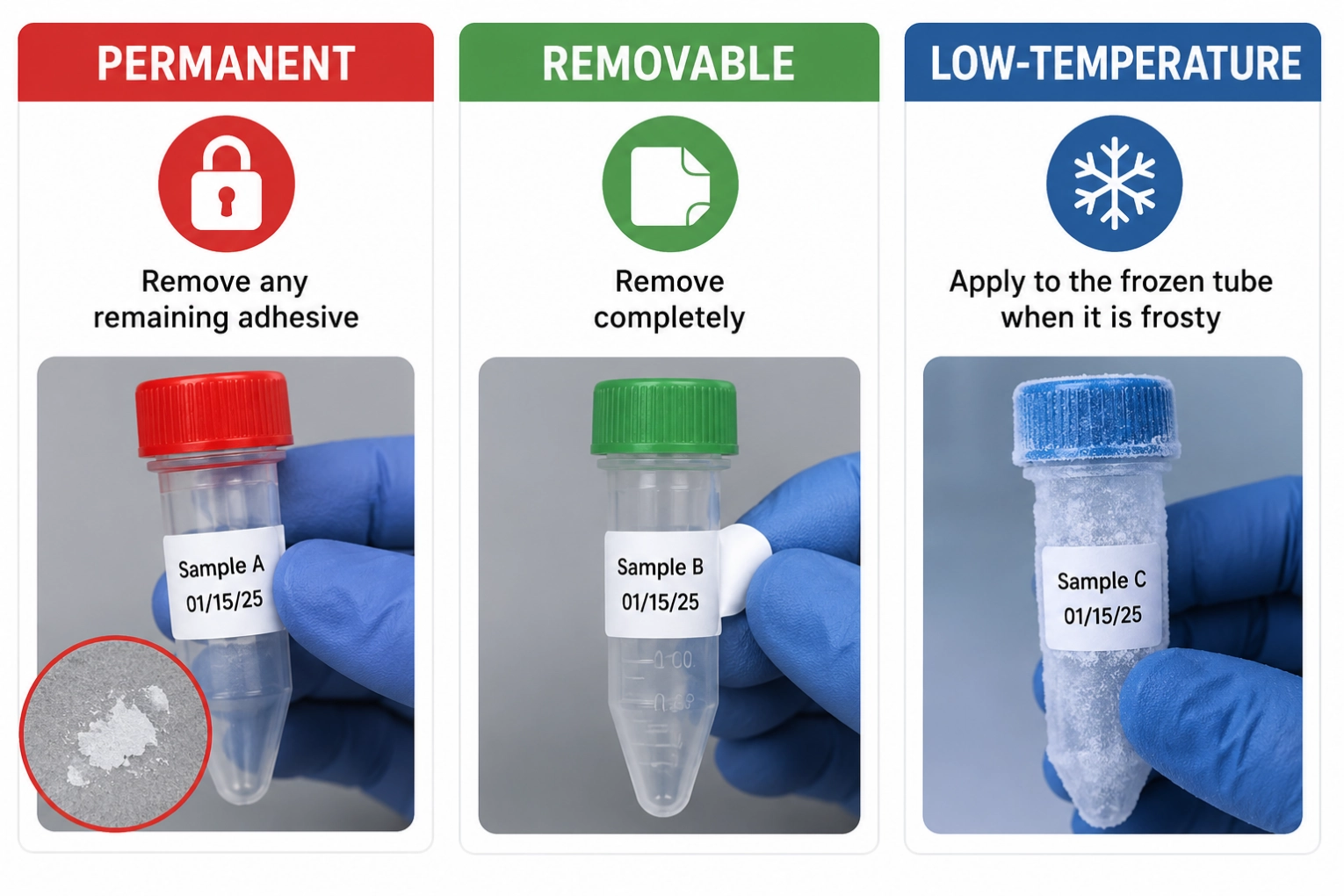
The 10-Second Adhesive Cheat Sheet (Read This First!) 🏷️
Adhesive Type | Best For | Removal | Temperature Range | When to Skip It |
|---|---|---|---|---|
Permanent | Long-term asset tags, compliance labels, chemical drums, outdoor equipment | Difficult; may leave residue | -40°C to +150°C (acrylic) | If you need clean removal or reuse containers |
Removable | Price tags, returnable bins, temporary IDs, promotions | Clean peel with minimal residue | 0°C to +60°C (standard) | If labels face extreme heat, UV, or long dwell time |
Low-Temperature / Freezer | Frozen food, cold chain, biobanks, liquid nitrogen storage | Varies (can be permanent or removable) | -40°C to -196°C (specialty grades) | If labels are applied at room temperature only |
The Golden Rule: ⚠️ Pick the wrong adhesive, and your labels will fall off or never come off. Pick the right one, and they work perfectly every time.
What Is Label Adhesive? (And Why Should You Care?) 🤔
Most modern self-adhesive labels use something called a pressure-sensitive adhesive, or PSA for short. A PSA bonds when pressure is applied—it does not need heat, water, or solvents to activate. Just press and stick.
Think of it like this: When you press a sticker onto your notebook, the adhesive flows into the tiny bumps and gaps on the surface. That is what creates the bond. But not all adhesives flow the same way. Some flow aggressively and never let go. Others flow gently and let you peel them off later. And some are specially designed to flow even when everything is freezing cold.
A typical pressure-sensitive label includes four layers:
- 🏷️ Face material – The printable surface (paper, PET, PI, PP, etc.)
- 🧲 Adhesive layer – The sticky stuff that does the actual work
- 🧴 Release coating – Helps the label peel off the liner
- 📄 Liner or backing – The protective sheet you throw away
As one industry expert from a leading adhesive manufacturer explains, "A label can be beautifully designed, perfectly printed, and completely irrelevant if it does not stick. Peel-back corners, bubbling surfaces, and labels that slide off in cold storage are not print problems—they are adhesive problems."
The adhesive creates the bond by wetting out across the surface. That means it spreads into all the microscopic valleys and peaks. And here is the important part: Adhesion develops over time. A label that feels attached immediately may become significantly stronger after several hours or even days. This is called "dwell time," and it matters more than most people realize.
Bottom line: A label is only as good as its adhesive. You can have the best face material in the world, but if the adhesive fails, the label fails.
Permanent Adhesive – What Is It and When Should You Use It? 🔒
Permanent adhesive is exactly what it sounds like. It is designed to create a durable bond that stays attached throughout the label's entire service life. Once it is on, it is on for good.
Think of permanent adhesive like super glue for labels. It bonds aggressively and does not want to let go.
Advantages of Permanent Adhesive ✅
- 💪 Strong final adhesion – Once it sets, it stays set.
- 🛡️ High resistance to edge lifting – Corners stay flat.
- 🔥 Handles heat, chemicals, and outdoor conditions – When formulated correctly.
- 🏗️ Works on many surfaces – Metal, glass, plastics, painted surfaces, and powder coatings.
- ⏳ Long-term reliability – Perfect for assets that need identification for years.
Permanent acrylic adhesives are especially popular for demanding applications. Why? Because acrylic chemistry provides strong aging, UV, and chemical resistance. A 3M polyester label material, for example, uses a permanent acrylic adhesive designed to bond to low- and high-surface-energy plastics, textured surfaces, powder coatings, and even slightly oily metals.
Common Applications 📍
- Industrial asset labels
- Serial-number and barcode labels
- Chemical drums – permanent adhesives resist solvents and oils
- Automotive parts
- Electrical equipment
- Warning and compliance labels
- Outdoor equipment
- Product labels that must stay attached through distribution and use
Limitations ⚠️
- May leave adhesive residue when removed
- Can damage paint, coatings, or delicate surfaces during removal
- Often becomes more difficult to remove after heat, UV exposure, or long dwell time
- Usually unsuitable for returnable containers or temporary identification
Important reminder: A permanent adhesive does not guarantee permanent performance if the surface is dusty, oily, wet, cold, or incompatible with the adhesive. Always clean the surface first.
Removable Adhesive – What Is It and When Should You Use It? 🔄
Removable adhesive is engineered for one simple purpose: allowing label removal without significant adhesive transfer or substrate damage. It sticks when you need it to stick, and it lets go when you need it to let go.
Think of removable adhesive like a Post-it Note on steroids. It holds firmly enough to do its job, but it peels off cleanly when the job is done.
Advantages of Removable Adhesive ✅
- 🧹 Clean removal – Minimal to no residue left behind
- 🛡️ Surface protection – Won't damage paint, coatings, or delicate finishes
- 🏷️ Ideal for temporary use – Price tags, promotions, seasonal labels
- 📦 Perfect for returnable containers – Reusable bins and totes
- 🔄 Allows repositioning – Some removable adhesives let you adjust placement
As one adhesive expert explains, "Removable films are the preferred choice for applications where the message is ephemeral or the substrate is high-value and must remain pristine."
Common Applications 📍
- Retail price labels
- Promotional and seasonal labels
- Temporary warehouse identification
- Returnable packaging and reusable bins
- Rental equipment
- Glass, paper, and selected painted surfaces
- Temporary production or inspection labels
- White PET labels with removable adhesive for temporary industrial use
Limitations ⚠️
Removable does not mean removable from every material under every condition. Adhesion can increase after:
- ⏳ Longer dwell time
- 🔥 Exposure to heat
- ☀️ UV exposure
- 🧪 Contact with oils or chemicals
- 🏚️ Application to rough or porous surfaces
- ✋ Repeated handling
A label might remove cleanly from glass but leave residue on cardboard or textured plastic. That is why suppliers should always specify the recommended substrate and the removal window.
Removable vs. Repositionable – What Is the Difference? 🔄
These terms are related but different:
- Removable: Intended to be applied once and removed later. Clean removal is the goal.
- Repositionable: Designed to be lifted and reapplied during an initial positioning period. You can move it around before it sets.
- Temporary: Describes the intended service life, not necessarily the adhesive chemistry.
Pro tip: Over time, removable adhesives can become permanent! Exposure to heat, UV light, or simply leaving them on for too long can make them much harder to remove. Always test your specific application.
Low-Temperature and Freezer Adhesive – What Is It and When Should You Use It? ❄️
Low-temperature adhesive is specially formulated to stay soft and tacky in cold environments. Standard adhesives harden, lose tack, or become brittle as temperatures drop. Freezer-grade adhesives do not.
Think of it like this: Regular adhesives are like honey—they flow nicely at room temperature but turn into hard candy in the freezer. Low-temperature adhesives are more like syrup—they stay flexible even when it is freezing cold.
What Makes Low-Temperature Adhesive Special? 🧊
- ❄️ Maintains tack below freezing – Sticks when others fail
- 🧊 Resists brittleness – Stays flexible, not crackly
- 💧 Handles condensation – Formulated for damp, cold surfaces
- 🧪 Works on frosted surfaces – Special grades bond through light frost
Commercial freezer applications typically involve temperatures around -18°C to -40°C. Laboratory and biobank applications can reach -80°C or even lower. And specialized cryogenic label constructions are designed for liquid-nitrogen environments near -196°C.
Common Applications 📍
- Frozen food packaging
- Cold-chain logistics and shipping
- Medical samples and laboratory tubes
- Pharmaceutical storage
- Ultra-low-temperature freezers
- Biobanks and research facilities
- Polyimide labels for extreme cold + heat cycling
Application Temperature vs. Service Temperature – The Critical Difference 🌡️
This is one of the most important concepts in this entire article. Read this carefully.
- Application temperature is the temperature of the label AND the surface when you stick it on.
- Service temperature is the temperature range the label can handle AFTER the adhesive has bonded.
These are NOT the same thing.
For example, a label might have a service rating down to -40°C. That means it can survive once it is already stuck. But it might still require application above 0°C to bond properly in the first place.
Here is why this matters: If you try to apply a freezer label to a frost-covered vial that just came out of cold storage, the adhesive cannot wet out properly. It cannot flow into the surface. It freezes before it bonds. The label falls off.
As one cold-storage expert advises, "If you can, apply labels in a warmer staging area and allow some dwell time before moving the product into deep cold." For freezer labels, suppliers commonly recommend allowing approximately 24 hours for bond development before the first freezer cycle.
Bottom line: Always check BOTH the application temperature AND the service temperature. They are two completely different numbers.
Permanent vs Removable vs Low-Temperature – Quick Comparison Table 📊
Feature | Permanent | Removable | Low-Temperature |
|---|---|---|---|
Main purpose | Long-term attachment | Clean removal | Cold application or cold service |
Final adhesion | High | Low to moderate | Varies (often permanent) |
Removal | Difficult or destructive | Usually clean under specified conditions | May be permanent or removable |
Best surfaces | Metal, glass, plastics, painted surfaces | Glass, paper, selected plastics and painted surfaces | Dry, wet, frozen, or cold substrates |
Temperature performance | Depends on chemistry | Often moderate unless specially formulated | Specifically engineered for cold |
Main risk | Residue or surface damage | Premature removal or becoming permanent | Edge lift, brittle adhesive, condensation |
Typical applications | Assets, equipment, compliance | Promotions, returnables, temporary labels | Freezer, cold-chain, laboratory, pharmaceutical |
Which Adhesive Chemistry Is Best? (Acrylic vs Rubber vs Silicone) 🧪
Not all adhesives are created equal. The chemistry behind the adhesive matters just as much as the type.
Acrylic Adhesive 🎨
Acrylic PSAs are the most widely used and versatile option. They offer:
- ☀️ Good UV resistance – Won't break down in sunlight
- ⏳ Strong aging stability – Stays sticky for years
- 🧪 Chemical resistance – Handles oils, solvents, and cleaners
- 👀 Good clarity – Works well for clear "no-label" looks
- 🌡️ Broad temperature options – From freezer-grade to high-heat versions
Acrylic adhesives often develop adhesion more gradually than rubber-based types. But they provide better long-term stability.
Typical service range: Approximately -40°C to +120°C for standard acrylic, up to +150°C for crosslinked acrylic.
Rubber-Based Adhesive 🏃
Rubber-based adhesives are known for:
- ⚡ High initial tack – Grabs instantly
- 🏗️ Fast bonding – No waiting around
- 🔧 Good performance on difficult surfaces – Works well on low-energy plastics
- 💰 Cost-effective – Often cheaper than acrylic
Their limitations include lower UV resistance, lower long-term aging stability, and a narrower temperature range than specialty acrylic or silicone systems.
Typical service range: Approximately -20°C to +70°C for rubber hot-melt PSA.
Silicone Adhesive 🔥
Silicone PSAs are the specialty option for extreme conditions:
- ❄️ Very low-temperature flexibility – Stays flexible in extreme cold
- 🔥 High-temperature capability – Handles heat that kills others
- 🧪 Good chemical resistance – Resists many aggressive chemicals
- 🧴 Works on silicone-coated surfaces – Where other adhesives fail
The downsides? Higher cost and, in some applications, lower initial tack or lower ultimate adhesion than aggressive acrylic systems.
Typical service range: Approximately -60°C to +230°C.
Which One Should You Choose? 🤷
If you need... | Choose... |
|---|---|
Best all-around performance | Acrylic |
High initial tack on difficult plastics | Rubber-based |
Extreme temperatures (-60°C to +230°C) | Silicone |
UV and chemical resistance | Acrylic |
Low cost for simple applications | Rubber-based |
Performance on silicone surfaces | Silicone |
How to Choose Adhesive for Different Surfaces 🏗️
The surface you are sticking to matters just as much as the adhesive itself. Here is a quick guide:
Surface | Recommended Starting Point | Important Consideration |
|---|---|---|
Glass | Permanent or removable acrylic | Clean surface usually supports reliable bonding |
Stainless steel | Permanent acrylic | Oil, condensation, and surface finish affect adhesion |
Painted metal | Acrylic matched to coating | Test for paint lift during removal |
Cardboard | Removable or permanent paper-compatible adhesive | Fibers may tear during removal |
PP or PE plastic | High-tack or specialty acrylic | Low surface energy can reduce adhesion |
Powder coating | High-performance acrylic | Texture and surface contamination matter |
Silicone-treated surface | Silicone adhesive | Ordinary acrylic may fail |
Rubber | High-tack adhesive | Plasticizer migration can weaken the bond |
Frosted or wet surface | Freezer or wet-surface adhesive | Ordinary PSA generally performs poorly |
Electronics/PCB | Low-ion or process-rated adhesive | Test heat, solvents, ESD, and residue |
Special Notes on Plastics 🧴
Low-surface-energy plastics such as polypropylene (PP) and polyethylene (PE) are among the most difficult label substrates. A permanent adhesive may still fail if it lacks enough wetting and anchorage. That is why FuYue Labels offers PP synthetic paper labels with specially formulated adhesives designed for these challenging surfaces.
How Does Temperature Affect Adhesion? 🌡️
Temperature changes can affect almost every aspect of adhesive performance:
- 🧊 Initial tack – Cold reduces stickiness
- 💧 Wet-out – Cold prevents proper flow
- 📏 Peel strength – Heat can reduce holding power
- 🏋️ Shear resistance – Heat softens the bond
- 🔄 Flexibility – Cold makes adhesives stiff and brittle
- 🧹 Residue – Heat can cause oozing and residue
- 📐 Edge lift – Temperature cycling causes expansion and contraction
- 📏 Shrinkage and curling – Different materials expand at different rates
Effects of Cold ❄️
At low temperatures, an adhesive can become stiff and lose its ability to conform to surface irregularities. The bond fails because the adhesive cannot flow into the microscopic gaps on the surface.
Effects of Heat 🔥
At high temperatures, an adhesive may soften, ooze, lose cohesion, or leave residue. The bond weakens because the adhesive becomes too fluid.
Repeated Freeze-Thaw Cycles 🔄
A label used outdoors or in cold-chain logistics may also experience repeated temperature cycling. The adhesive must survive not just one cold exposure but transitions such as:
- Room temperature to refrigeration
- Freezer to room temperature
- Freezer to condensation
- Outdoor heat to overnight cold
- Repeated freeze-thaw cycles
Bottom line: Temperature is not a single number. It is a range, a cycle, and a history. Test your labels under real conditions.
What Causes Label Adhesive Failure? ❌
Labels fail for many reasons. Here are the most common:
- ❄️ Applying the label below its minimum application temperature
- 💧 Applying to frost, water, condensation, oil, or dust
- 🧴 Choosing the wrong adhesive for PP, PE, powder coating, or rubber
- ✋ Insufficient pressure during application
- 📄 Removing the liner too early or incorrectly
- 📐 Using a label that is too rigid for a curved surface
- 🧪 Exposing the adhesive to chemicals outside its rating
- ⏳ Expecting a removable adhesive to remain permanent indefinitely
- ⏰ Ignoring dwell time before freezing or handling
- 🖨️ Using unsuitable face material or thermal-transfer ribbon
The Dwell Time Mistake ⏰
This is one of the most common mistakes in cold storage labeling. People apply labels and immediately put products into the freezer. The adhesive does not have time to develop its full bond. The labels fall off.
The solution? Allow dwell time. For freezer labels, suppliers commonly recommend allowing approximately 24 hours for bond development before the first freezer cycle when application occurs at room temperature.
How Should Adhesive Performance Be Tested? ✅
Do not trust the label just because it says "permanent" or "freezer-grade" on the box. Test it. Here is a practical 10-step validation program:
Step 1: Identify the Exact Surface 🏗️
Know exactly what you are sticking to. Is it metal? Plastic? Powder coating? Write it down.
Step 2: Record Application Conditions 🌡️
Note the temperature and humidity when the label is applied.
Step 3: Apply Using Your Production Process ✋
Use the same method, pressure, and tools you will use in real production.
Step 4: Allow the Specified Dwell Time ⏰
Wait the recommended time before testing. For freezer labels, this is often 24 hours.
Step 5: Measure Peel Adhesion 📏
Use a recognized test method like ASTM D3330.
Step 6: Test Shear or Holding Power 🏋️
How much weight can the label hold before sliding?
Step 7: Evaluate Clean Removability 🧹
If removable, peel it off and check for residue.
Step 8: Condition at Service Temperature ❄️🔥
Put the labeled item in the actual environment it will face.
Step 9: Run Relevant Exposure Tests 🧪
Test wet, condensation, freeze-thaw, UV, chemical, or abrasion conditions.
Step 10: Inspect Everything 🔍
Check edge lift, curling, residue, print quality, and barcode readability.
Relevant Test Methods 📋
- ASTM D3330 – Peel adhesion of pressure-sensitive tape
- PSTC-101 – Peel adhesion for pressure-sensitive tape
- PSTC-7 – Shear adhesion
- ASTM D3654 – Holding power
Important: Do not compare peel values unless the test substrate, dwell time, temperature, peel angle, peel speed, and conditioning are exactly the same.
Quick Answers to Common Adhesive Questions ❓
What is the difference between permanent and removable label adhesive?
Permanent adhesive is designed for long-term attachment and usually becomes difficult to remove cleanly. Removable adhesive is designed to peel away with limited residue from specified surfaces within a defined time and environmental range.
What does low-temperature adhesive mean?
It means the adhesive is formulated to maintain tack, flexibility, or bond strength in cold conditions. The product must still be checked for both minimum application temperature and service temperature.
Is freezer adhesive permanent?
Usually, freezer adhesive is selected for reliable attachment at low temperatures, but it may be permanent or removable. "Freezer-grade" describes temperature performance, not removability.
What is the best adhesive for frozen food labels?
Use a freezer-grade adhesive matched with a moisture-resistant paper, PP, PET, or film facestock. If labels are applied after the product is frozen, choose a product specifically rated for application to cold, wet, or frosted surfaces.
Can regular labels go in a freezer?
Some may remain attached if applied warm and kept dry, but regular adhesives often lose tack or become brittle below 0°C. A freezer-grade construction is safer for frozen storage, condensation, and repeated temperature cycling.
What is the difference between application temperature and service temperature?
Application temperature is the temperature during installation. Service temperature is the temperature range the label can tolerate after it has bonded. A label may survive -40°C in service but require application above 0°C.
Which adhesive is best for low-energy plastics?
High-tack acrylic or specialty adhesives designed for low-surface-energy materials are common starting points for PP and PE. Clean the surface and test the specific plastic.
Is acrylic adhesive better than rubber adhesive?
Neither is always better. Acrylic generally offers stronger UV, chemical, and aging performance. Rubber-based adhesive often provides higher initial tack and fast bonding on difficult surfaces. The choice depends on the environment and substrate.
Can removable labels become permanent?
Yes. Removable labels may become harder to remove after long dwell time, heat, UV exposure, chemical contact, or application to porous or rough surfaces.
What does repositionable label adhesive mean?
Repositionable adhesive allows a label to be lifted and adjusted during installation. It is generally intended for temporary positioning and may not provide the long-term bond of a permanent adhesive.
The Bottom Line – Stick with the Right Adhesive 💪
We have covered a lot of ground. Let us bring it all together.
The Three Key Takeaways 📌
1. Choose permanent adhesive for long-term jobs.
If your label needs to stay on for years—on assets, equipment, chemical drums, or outdoor gear—permanent adhesive is your friend. It bonds aggressively and does not let go. Just be careful: removal can be messy.
2. Choose removable adhesive for temporary or reusable items.
If your label needs to come off cleanly—for price tags, returnable containers, or promotions—removable adhesive is the way to go. But remember: removability depends on the surface, the time, and the conditions.
3. Choose low-temperature adhesive for cold environments.
If your label goes into a freezer, a cold chain, or a biobank, you need an adhesive that stays flexible and tacky when it is cold. And always check BOTH the application temperature AND the service temperature—they are different numbers.
Why FuYue Labels? 🏭
At FuYue Labels, we have been manufacturing industrial labels since 2016. We understand that labels are not just sticky paper—they are critical safety and traceability tools. And the adhesive is the most important part.
What we offer:
- 🔹 Chemical-resistant labels with permanent adhesives for harsh industrial environments
- 🔹 Cryogenic labels with low-temperature adhesives for liquid nitrogen storage (-196°C)
- 🔹 Polyimide labels with high-temperature adhesives for reflow soldering (260°C+)
- 🔹 Resin thermal transfer ribbons matched to our label adhesives for extreme durability
- 🔹 White PET labels with permanent or removable adhesive options
What makes us different:
- ✅ Matched label-and-ribbon solutions – the adhesive and the ribbon must work together
- ✅ Low-volume orders – no need to buy 10,000 just to test
- ✅ Free samples – test before you commit
- ✅ Custom die-cutting – any shape, any size
- ✅ Printer compatibility support – we check before we ship
Still Not Sure? 🧐
Do not guess. Do not hope. Test.
Reach out to us. Tell us about your surface, your temperature, your chemicals, and your removal requirements. We will help you select the right adhesive construction. Then, we will send you samples to run through your actual production line.
Ready to solve your adhesive challenges once and for all?
Contact us today for a free consultation and sample kit. Let us find the perfect adhesive for your application—whether it is permanent, removable, or low-temperature.
External Link Ideas & Resources (For further reading):
- ASTM D3330 – Peel Adhesion Test Standard – Standard test method for measuring peel adhesion of pressure-sensitive tape.
- Pressure Sensitive Tape Council (PSTC) – Test methods including PSTC-101 (peel adhesion) and PSTC-7 (shear adhesion).
- Avery Dennison Adhesive Guides – Additional adhesive selection resources and technical data.
- 3M Adhesive Selection Guide – Understanding adhesive chemistries and applications.
- Finat (European Label Association) – Industry standards and label market data.