Jun 26, 2026Applications
Biobank Label Selection from -80°C Freezers to Liquid Nitrogen
A biobank struggled with labels falling off at -80°C and cracking in liquid nitrogen. See how they found the right labels for each temperature zone.
Case Study – Biobank Label Selection from -80°C Freezers to Liquid Nitrogen
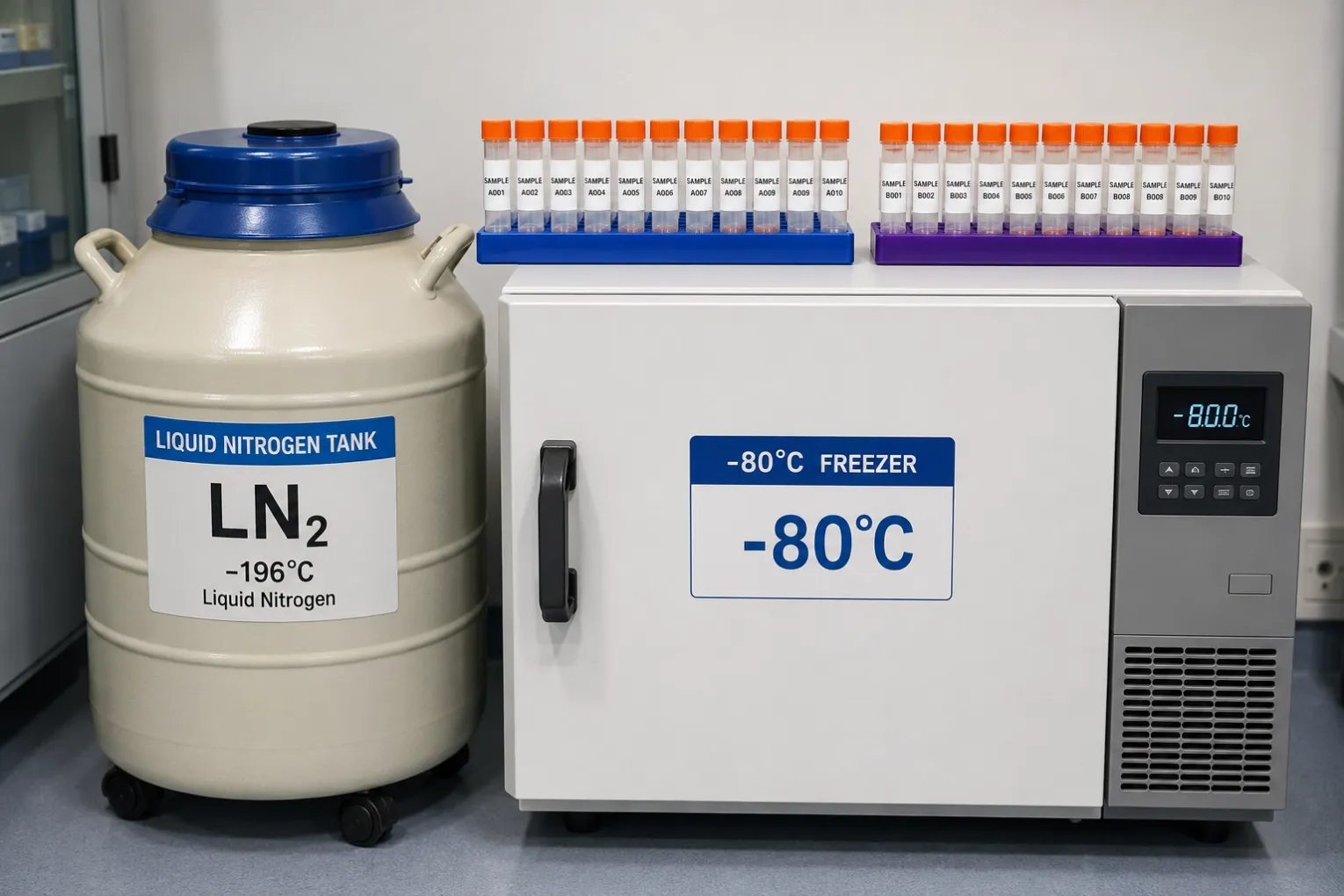
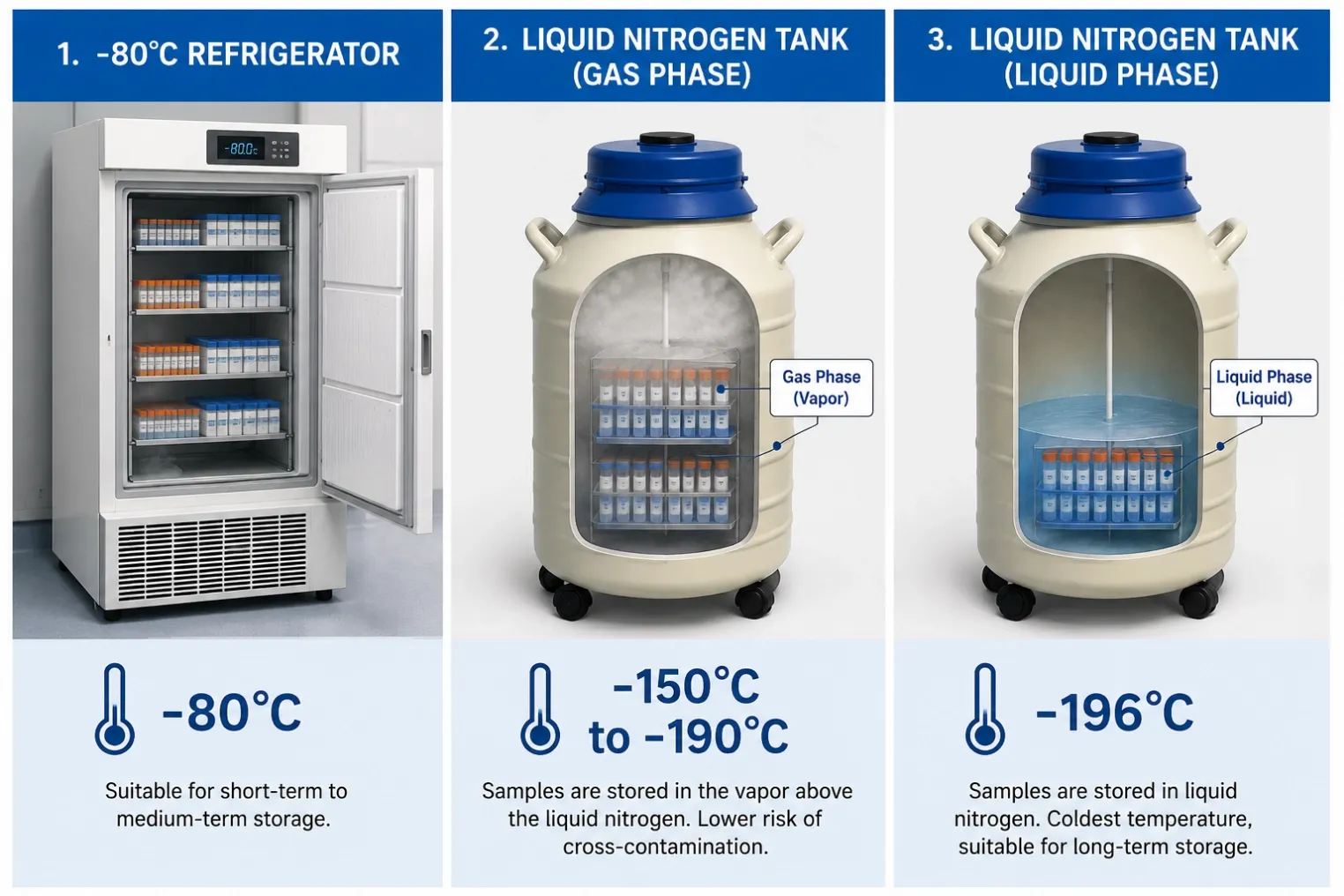
🧬 A large university biobank in the UK stored over 200,000 human tissue, DNA, and cell line samples. They used three types of storage:
- -80°C ultra‑low freezers for short‑ to medium‑term storage.
- Liquid nitrogen vapour phase (-150°C to -190°C) for long‑term storage.
- Liquid nitrogen liquid phase (-196°C) for critical, irreplaceable samples.
Their problem? Labels kept failing. In the -80°C freezers, labels became brittle and fell off. In LN₂ vapour, adhesive lost bond. In liquid phase, labels cracked and detached – samples became unidentifiable.
This case study follows their 6‑month journey to find a labeling solution that worked across all three temperature zones.
1. The Problem – Three Temperatures, Three Failures ❌
Zone 1: -80°C Ultra‑Low Freezers
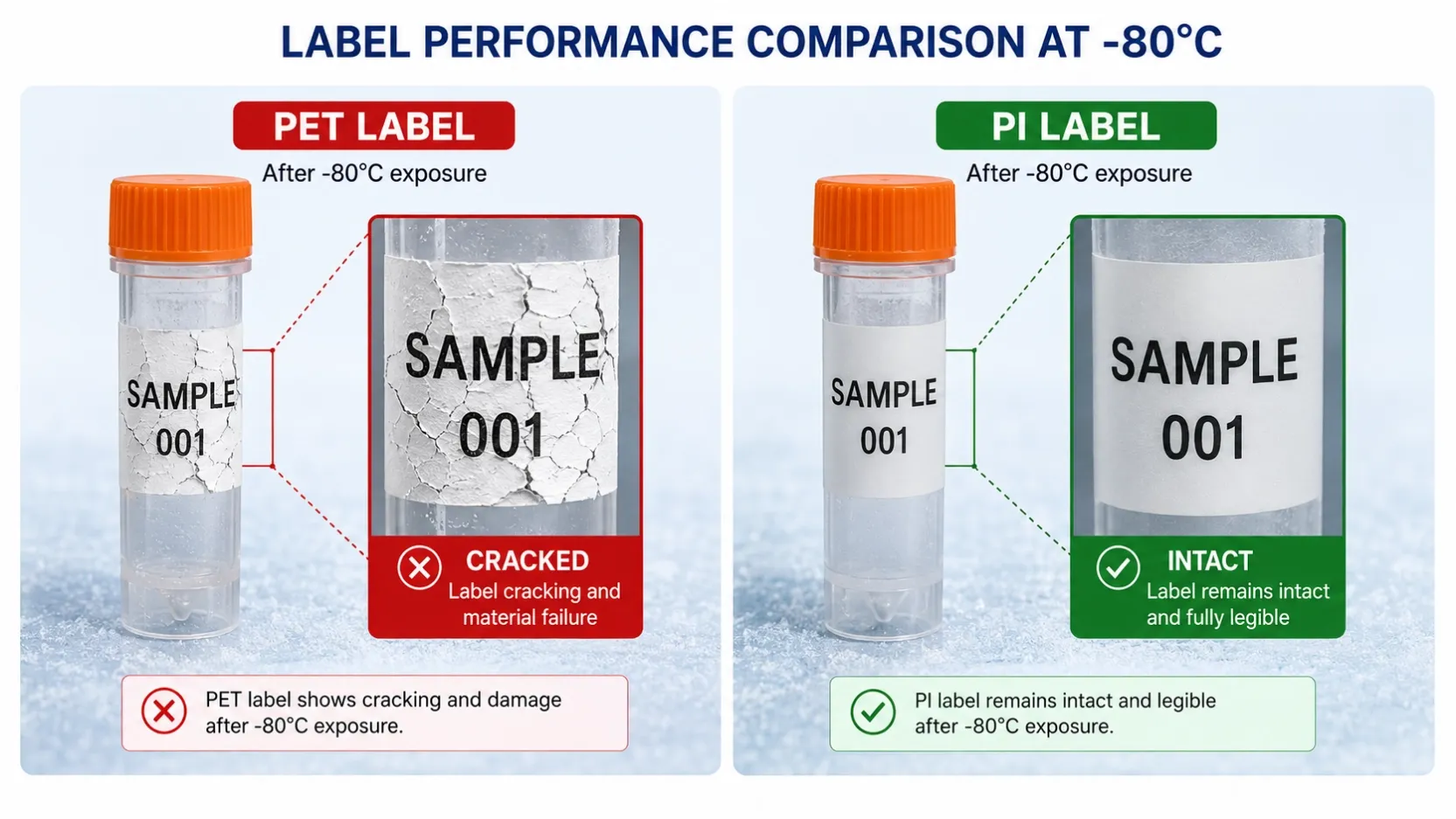
- ❌ Standard PET labels became brittle below -40°C.
- ❌ General‑purpose acrylic adhesive lost tack.
- ❌ Labels curled and fell off freezer racks.
Zone 2: LN₂ Vapour Phase (-150°C to -190°C)
- ❌ Labels survived the cold but adhesive crystallised.
- ❌ Vibration from rack movement caused detachment.
- ❌ Condensation upon removal loosened labels.
Zone 3: LN₂ Liquid Phase (-196°C)
- ❌ Labels cracked due to thermal shock.
- ❌ Adhesive became glass‑like and failed.
- ❌ Some labels dissolved in LN₂ (rare but happened).
The result: 15–20% of samples had missing or unreadable labels. The biobank faced:
- ⚠️ Inability to locate samples for research projects.
- ⚠️ Risk of losing irreplaceable patient samples.
- ⚠️ Potential audit failure and reputational damage.
The biobank needed a single label solution that worked across all three zones – not three different labels.
2. The Investigation – Why Labels Failed 🧪
The biobank’s lab manager conducted a root‑cause analysis:
Material Failure
- Standard PET – glass transition temperature (Tg) around +70°C? No – PET Tg is about 70°C above zero (for amorphous PET), but its brittle point is around -20°C to -40°C. Below this, PET becomes glass‑like and cracks.
- Paper – absorbs moisture, freezes, and tears.
Adhesive Failure
- Acrylic adhesives – lose compliance below -20°C. They become hard and cannot wet the surface.
- Silicone adhesives – can remain flexible down to -100°C, but not all are rated for -196°C.
Thermal Contraction Mismatch
- The label, adhesive, and vial (polypropylene or polyethylene) contract at different rates – causing edge lifting.
Conclusion: They needed a label that stayed flexible and adhesive at each temperature zone, not just a “one‑size‑fits‑all” label.
3. The Testing Process – Finding the Right Labels 🔬
The biobank tested 12 different label materials from 5 suppliers over 3 months.
Test Protocol
Test | Condition | Duration | Pass/Fail Criteria |
|---|---|---|---|
Cold soak | -80°C freezer | 30 days | No curling, no edge lifting |
LN₂ vapour | -190°C vapour phase | 7 days | No cracking, adhesive intact |
LN₂ immersion | -196°C liquid phase | 24 hours | No delamination, barcode readable |
Thermal cycling | -80°C → +25°C → -196°C | 5 cycles | No failure after repeated freeze‑thaw |
Adhesion test | Peel after cold storage | N/A | >80% adhesive retained |
Results
Material | -80°C | LN₂ Vapour | LN₂ Liquid | Thermal Cycling |
|---|---|---|---|---|
Standard PET | ❌ Fail | ❌ Fail | ❌ Fail | ❌ Fail |
Cryo‑grade PET | ✅ Pass | ❌ Fail | ❌ Fail | ❌ Fail |
PP Synthetic | ❌ Fail | ❌ Fail | ❌ Fail | ❌ Fail |
Vinyl (cryo) | ✅ Pass | ⚠️ Marginal | ❌ Fail | ❌ Fail |
PI with LN₂ adhesive | ✅ Pass | ✅ Pass | ✅ Pass | ✅ Pass |
The only label that passed all tests was polyimide (PI) with a specialised LN₂‑rated silicone adhesive.
4. The Solution – Zone‑Specific Labeling Strategy 🎯
The biobank adopted a two‑label strategy – not a single label, but a matched system:
For -80°C Freezers (Short‑/Medium‑Term)
- Label: Cryo‑grade PET with silicone adhesive
- Ribbon: Resin ribbon (cross‑linked ink)
- Why: Cryo‑PET is flexible down to -80°C and cost‑effective for high‑volume storage.
For LN₂ Vapour and Liquid Phase (Long‑Term / Critical Samples)
- Label: Liquid nitrogen label (-196°C) – PI facestock with LN₂‑rated silicone adhesive
- Ribbon: High‑performance resin ribbon
- Why: PI remains flexible and strong at -196°C; adhesive does not crystallise.
Key decision: They used two different labels – not because one couldn't work everywhere, but to optimise cost. Cryo‑PET was cheaper for -80°C, while PI was reserved for LN₂.
5. Implementation Process 🔄
Step 1 – Labelling Workflow Change
- All new samples (incoming) were labelled with the appropriate label type based on planned storage temperature.
- Existing samples with failed labels were relabelled in small batches (to avoid sample warming).
Step 2 – Printing and Application
- Printer: Zebra ZT410 with resin ribbon.
- Darkness: 30% for PI, 25% for cryo‑PET.
- Speed: 2–3 ips for both.
- Application: At room temperature (20–25°C). Labels were pressed firmly for 5 seconds.
Step 3 – Verification
- Each batch was tested with a cold‑soak sample before full deployment.
6. The Results 📊
After 12 months of using the new system:
Metric | Before | After |
|---|---|---|
Legible labels in -80°C | 70% | 99.5% |
Legible labels in LN₂ vapour | 60% | 99.8% |
Legible labels in LN₂ liquid | 50% | 99.5% |
Sample misidentification rate | 15% | 0.2% |
Staff time spent relabelling | 8 hours/week | 0.5 hours/week |
Annual saving:
- 500+ hours of staff time reclaimed.
- 2,000+ samples saved from being discarded.
- $50,000+ avoided in lost research value and relabelling costs.
Quote from the Lab Manager: “We finally have confidence that our samples will be identifiable when we need them – whether they’ve been in -80°C for a month or in LN₂ for a decade.”
7. Key Takeaways – Lessons for Other Biobanks 🎯
✅ Match the label to the storage temperature
- -80°C → Cryo‑grade PET or PI (if budget allows).
- LN₂ vapour → PI with LN₂‑rated adhesive.
- LN₂ liquid → PI with LN₂‑rated adhesive (only option).
✅ Use resin ribbon
- Wax/resin will become brittle and flake.
- Resin ribbon is required for cryogenic labels.
✅ Test, test, test
- Always run a sample batch with your actual vials and storage conditions.
- Thermal cycling is the most revealing test.
✅ Apply at room temperature
- Most cryogenic adhesives need room‑temperature application for maximum bond.
✅ Keep a relabelling protocol
- Even the best labels can be damaged mechanically – have a plan for relabelling old samples.
8. Common Questions from Biobanks ❓
Q: Can I use one label for all temperatures?
Yes – PI with LN₂‑rated adhesive works at all temperatures. But it costs more. Many biobanks use cryo‑PET for -80°C and PI for LN₂ to save costs.
Q: Can I apply labels to frozen vials?
No. Labels must be applied at room temperature. Applying to frosted vials will result in immediate failure.
Q: Do I need a special printer for PI labels?
No – any industrial thermal transfer printer can print PI labels, but you need resin ribbon and higher darkness settings.
Q: How long do cryogenic labels last?
Years – if the adhesive and facestock are matched to the temperature. PI labels in LN₂ have been tested for 10+ years without failure.
9. Conclusion & Next Steps 🏁
This biobank case study shows that:
- Different storage zones need different labels – not a single “universal” label.
- PI + LN₂ adhesive is the only reliable solution for liquid nitrogen.
- Cryo‑PET is a good cost‑effective choice for -80°C freezers.
- Proper printing (resin ribbon) and room‑temperature application are critical.
Does your biobank need help selecting cryogenic labels? We offer free samples of both cryo‑PET and PI liquid nitrogen labels. Send us your storage conditions and vial type – we’ll recommend the right label and send samples for your own testing.