Sep 9, 2026Guides
GHS Label Compliance – Size, Color, and Durability Requirements You Must Meet
GHS labels must meet strict size, color, and durability standards to remain compliant. Learn the requirements and how to choose labels that pass inspection.
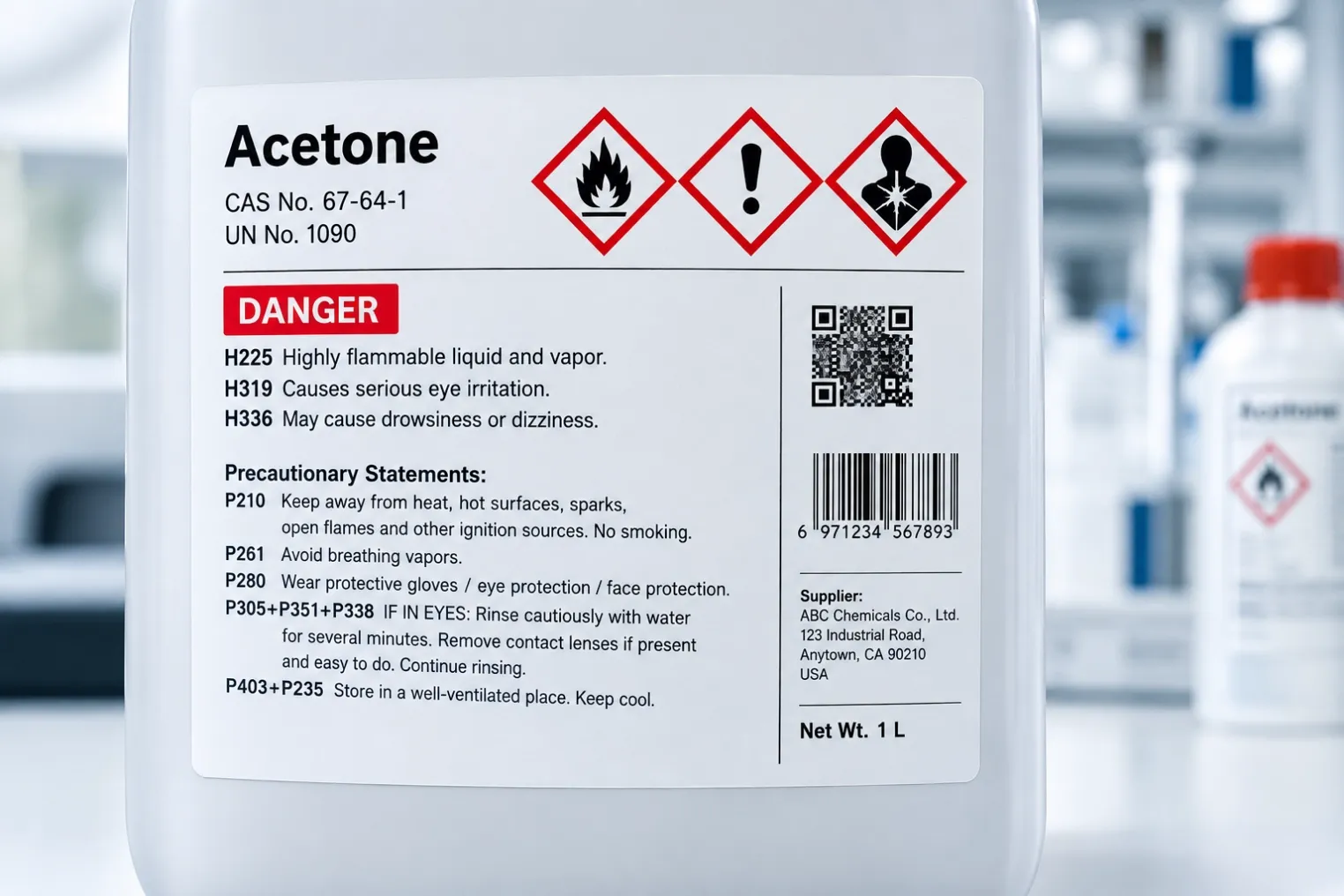
🧪 You manufacture or handle hazardous chemicals. Your containers are labelled with GHS pictograms, signal words, and hazard statements. But when an inspector arrives, they pull out a ruler and a checklist – and your labels fail.
GHS labelling is not optional. It is a legal requirement in over 70 countries. And the requirements go far beyond "put a pictogram on the container." Size, colour, and durability are all strictly regulated.
In this guide, I will explain the mandatory GHS label elements, the specific size and colour requirements, and the durability standards your labels must meet – so you stay compliant and avoid fines.
1. What Must a GHS Label Include? 📋
Every GHS-compliant label must contain the following six elements:
Element | Description |
|---|---|
Product identifier | The chemical name or code identifying the substance |
Signal word | "Danger" (severe hazards) or "Warning" (less severe hazards) |
Hazard pictograms | Diamond-shaped symbols with black images on white background and red border |
Hazard statements | Standardised phrases describing the nature of the hazard (H-codes) |
Precautionary statements | Recommended measures to prevent or respond to exposure (P-codes) |
Supplier information | Name, address, and telephone number of the manufacturer or supplier |
An empty red diamond without a pictogram inside is not permitted. All GHS labels must be printed in colour – the red border and black symbol are mandatory.
2. Size Requirements – How Big Must the Label Be? 📏
GHS label size is determined by the capacity of the container.
Minimum Label Dimensions by Container Size
Container Capacity | Minimum Label Size | Minimum Pictogram Size |
|---|---|---|
≤ 3 litres | 52 x 74 mm | 10 x 10 mm (min) to 16 x 16 mm (max) |
> 3 litres to ≤ 50 litres | 74 x 105 mm | At least 16 x 16 mm |
> 50 litres to ≤ 500 litres | 105 x 148 mm | At least 23 x 23 mm |
> 500 litres | Proportional increase | Proportional increase |
The "One-Fifteenth" Rule
Each hazard pictogram must occupy at least one fifteenth of the minimum area of the label. Additionally, the minimum area for any pictogram must not be less than 1 cm². Each pictogram must be diamond-shaped (square set at a point).
Transport pictograms for shipping have stricter requirements – minimum dimensions of 100 x 100 mm, with limited exceptions for very small packagings.
What This Means for You
If your container holds 200 litres of a hazardous chemical, your label must be at least 105 x 148 mm, and each pictogram must be at least 23 x 23 mm. If your label is smaller, you are non-compliant.
3. Colour Requirements – Getting the Red Right 🔴
GHS colour requirements are precise and non-negotiable:
Mandatory Colour Specifications
Element | Colour Requirement |
|---|---|
Pictogram symbol | Black |
Pictogram background | White |
Pictogram border | Red diamond |
Border width | Sufficiently wide to be clearly visible |
Entire label | Must be printed in colour – black and white is not acceptable |
The Red Border Must Be Colourfast
The red border of the pictogram must remain colourfast. If it fades to orange or pink, the label is no longer compliant.
This means:
- Labels exposed to UV light must use UV‑stable inks
- Labels exposed to chemicals must use chemical‑resistant inks
- Labels in outdoor storage must use fade‑resistant materials
Contrast Requirements
Recent regulatory updates have introduced stricter contrast requirements between symbols, text, and background colours to improve legibility. The black symbol on white background with red border is the only acceptable format.
Using a pre‑printed label with only the red diamond and printing the pictogram in black ink is not acceptable. The symbol must be black and the background white – not the other way around.
4. Durability Requirements – Labels Must Survive the Environment 🌡️
GHS labels must remain legible and securely attached throughout the life of the product – even when exposed to harsh conditions. This is where many labels fail.
What Durability Means in Practice
Requirement | Why It Matters |
|---|---|
Chemical resistance | Labels must withstand spills, splashes, and wipe‑downs with solvents |
Abrasion resistance | Labels must survive handling, stacking, and transport without smearing |
UV resistance | Labels must not fade or yellow when exposed to sunlight |
Temperature resistance | Labels must remain intact from cold storage to hot environments |
Water resistance | Labels must survive rain, condensation, and wash‑downs |
The BS5609 Standard – The Gold Standard for Durability
BS5609 is the most stringent durability test for chemical labels. It requires labels to withstand three‑month seawater submersion with the label remaining fully adhered. Labels that pass BS5609 are considered the gold standard for chemical drum labelling.
If your labels will be used on chemical drums that are shipped internationally, stored outdoors, or exposed to harsh conditions, always specify BS5609‑certified labels.
What Happens When Labels Fail
Non‑resistant labels can lead to regulatory violations, fines and penalties, product recalls, safety incidents from misidentified chemicals, and failed inspections.
For extreme durability, our Chemical & Solvent Resistant Label is engineered to withstand harsh chemicals and industrial environments.
5. How to Choose GHS‑Compliant Labels – A Buyer's Checklist ✅
Checklist Item | What to Look For |
|---|---|
Size | Does the label meet the minimum dimensions for your container size? |
Colour | Are the pictograms printed with black symbol on white background with red border? |
Colourfastness | Will the red border stay red (not fade to orange or pink)? |
Chemical resistance | Has the label been tested against the specific chemicals it will contact? |
Durability certification | Is the label BS5609 certified for harsh environments? |
Adhesive | Will the label stay attached through temperature changes, humidity, and handling? |
Printer compatibility | Can your printer produce full‑colour GHS labels? |
Recommended Label Materials for GHS Compliance
Application | Recommended Material |
|---|---|
Indoor chemical storage | Chemical‑resistant PET with permanent adhesive |
Outdoor / shipping | BS5609‑certified chemical‑resistant labels |
Solvent exposure | Chemical‑resistant PET or PI with resin ribbon printing |
Cold storage / freezer | Cryogenic‑grade labels with low‑temperature adhesive |
High‑volume printing | Pre‑printed red diamond labels with variable data printing |
6. Common GHS Label Mistakes That Cause Compliance Failures ❌
Mistake | Consequence |
|---|---|
Using black‑and‑white labels | GHS requires colour – pictograms must have red borders |
Pictogram too small | Fails the "one‑fifteenth" rule or minimum 1cm² requirement |
Label too small for container | Fails minimum dimension requirements |
Red border fading to orange | Label no longer compliant |
Using standard paper labels | Fail in chemical environments – peel, smear, or dissolve |
Blank red diamond without pictogram | Not permitted – each pictogram must contain a symbol |
Not testing durability | Labels fail in real‑world conditions – compliance violation |
Always validate your GHS labels with your specific chemicals, storage conditions, and handling procedures.
7. Summary & Next Steps 🎯
GHS labels must include six mandatory elements: product identifier, signal word, pictograms, hazard statements, precautionary statements, and supplier information.
Size requirements depend on container capacity – from 52 x 74 mm (≤3L) up to 105 x 148 mm (>50L). Colour requirements are precise: black symbol, white background, red diamond border – colourfast and UV‑stable. Durability requirements demand chemical, abrasion, UV, temperature, and water resistance – BS5609 certification is the gold standard.
Common failures include incorrect size, faded red borders, and non‑durable materials.
Need GHS‑compliant labels for your chemical containers? We offer chemical‑resistant labels in custom sizes with permanent adhesives and BS5609‑certified durability. Send us your container sizes, chemical list, and storage conditions – we will recommend the right labels and send free samples for you to test.