Guides
Industrial Label Buying Guide - 10 Questions Every Buyer Must Answer Before Ordering
Choosing industrial labels without the right questions leads to failures, rework, and compliance risk. Use this 10-question checklist before your next label order.
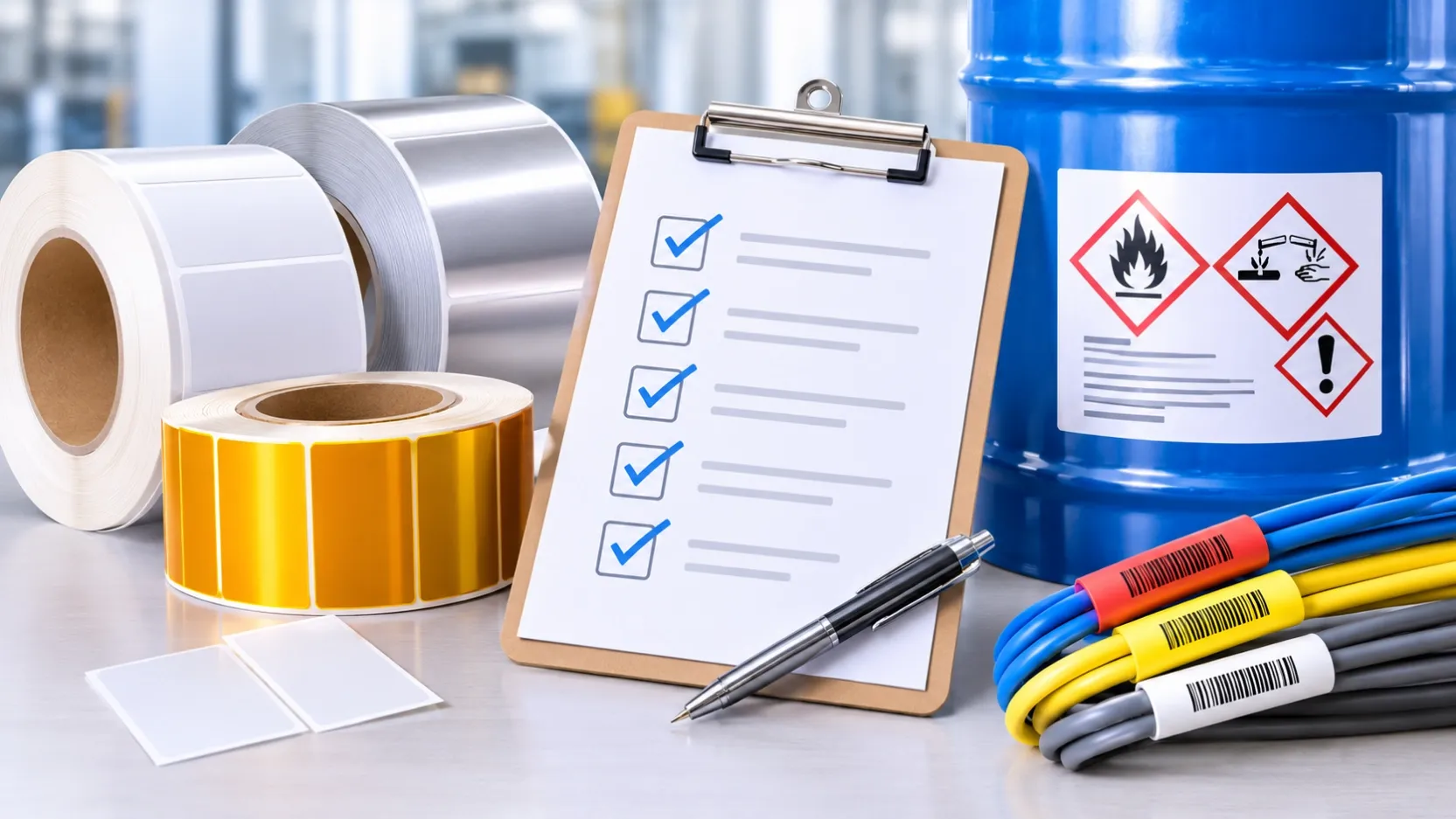
Industrial labels are not commodity items. A label that works on a warehouse carton may fail completely on a chemical drum, a PCB going through reflow soldering, or a cryogenic vial stored in liquid nitrogen. The wrong specification does not just waste money - it can cause traceability loss, compliance violations, and production downtime.
Most procurement problems trace back to questions that were never asked before the order was placed. The supplier ships what was ordered, the label arrives, and only then does the buyer discover that the adhesive does not bond to the substrate, the facestock cannot handle the temperature, or the barcode cannot be verified.
This buying guide covers the 10 questions that separate a successful label order from an expensive lesson. Each question includes why it matters and what to verify with your supplier.
1. What environment will the label face?
This is the first question - and the one that eliminates the most wrong choices.
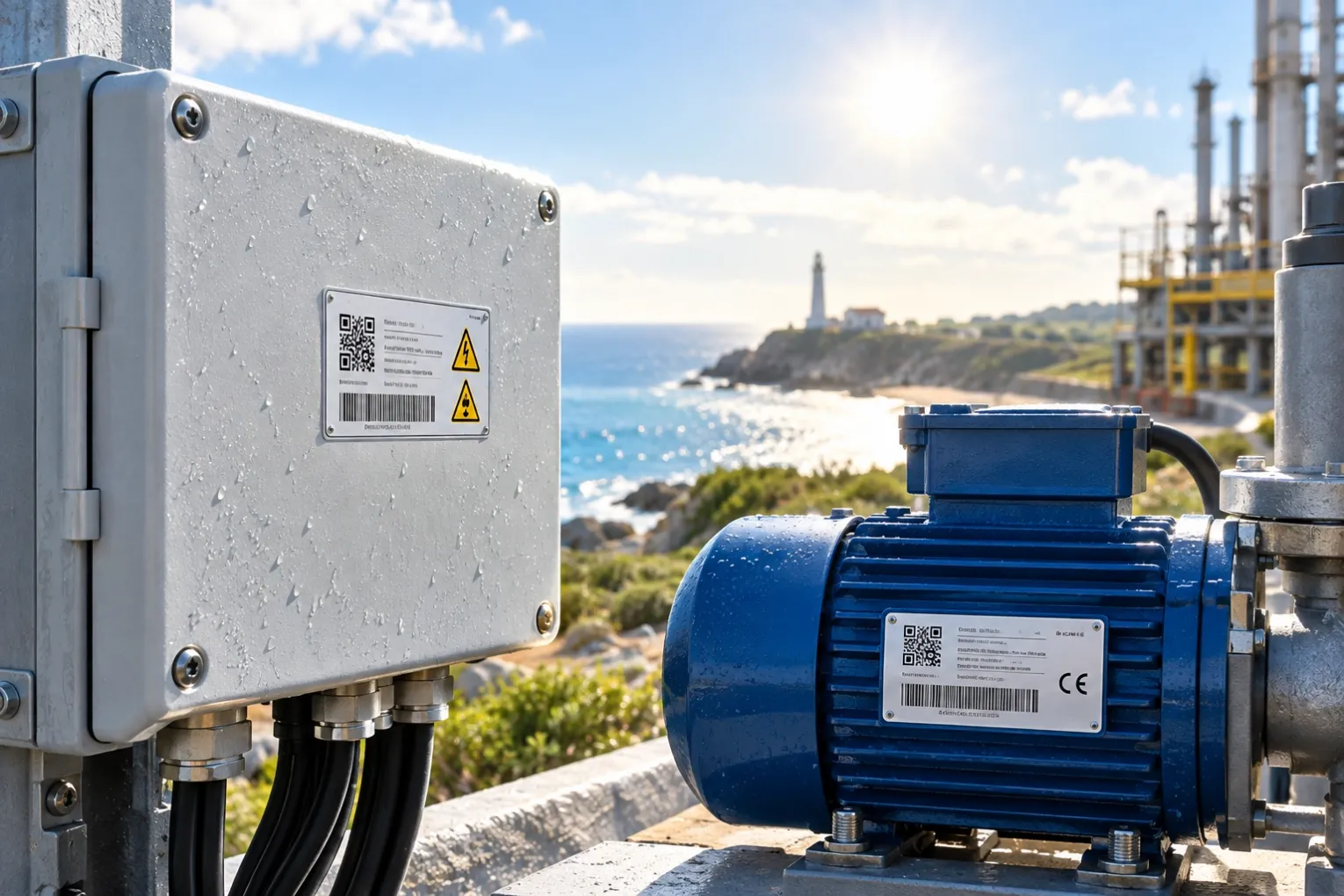
Industrial labels face combinations of heat, cold, chemicals, moisture, UV, abrasion, and handling. A label rated for a dry warehouse will not survive a chemical spill. A standard PET label will crack in a -80C freezer. A paper label will dissolve in a wash-down environment.
What to define
Environment | What to specify |
|---|---|
Temperature range | Minimum and maximum, including peaks |
Chemical exposure | Specific solvents, acids, bases, oils |
Moisture | Humidity, condensation, immersion, wash-down |
UV exposure | Indoor, outdoor, direct sunlight duration |
Abrasion | Conveyor contact, handling, stacking |
What to verify
Ask the supplier for test data at your actual conditions - not just a generic "chemical resistant" claim. For solvent exposure, specify the chemical and exposure duration. For cold storage, confirm the label's minimum temperature rating and adhesive glass transition temperature.
For high-temperature applications, see our High-Temperature PI Label. For chemical exposure, see our Chemical & Solvent Resistant Label.
2. What surface will the label be applied to?
Adhesive performance depends on the substrate. A permanent acrylic adhesive that bonds perfectly to metal may fail on a low-surface-energy plastic bottle.
Common substrates and their challenges
Substrate | Challenge |
|---|---|
HDPE / PP | Low surface energy - requires high-tack adhesive |
Metal | Good adhesion, but may need corrosion protection |
Glass | Clean removal or permanent bond - specify |
Cardboard | Porous surface - adhesive may absorb |
Curved surfaces | Flexibility required - rigid labels lift |
Textured / rough surfaces | Adhesive must wet the surface |
What to verify
Request adhesion test data on your actual substrate - not a generic steel panel. If the surface is contaminated with oil, dust, or mold release agents, specify a cleaning step before application.
3. What regulatory or certification requirements apply?
Industrial labels often carry legal weight. A label without the required certification mark can fail customs clearance, trigger a recall, or cause a safety incident.
Common certifications by industry
Industry | Typical requirements |
|---|---|
Electronics | UL, RoHS, REACH |
Chemical | GHS / CLP, BS5609 for drum labels |
Medical devices | UDI, ISO 10993 for biocompatibility |
Food contact | FDA, EU 10/2011 |
Automotive | IATF 16949 supplier requirements |
What to verify
Ask for certificates - not just claims. For RoHS and REACH, request the declaration of conformity. For UL, confirm the label is UL-recognized for the specific application. For GHS, verify that the label meets the size, colour, and durability requirements.
4. How will the label be printed - and with what?
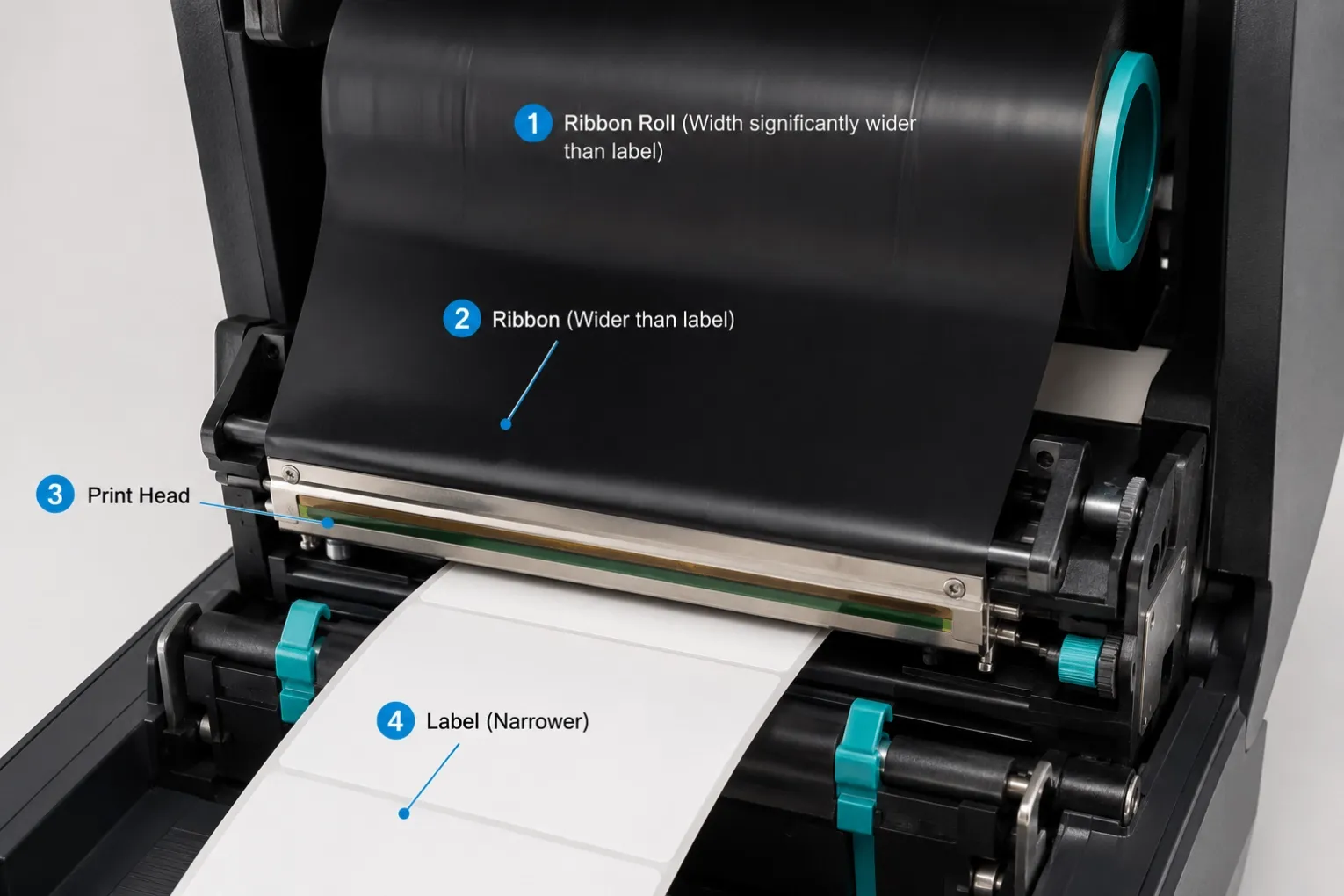
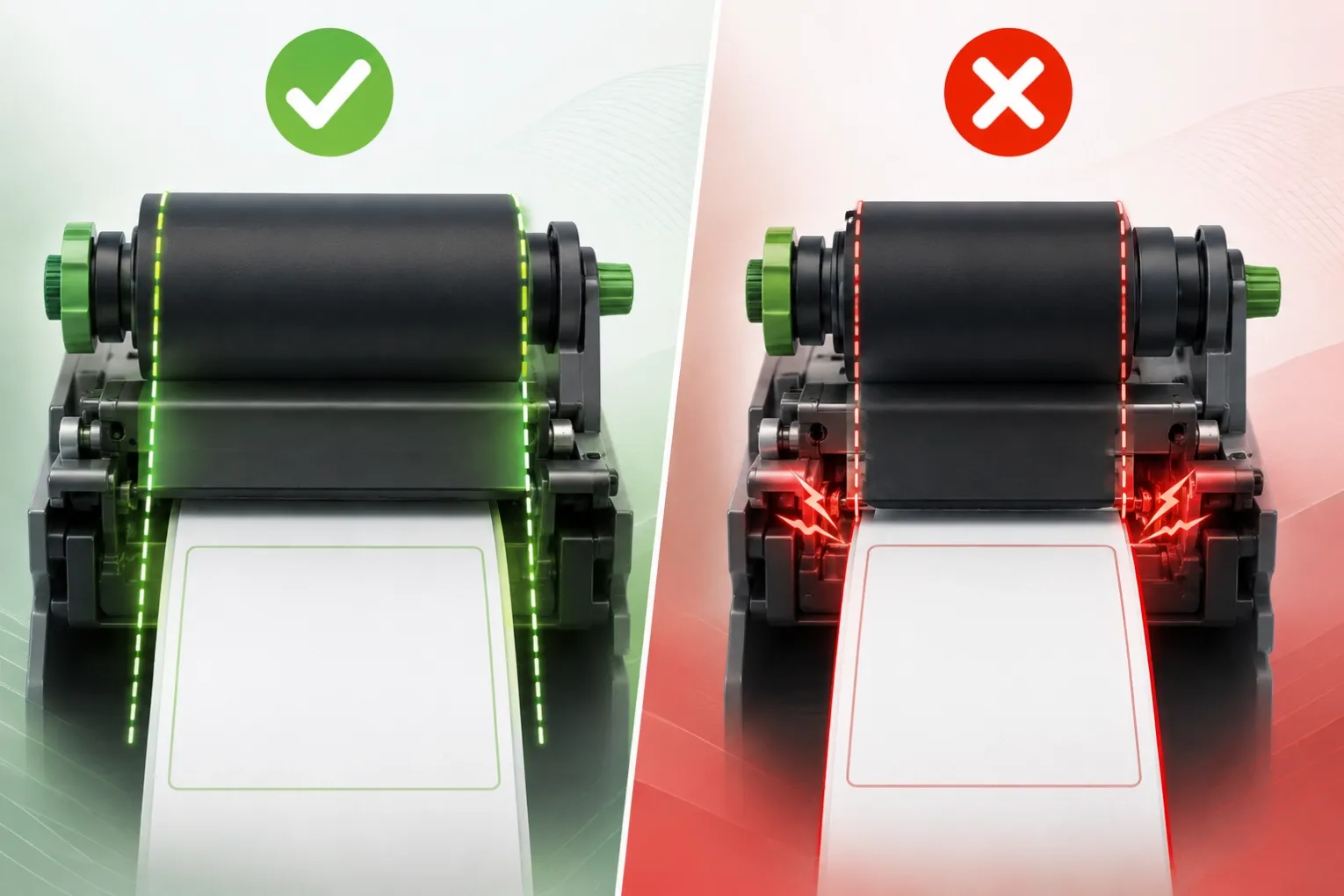
The label facestock, adhesive, and ribbon must work together as a system. A label that prints perfectly with one ribbon may fail with another.
Printing method matters
Method | Ribbon / ink requirement |
|---|---|
Thermal transfer | Wax, wax/resin, or resin ribbon - must match facestock |
Direct thermal | No ribbon - facestock is heat-sensitive |
Pre-printed | Flexographic or digital - no ribbon needed |
What to verify
Confirm the recommended ribbon type for your label. For synthetic labels (PET, PI, PP), resin or wax/resin ribbon is usually required. For high-temperature PI labels, only resin ribbon works. For near-edge TTO printers, only near-edge ribbon works.
5. Will the barcode meet scan quality requirements?
A barcode that looks readable to the human eye may fail a scanner. Scan failures cause manual data entry, mis-sorts, and traceability gaps.
What to specify
Requirement | What to define |
|---|---|
Symbology | Code 128, GS1-128, Data Matrix, QR |
Print quality grade | ANSI grade A or B (C minimum) |
Verification method | Online verifier or offline spot check |
Quiet zones | Minimum margins required |
What to verify
Ask the supplier whether they verify barcodes to ISO/IEC 15416 or 15415 - not just whether the barcode "scans". A compliant barcode should consistently grade B or better.
6. What label format and winding do you need?
The physical format of the label affects printer compatibility, application speed, and waste.
Format variables
Variable | Options |
|---|---|
Label size | Width, height, corner radius |
Core diameter | 1 inch or 3 inch |
Winding | Inside or outside |
Labels per roll | Based on diameter and spacing |
Liner | Glassine, PET, or linerless |
Gap / die-cut | Standard gap, tight gap, or sheet |
What to verify
Confirm that the core size and winding match your printer. A 3-inch core will not fit a desktop printer designed for 1-inch cores. For automated applicators, confirm the liner type and release force.
7. What is the minimum order quantity - and what does it really mean?
MOQ is not just a number. It affects inventory cost, cash flow, and your ability to test before committing.
What to clarify
Question | Why it matters |
|---|---|
MOQ per SKU | Standard sizes vs custom die-cut |
MOQ for custom printing | Logo, barcode, serialisation |
Sample policy | Free, paid, or credited against order |
Price breaks | At what quantities do unit costs drop |
Stock vs made-to-order | Lead time difference |
What to verify
Low MOQ can be a benefit for testing, but extremely low MOQ may indicate limited production capacity or higher per-unit costs. For critical applications, always request a pre-production sample before committing to the MOQ.
8. What is the lead time - and how reliable is it?
Lead time reliability matters more than lead time length. A 10-day promise that ships in 25 days is worse than a 15-day promise that ships in 15 days.
What to separate
Lead time component | What to ask |
|---|---|
Sample lead time | How many days for a physical sample |
Production lead time | After artwork approval, not after order |
Custom tooling | Additional time for new die-cut shapes |
Peak season impact | Chinese New Year, Q4 shipping rush |
Shipping transit | Sea, air, or courier - door-to-door |
What to verify
Ask for a written lead time commitment and a buffer for peak season. For critical production, lock in capacity with a rolling forecast before your busy period.
9. What quality documentation will be provided?
Documentation is your protection against silent substitution, batch variation, and compliance disputes.
What to request
Document | Purpose |
|---|---|
TDS (Technical Data Sheet) | Performance specifications |
SDS (Safety Data Sheet) | Chemical hazards and handling |
Certificate of Conformance | Batch-specific compliance statement |
Test reports | Adhesion, chemical resistance, aging |
Golden sample | Approved physical reference for bulk comparison |
What to verify
A supplier who cannot provide a TDS or SDS is not a supplier you should rely on. For regulated industries, request batch-specific documents - not generic certificates.
10. What happens when something goes wrong?
Every supplier relationship faces problems eventually. The question is how the supplier responds.
What to clarify before ordering
Issue | What to agree |
|---|---|
Defect rate | Acceptable quality level (AQL) |
Replacement policy | Who pays for return freight |
Root cause process | How the supplier investigates failures |
Escalation contact | Who you contact when the account manager is unavailable |
Technical support | Pre-sales and post-sales support availability |
What to verify
Ask for the name and contact of a technical support person - not just a sales contact. A supplier who can answer technical questions before the order is more likely to resolve problems after the order.
Summary - The 10 Questions at a Glance
# | Question | What It Prevents |
|---|---|---|
1 | What environment? | Wrong material selection |
2 | What surface? | Adhesive failure |
3 | What certifications? | Compliance rejection |
4 | How printed? | Ribbon incompatibility |
5 | Barcode scan quality? | Traceability gaps |
6 | Format and winding? | Printer jams, waste |
7 | MOQ and sample policy? | Excess inventory, untested orders |
8 | Lead time reliability? | Production delays |
9 | Quality documentation? | Silent substitution |
10 | Problem resolution? | Unresolved failures |
The bottom line: A label order is a specification problem before it is a price problem. Answer these 10 questions with your supplier before you order - and you eliminate the most common causes of label failure.
Need help specifying industrial labels for your application? Send us your environment, substrate, printing method, and certification requirements. We will recommend the right label and ribbon combination and send free samples for your validation testing.